


There’s no denying that Robert Eggers likes to make atmospheric films. However, his 2019 film “The Lighthouse” didn’t really do it for me. It’s not a cinematic failing, but that x-factor that will appeal to some people but not others. The film’s cinematography is pristine, and the black and white presentation an easy choice. Perhaps it was because the film sought to chronicle madness and insanity—rather than tangible horrors—that it didn’t sit with me as I hoped. Or maybe it was the film’s stark jump into artistry towards its third act. But I felt I was watching a film about madness rather than feeling the madness itself.
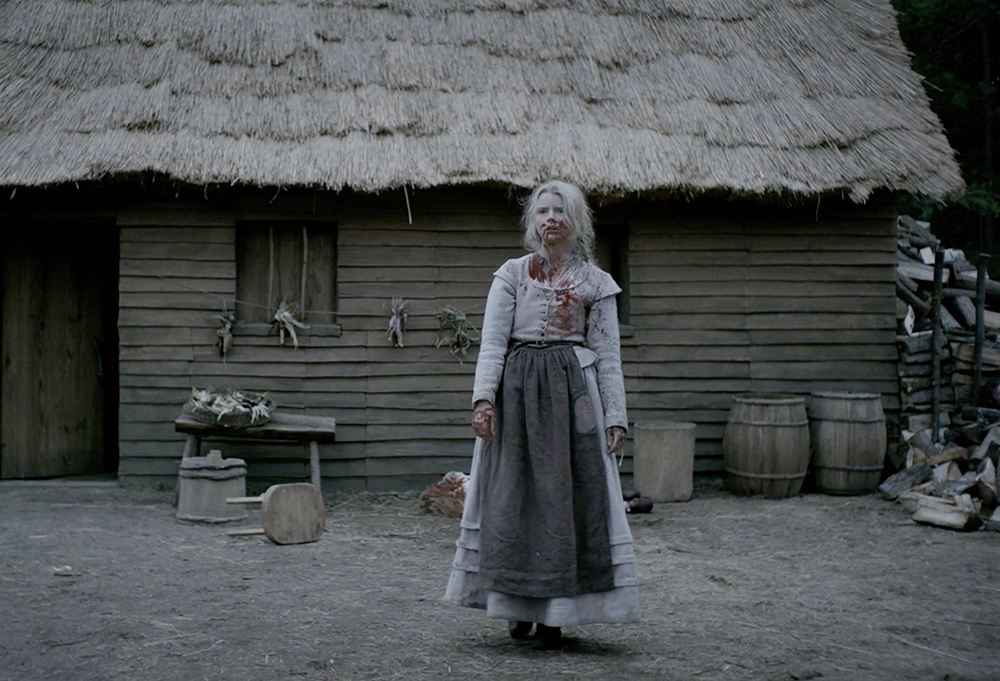
Eggers’ 2015 debut, however, “The VVitch,” does not share this criticism. Eggers and Cinematographer Jarin Blaschke pull back on the artistry and let the story tell itself. The camerawork has the same perfection as a simple marketing logo; its shots of a commonplace, isolate farm and forbidden woods feel like a normal photo taken on any day of decaying fall in New England. A 7-member Puritan family has moved to this location from a more-populated village after inconsolable religious differences. Life is hard here, and—with a missing (stolen) newborn, failing crops, and a literal witch in the woods—the family’s seams begin to come apart.
An Indictment of Religious Hysteria
Eggers’ film has been accused of being an indictment of early Christianity, and in that it ought. The true horror of the film rest on the behaviors of its protagonists, and not on the very real witch in the woods.
I’ve seen two horror folk tales in as many weeks. The first was Robin Hardy’s 1973 “The Wicker Man,” and the second “The VVitch.” While Hardy’s film is basked in paganism, its horror committed against Puritans, Eggers film is about Puritan horrors committed against their own. I suppose you could make an argument it’s about a witch preying on ill-equipped and simple folk. But the darker side of human nature comes out as a result of it, a dark side that throws its own to the wolves—in a stalwart and an unquestioningly escalated fashion—due to not being able to explain something.
Of course the idea of the devil is in both films. The islanders in Hardy’s tale ‘are satanic’ by the logic that they participate in sacrifices and orgies. And in “The VVitch,” satanism drives the witch, a crusty, despicable creature that changes into a hare (inspiration from “The Wicker Man,” to be sure) and a beautiful woman as needed. There’s also ‘Black Phillip,’ a goat kept in a pen to be used for farming needs, which enchants the family’s two young twins. The ensuing events and the witch’s manipulation of the family reminded me of Stephen King’s excellent “Needful Things”—another story that uses an evil, outside force to bring out the absolute worst in its seemingly benevolent townsfolk.
Eerie Shots, but the Horrors are Human
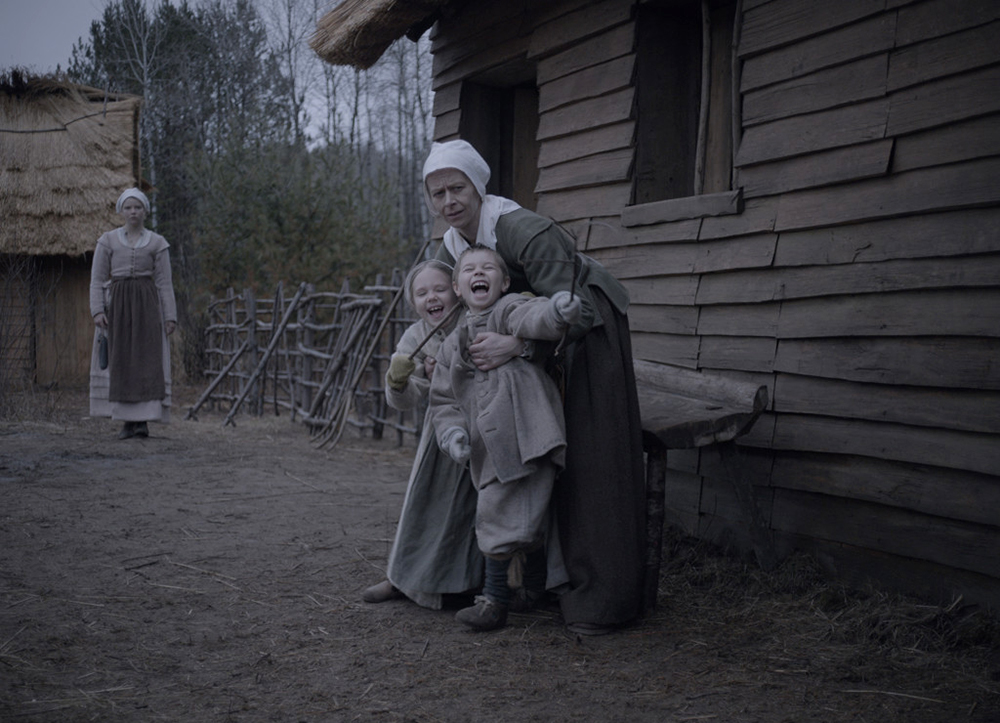
However, the way that ‘satan’ and ‘witches’ have been used since time immemorial to victimize people is the true horror of this film. So may it also be a very on-the-nose parable of how a family traumatizes children. Young Thomasin (a phenomenal Anya Taylor-Joy) is the film’s true victim. First she’s in the care of her newborn brother, Samuel, when he is stolen by the witch as she plays peek-a-boo with him.
This event is blamed on her by her mother, Katherine (Kate Dickie), who subsequently detaches from life via mourning. Her father, William (Ralph Inerson) teaches his son, Caleb (Harvey Scrimshaw) to trap in the woods against his wife’s dictates. He confides in Caleb that he sold his mother’s silver cup for the trap he hopes to catch rabbits with. The missing cup—along with going into the woods and Caleb’s ultimate possession by the witch—will also be blamed on Thomasin by her mother. William will ultimately speak up to clear her name, but long after it’s realistic, and while himself fearing that she’s a witch at this point.
A Cautionary Tale Against Fanaticism
With skill, Eggers shows the film’s horror as Thomasin’s family turns against her. Sure, he and Blaschke’s shots of the eerie woods and witch’s hut are expertly done. And I wondered, if Eggers had set out to make a true witch tale, why only minutes of screen-time are devoted to this creature, with so much of his tale reserved for the family’s mental decay. Of course, the witch is meant to manipulate; but the fact that the family has no actual knowledge of the witch—yet believes it steadfastly—adds to the film’s hysteria. It reminded me of Netflix’s “Fear Street” trilogy’s final act, “1666” as Puritan townsfolk turn against a gay woman for “bewitching” another girl, evoking the historical Salem Witch Trials. There are of course no actual witches, and in “Fear Street” and “The VVitch,” their villains deign to murder their own based on fear and imagination.
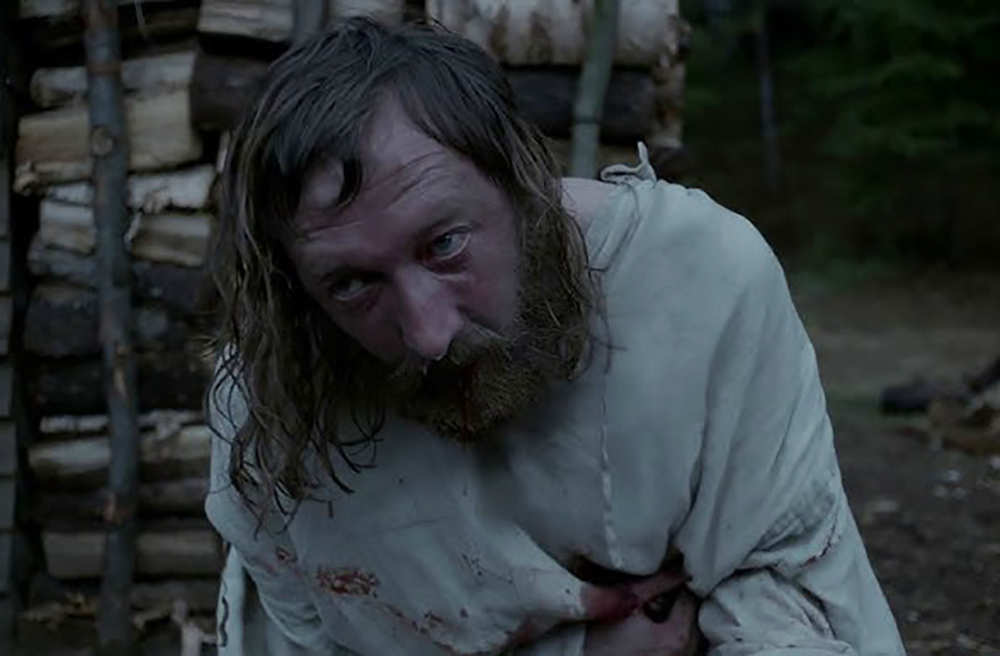
I don’t know if these are the themes Eggers was going for, but for me it was stark. It was stark, because I know these things actually happened in our country’s history. And when Thomasin’s mother fell upon her with a knife— trying to kill her because she was ‘responsible’ for the ill events that have befallen their family—the point was hammered home. Katherine and William abandoned Thomasin when young Samuel was taken in every way that mattered, and caused many of the film’s future misfortunes.
Up to the Eye of the Beholder
There is a witch in Eggers’ film… or maybe there isn’t. It’s not clear. The ending featuring a talking Black Phillip is heralded as one of the scariest scenes in horror. But by this point—and the film’s closing shot—I couldn’t imagine a worse horror than what I had already seen befall young Thomasin. Of course she joins a witches coven—a family—when her own had so fully thrown her aside. And of course it’s not just Christianity or religion that Eggers’ film can be generalized to, but every family ‘tradition’ that is used as an excuse to abandon or disown children—who are real—in favor of fantasies and convictions which are not.
Or maybe I’m wrong, and Eggers’ film is just about a witch. It’s up to the beholder.

