Iâve watched three films now written, directed, and/or produced by Ashley Tabatabi. The first was âFalsified,â a moving tale about a son and father separated at birth. The second was âThe Interview,â a satirical, comedic short where he played a hotshot interviewing a hapless man for a job. I was then impressed by how Tabatabai was able to act in two shorts of different genres. And now in his latest, âHamdardi,â Tabatabai is back to his more serious side, and the film, at only 27 minutes, is decidedly worth the effort.Â
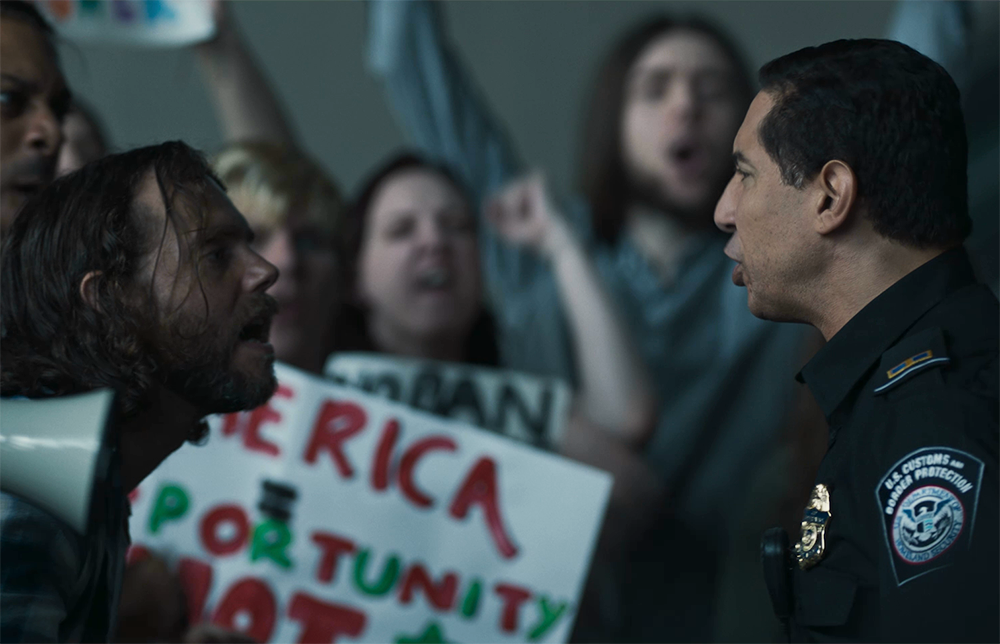
âHamdardiâ is a look at the 2017 United States travel ban from the point of view of a reluctant Customâs agent, himself down on his luck. At the filmâs beginning, as a car radio discusses the travel ban and a man (Tabatabai) irritatedly flips it off, we donât know much about him. Is he in a foreign country, wanting to enter the U.S. who now learns he canât? Heâs just had a conversation expressing his frustration that his daughter is being kept from him. However, in due time, the man pulls on a Customâs hat and slips through the gates. Heâs an airport Customâs officer.Â
A Backstory that Makes Us Care
Within due time, the camera lands on a traveling brother and sister, one 18 and the other less than 10. They are played by Arian Nik (Reza) and Ayla Rose (Parveneh) in performances that eschew the kind of fear and frustration that would accompany such a situation. They hunker in a corner as who appears to be the lead Customâs agent, Henson (Mitchell Mullen) screams at people who donât speak his language to move faster when they donât respond to his directions. Itâs clear from these opening sequences that Tabatabaiâs Reynolds has compassion and empathy for those affected by the travel ban, and with both commands and glaring eye gestures, itâs also clear that Henson resents it.Â
With these pieces, Tabatabai (who co-directs along with Stefan Fairlamb) could have made a film for those with  prior sympathy for casualties of the travel ban. However, what makes âHamdardiâ successful is that Tabatabai gives Reynoldâs a backstory that makes it resonate with not just foreign travelers, but those born in and living in the United States. We learn Reynolds had a wife who died of tragic circumstances prior, along with a daughter he lost custody of, now part of the system. Reynolds used to be a drinker, and now heâs sober. He muddles through his work as a hearing to reunite with his daughter stalls again and again. And all the while he sees how âthe systemâ treats those on the outskirts. Itâs no shock that when Henson tells him to âtrust the system,” the words are spoken by a man who never once had to rely on it.Â
Tabatabai and Cast are Engaging
Tabatabai is excellent as Reynolds. His role is one of endurance; he watches the effect of the travel ban daily, would-be travelers to the U.S. sent back to their countries without connecting with their loved ones, the only explanations being ârules are rules.â Also good here is Helene Maksoud, who plays an advocate named Carole Williams, who begs permission for the brother and sister to visit their father, who is sick in the hospital. Given the amount of backstory necessary for Reynolds in this film, Maksoud doesn’t have the most to work with, but makes her scenes of empathy and entreaty stick. Sheâs asking Reynolds to âdo something;â but we never think that âsomethingâ is anything else than a rule violation that may lead to termination, arrest, or blowing his chance to see his daughter again.Â
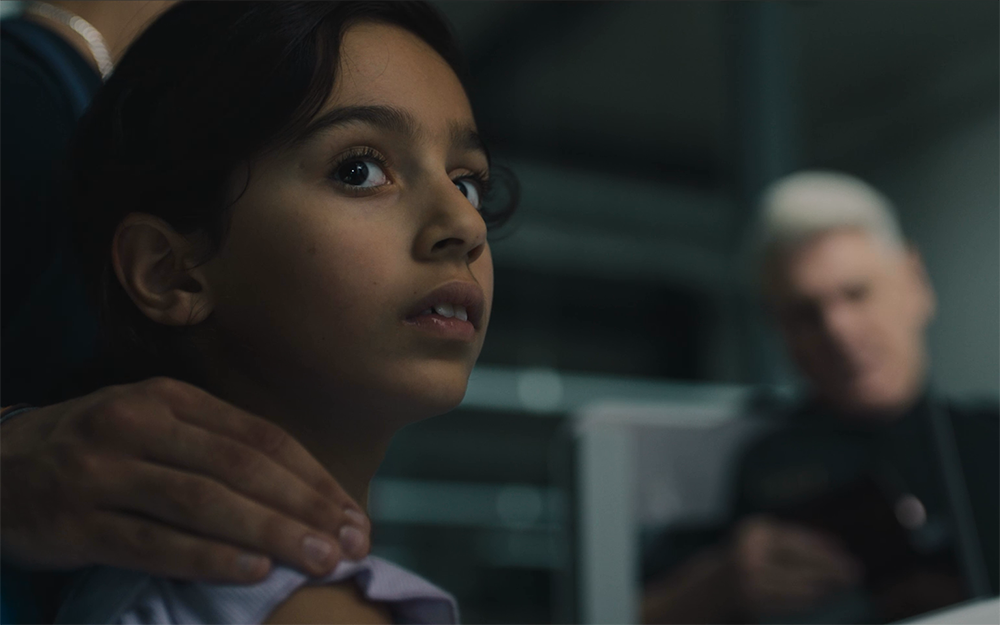
The cinematography by Adam Lyons is here clean and pristine, and captures the glass, concrete, and bureaucracy of the Customâs department well. The camera focuses on Reynolds as heâs near tears in a stairwell when he learns of yet another stall in his custody hearing. And it focuses later uncomfortably on Reynoldâs as he angrily restrains another detainee he must send back to Syria. A scene ago, we saw him console the older brother by offering him food and playing Tic-Tac-Toe with the sister. His sudden shift is the result of being able to do nothing to help his daughter and being brow-beaten by Henson. And while we abhor his actions, we understand them, and are willing to forgive him.Â
An Empathy-Laden Picture
âHamdardiâ is a hard film. Itâs hard, because it forces you to wade alongside Reynolds, Reza, and Parveneh and feel their frustration and pain. It causes you to emphasize with the siblings â who we do not know â by comparing them to Reynolds, who we grow to. If there are any criticisms of the film, itâs that the ending breaks free from the indie feel of the first two acts and threatens to âfeelâ like a movie. But itâs forgivable; because, in this case â and though we may already know where âHamdardiâ is going â we want it to. We turn on the evening news for heartbreaking depictions of how hard life can be. We turn to movies to escape from that, and, when done right, to feel something this side of justice. âHamdardiâ delivers that in spades, and will hopefully pick up an audience as it moves to the festival circuit.
You can watch the trailer for “Hamdardi” below. The film is in the process of submission to film festivals. Follow The Movie Buff for updates.