





Ashley Tabatabiâs short film âFalsifiedâ takes a look at father-son reconciliation, albeit in a less traditional manner than weâre accustomed. The film is not about a father who abdicated responsibility, nor of a parent and son who drifted apart after a falling out. Itâs a look at one man who lost his son at an early age and has spent a lifetime trying to find him, and a look at a son who also looked, thought he found, and then abandoned the idea. It talks about a difficult part of Spanish history – the âstolen baby scandalâ – and examines it on a personal level. âFalsifiedâ feels real; itâs performances and themes enhance it wonderfully.Â
At sixteen minutes in length, Tabatabi – who wrote and co-directed the film with Stefan Fairlamb – navigates this topic well; he doesnât comment on the morality of this period in Spanish history, but examines the effect it has on its victims. Is there something worse than losing a child directly after his or her birth and never seeing them again? Is finding them again harder? These are questions that Tabatabi answers with grace and realism.Â
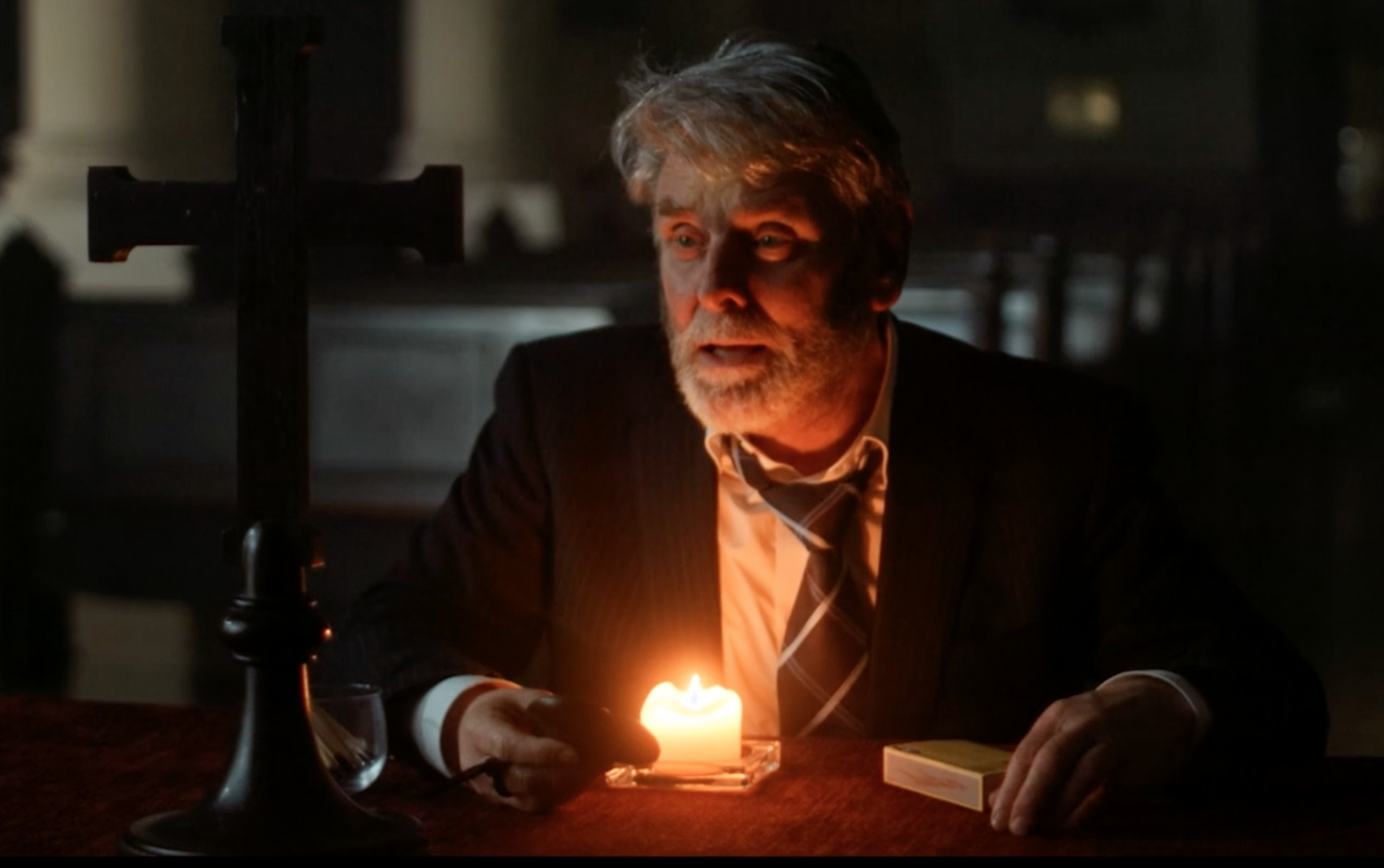
At the filmâs beginning we see a middle-aged man drinking in a bar, pensive. His name is Henry Mercer and heâs played by Mitchell Mullen. We learn shortly that heâs a father, looking for his son. A man approaches him, irritated and accusing Mercer of some stalking behavior. But we learn that Mercer is not there to harass, but to discover. He believes this younger man, Javier Baena, is his son. He wishes to talk Javier into a DNA test to confirm what he believes to be correct.Â
Baena is played by director Tabatabi, and the director juggles both roles well. The production for âFalsifiedâ is well done and professional, all the way from the performances, to the lighting, to the cinematography. The filmâs early scenes take place between lighted barrooms and dark churches. Thereâs something to the shots, I think. Mercer, dressed in suit and tie sips a scotch in a barroom that is animated and ornate. Yet he is dejected, fatigued after years of emotional pain. Javier is displayed differently: a simple suit over a turtleneck, clean cut appearance; healthy, prosperous. When he finds Mercer in the church in the next scene, we assume itâs Mercer who is looking for absolution. But maybe itâs both.Â

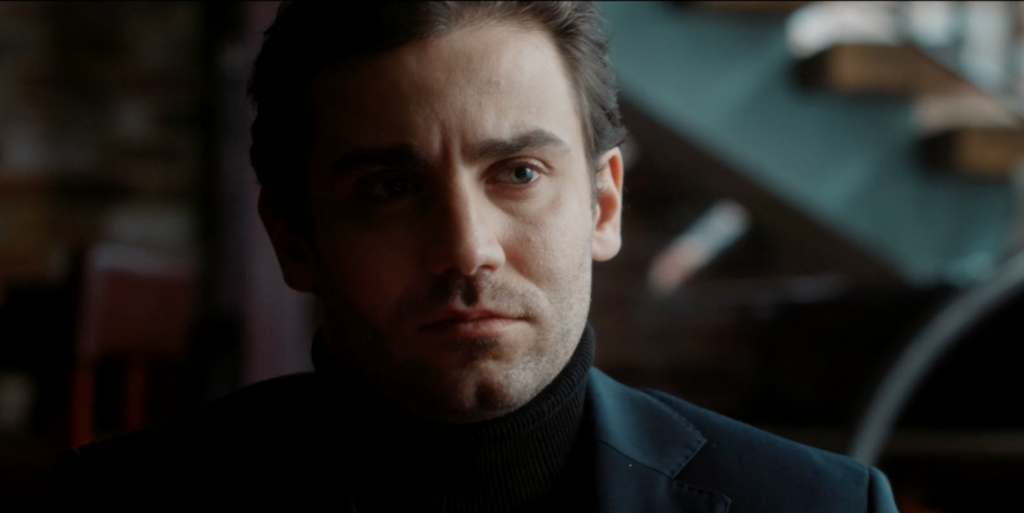
What works about âFalsifiedâ is that it presents the father/son relationship realistically, empathetically. There are no âyou abandoned meâ tropes here, because weâre not dealing with that kind of material. Instead Tabatabi wants to bring us in to this world, one where families have been torn apart without reason nor explanation. Mercer is a victim, but so is Javier. And while Mercer wears his hurt on his sleeve, Javier hides behind defense mechanisms he put up after a past attempt to discover his family ended in failure.Â
Tabatabi layers this well – both in his performance as Javier and in his direction. Thereâs a lot contained in the script, but in the effort of a fair review I will not reveal the specifics. But there is a scene, between Tabatabi and Mullen in a church, where it is discussed with over the shoulder shots and closeups. We learn about Javier: both his past and his heartache. The scene highlights both mensâ journeys well, and sets up some expectations for us, as viewers. Javier and Mercerâs fledgling relationship rests upon a lot, and we feel their insecurity. The film also handles its plot well. Mercer finds what he was looking for, but not in the way you think. Mullen and Tabatabi have great chemistry together and it makes the picture work in pleasing ways.Â
The film is scored by Howard Carter and Paul Harrison with a slow, droning bass and musicality that further its impression. âFalsifiedâ takes its time and watches slow, but its all the better for it.Â
I read a bit about Spainâs âstolen baby scandal.â A child trafficking operation involving hospitals and childrenâs homes run by the Roman Catholic Church, spanning decades, with international ties to the United States and South America. Thousands of victims; parents without children, children without parents. I can only imagine the sense of loss and horror such an event brings.Â
With âFalsified,â however, Tabatabi brings us into this world smartly and wholly. Itâs not the event he wishes to comment on, but its effect and the personal loss on two individuals we come to know. Both Mercer and Javier are coming from places we understand. The movie shines a light on their journey and you understand what their reunion means. The filmâs final shot is open-ended and leaves many questions, but is still pensive and kind.Â
– by Mark Ziobro


