





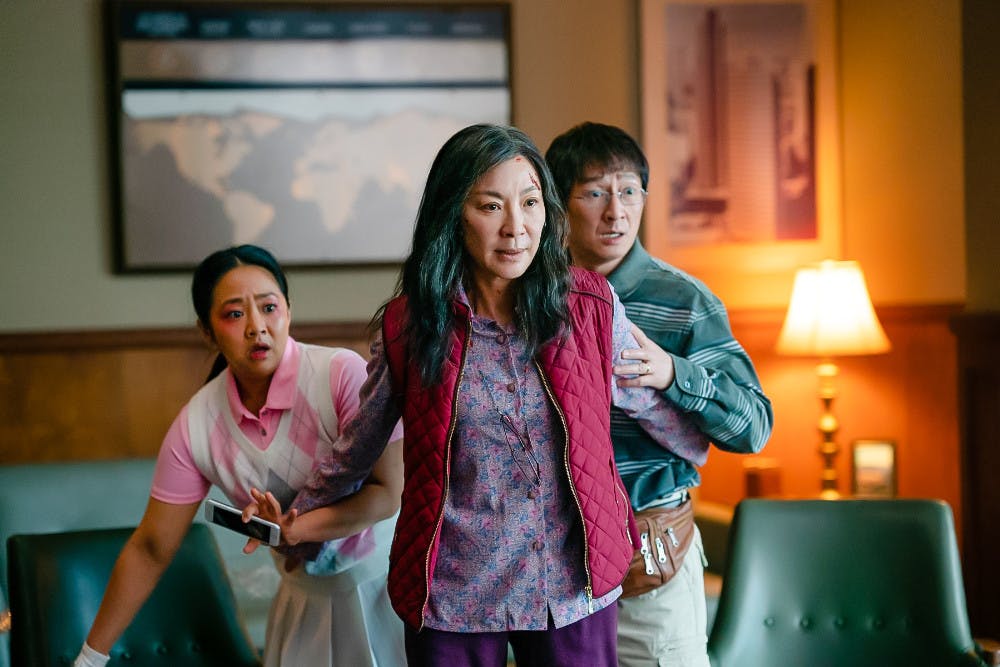
The biggest comment floating around social media at the time of this filmâs release was: âEverything Everywhere All at Onceâ was the multiverse movie âDoctor Strange in the Multiverse of Madness” should have been. I donât particularly dig sound bites like this, and it does âEEAAOâ an extreme disservice. The latter is a comic book movie sequel about a wizard traveling through a multiverse to stop a witch turned evil, and its multiverse is presented and accepted as entertainment. In the former, the âmultiverseâ is a cinematic tool to explore its central characterâs missed opportunities, sadness, regret, and ultimate healing. They have nothing in common.Â
With that in mind, production company A24 is known for brining more artistic pictures to the fray, and âEverything Everywhere All at Onceâ is no exception. Itâs directedâand writtenâby Dan Kwan and Daniel Scheinert, and tasks lead actress Michelle Yeoh with heavy liftingâand she delivers. The movie is presented as a hyper dream; its leadâand othersâare catapulted through parallel and past universes. In their confines lies the many lives Yeohâs Evelyn Wang could have lived should she have made the choice to not run away from her father at a young age and marry her husband, Waymond (Ke Huy Quan). The movie isnât quick to explain the events and keeps us guessing. You have to dive in headfirst. If you spend any amount of time fighting âEEAAOâsâ logic, youâll have missed the point.Â
Just Going with ‘EEAAO’ Provides the Best Experience
Evelynâs character is layered, and itâs a credit to Yeoh that she’s as likable as she is. Weâve seen in the opening that her husband wants to divorce her, sheâs behind on her taxes, she lives in a tiny apartment and runs a failing laundromat, and works tirelessly to please her father (veteran James Hong), who treats her as a disappointment. Sheâs a bit of an enigma. Her daughter (Stephanie Hsu) is dating another girl (Tallie Medel), and though Evelyn reminds her sheâs âlucky she has such an accepting momâ (a base exploration of Chinese culture comes into play), sheâs still quick to judge her figure and tattoos, in one scene even telling her sheâs âstarting to get fat.â This sends a solemn tear down her daughterâs face in one of the filmâs opening scenes.Â
You can easily see how âEEAAOâ could at this point devolved into a standard parental disapproval tale, or a class parable (âKnives Out,â âParasite,â and other recent films come to mind). However, what Kwan and Scheinert want to do is present a film that connects with you visually and emotionally. It shifts in and out of present reality to other âuniverses.â Evelynâs guide is her husband; well he looks like the same guy, but heâs not. He explains the rules of the multiverse and explains that only she can help overthrow the threat, which is at first spearheaded by an IRS tax auditor (a stellar Jamie Lee Curtis), but is ultimately âmastermindedâ by Jobu Tupaki, who looks an awful lot like her daughter, Joy.Â
An Absurdist Experience that Shows off Yeoh’s Martial Arts and the Filmmakers Vision in Equal Measure
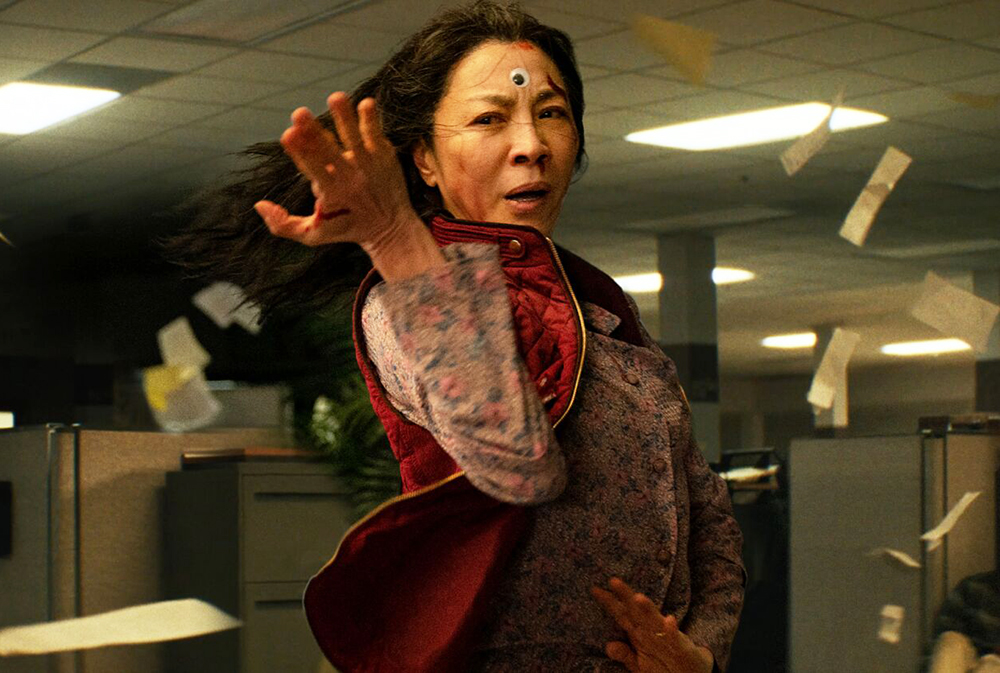
Thus begins an assault on the senses that encapsulates the film’s first chapter, titled âEverything.â Everything represents the hurriedness of Evelynâs life. The continuing barrage of enemies that attack her. Her own demons. Regrets. Longing. In one universe she didnât marry her husband and became a Kung Fu star and celebrity; in another a chef, and so on. The filmmakers assault our perceptions with engaging fights, philosophical battles of wits, and âverse jumping,â in which characters do something usually very odd (while wearing Bluetooth headsets), and jump into another universe. These acts range from eating odd things, to giving oneself paper cuts, to sitting on statues naked⦠and we can probably stop there. The fights are especially intriguing. They clearly draw from âThe Matrixâ or âKill Bill,â but lack the respective urgency or viciousness of those movies. Â
The cinematography is fitting, and Larkin Seiple shoots the scenes wonderfully. Sometimes you wonder what’s happening; in fact, for most of Part 1, that’s what youâll doubtless feel. Yeoh superbly plays the floundering âheroâ that doesnât know what sheâs fighting forânot at firstâand acts flabbergasted as the pieces come together. She gets to show off her martial arts skills (it’s the same Yeoh from âCrouching Tiger, Hidden Dragon,â after all). But itâs equally engaging to watch Ke Huy Quan play many charactersâall more daring than her husbandâand Stephanie Hsu as the âevilâ Jobu Tupaki. Tupaki mesmerizes Evelyn in one scene, drawing her into a black hole she’s made with her hopes, fears, and everything else she could think of; and itâs not hard to grasp the movieâs parallel that it’s Joyâs pain at not being accepted by her mom sheâs sharing, not ideas of world domination.Â
Hard-Hitting Cinematography Coupled with Relatable Emotion
And, to me, this is where the film becomes wholly interesting. The hard-hitting fight scenes give way to something simpler and more sublime. Sometimes it takes a movie like thisâone that jumps in and out of reason, timeframes, and dreams to allow audiences to feel its pain, rather than just to see it. The same was true of a forgotten indie (I doubt many know it, but I could be wrong) titled âMr. Nobodyâ starring Jared Leto. Scenes with Lee Curtis, Huy Quan, and Hsu fill âEEAAOâ with a dolor and sweetness that is indescribable. You just have to watch it and experience it. A scene between Yeoh and Hsu, as both are rocks sitting in a desert, talking, is one of the filmâs most powerful scenes. As is a scene between Yeoh and a successful Waymond, in this universe whom she never married.Â

But not wanting to bore audiences, Kwan and Scheinert inject these themesâof love, loneliness, and a motherâs failingâwith more fights, âverse jumping,â and a kaleidoscope of lunacy. They become even more interesting as Evelyn âlearnsâ from her other lives, borrowing skills she uses to become a better fighter. The end fights, however, are the most insightful. As she makes her way up a flight of stairs guarded tooth and nail by guards and weaponryâher only goal to protect her daughter from turning away from her for goodâthe ways that she defeats her âenemiesâ shows more empathy and insight than most dramas. The filmâs ending is doleful and sublime, while grounded in realism. Itâs not massive growth but subtle, and its clear Kwan and Scheinert want it to be believable.Â
A Film to Remember as We Head into Awards Season
âEverything Everywhere All at Onceâ is not a perfect film, even as we near award season and nomination(s) become likely. The film stretches on for too long (itâs 2 hours and 19 minutes), and sometimes feels like Kwan and Scheinert try to inject too much involving various family members instead of focusing on just Joy and Waymond. The ending reconnection between Joy and Evelyn almost nails it perfectly, then lags on a bit, pulling back, landing somewhere between complete acceptance and the same Evelyn we knew before. But all-in-all itâs forgivable. For its small faults, âEEAAOâ presents a throughly-engaging and escapist fantasy complete with emotion, urgency, and soul. Its adventure propels its narrative, rather than being an end in itself, and leaves your heart warm as its credits roll. A film to make you think, and one to definitely check out if youâve failed to see it thus far.Â
You can rent or stream “Everything Everywhere All at Once” on a variety of streaming platforms.Â
Support the Site:Â Consider becoming a sponsor to unlock exclusive, member-only content and help support The Movie Buff!


