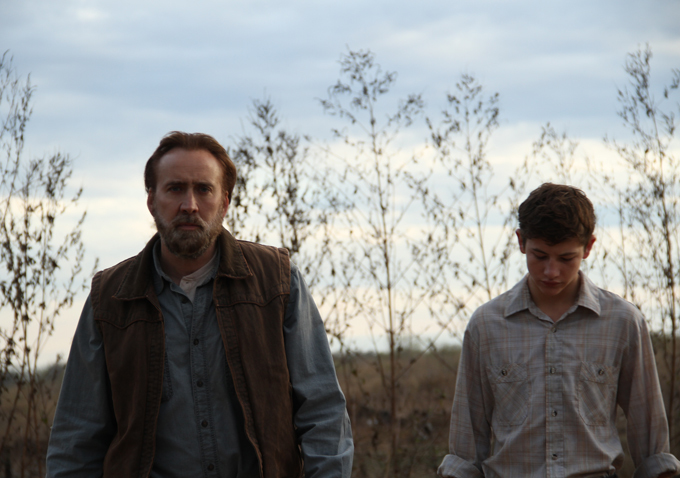
Films are made up of scenes. “Joe” has powerful ones, and then it has ones that wander and get a lost a bit. The movie is directed by David Gordon Green, and features a powerful performance by indie star Tye Sheridan (“Mud”), and an awe-inspiring effort by Nicholas Cage. Films are also made up of ambiance and an overall theme. And while “Joe” staggers a bit, the film is relatively tight from start to finish, and manages to lose audiences in its progression. This is not a film defined by plot and set pieces, but one of style, substance, and thorough character development throughout.
We are introduced to the film’s title character, Joe, through those who earn a living because of him. A group of employees clamber in the rain to load a work truck before getting drenched. Joe lights up a cigarette under a hood with a silver and gold lighter, a prop that is later used throughout the film to explain Joe’s pride and his acceptance of his lot in life. Sitting in a cramped truck, an employee asks Joe for a cigarette, his last in the pack. “I’m going to start taking these outta your pay,” Joe jokes. But everyone here knows who Joe is – a boss that inspires loyalty. Any of these men would kill to protect him.
“Joe” is complicated when 15-year-old Gary (Tye Sheridan) shows up asking for work for he and his dad, complicated even more as we’ve already seen what kind of man his dad is – a pass-out-at-noon drunk who slaps his son’s face at the film’s opening when he chastises him for being a bad father. The man who plays him, Gary Poulter, pulls off this act, an emotionally and physically abusive man who’s every bit as pitiful as he is evil. A host of other characters, such as Gary’s frozen mother and sister, align the quiet-spoken youth with Joe, whom we learn has served time for assault but never really got over it.
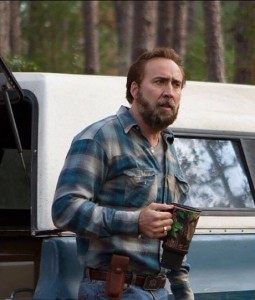
What is captivating about “Joe” is the authentic and totally immersing way its characters, small town, and backwoods wash over you. David Gordon Green has accomplished this before, in films like “All the Real Girls,” but in Joe his approach has a wider lens. The cinematography is wonderful, painting run-down country houses amidst honkey tonk saloons and a town mini-mart where everyone knows everyone. Lingering cameras help to solidify the film’s effect, especially in interactions between Cage and another of the town’s ruffians, played expertly by Ronnie Gene Blevins. And the intricate way Green shows how good and bad can fall on both sides only serves to heighten this. In one scene, Joe steps angrily out of new car to confront a police officer intent on harassing him. It’s not defiance, but frustration. Ex-cons in small towns make easy targets; and Joe can’t seem to get on the straight and narrow no matter how hard he tries.
The acting in the film is astounding, a credit to Green’s direction, but also to many of the film’s players – such as Poulter (a homeless man Green cast in the role who died shortly after the film’s release) and Joe’s work crew – who are not professional actors. And Cage brings such an awesome force to this movie that it blows any of his more half-hearted attempts out the window. I’ve never seen a better performance out of Cage, have never seen him so expertly become a character so completely. And the seamless perfection that Sheridan brings to his role, and the way that he and Joe have such great chemistry, only solidifies this film even more. One scene were Joe and Gary wander through the forest, looking for Joe’s lost dog, is one of the best in the entire film. It highlights a bond between the two, a bond equally important to both men. And in a film that highlights its characters’ misery, it shows a peace – even if short lived – that both men sorely need.
 To its detriment, “Joe” begins to break down during its third act, becoming more fixated on some of the film’s lesser characters than its two primary ones. It also careens toward somewhat unbelievable as Joe goes to extremes to protect Gary as things with his father spin out of control. If the film had pulled back slightly toward the less dramatic, it may have indeed been perfect. But in the end it is still an encapsulating film, and reminds us how good both Gordon Green and Cage can be when they want to. “Joe” is indie through and through, and that’s its strongest asset. Actors seldom lose themselves to this degree in mainstream Hollywood.
– by Mark Ziobro