“Phenomenon” might be one of the nicest films to come out of the 1990s, and certainly the closest Hollywood has ever come to achieving the quality and depth found in independent films. Whether the result of the Direction from John Turtletaub, known for such movies as 1993’s “Cool Runnings” and 2004’s “National Treasure,” or the toned-down and humanistic acting from John Travolta, the film is a success, a poignant drama and focused look at the life of a small-town man who undergoes a radical transformation that has farther reaching effects than anyone could have anticipated.
At the start of the film, we get a look at the life its central character, George Malley (John Travolta), leads. On the day of his birthday, his friend Nate (Forest Whitaker) drops off some solar panels for him to improve his house, but George can’t be bothered; he is busy solving the mystery of how a rabbit got into his garden. He’s a simple man; more concerned with fixing cars or trying talk to a beautiful woman (Kyra Sedgwick) than mysteries of universe.
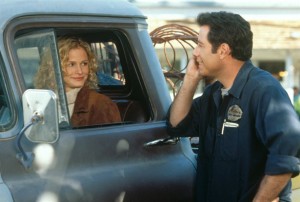
During “Phenomenon,” however, George starts to get smarter, becoming a wiz at crosswords and reading lots of books. What kinds of mysteries are contained in “Lady Chatterly’s Lover?” Malley’s friend and town physician Doc Brunder (Robert Duvall) asks sarcastically. “It’s a codebook for anyone who wants to understand a women’s heart and mind,” Malley responds. “I read it twice.”
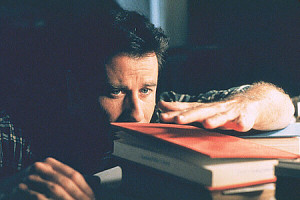
These kinds of observances are the heart of “Phenomenon,” a movie that, despite the temptation, doesn’t stray form the land of the known in a quest for the quick sell. Malley’s increased intelligence is attributed to a UFO, a bright light, or some other unexplained phenomenon. On the night of his birthday, George sees a light, falls to the ground, and shatters his glass. Was it a UFO? He never says so, but everyone in town says it for him. When strange things start happening, such as his being able to learn a new language in a few hours or move pens with his mind, people shun him. Other occurrences, as when he cracks a secret Morse code by ear and garners the interest of the F.B.I., lead to his almost complete alienation from the town, the exception his few close friends that stay by his side.
“Phenomenon” is not a sci-fi movie but a human one. It’s is sold not through special effects and intrigue, but almost solely by its acting. The star of this film is undoubtedly John Travolta, who plays Malley with commitment and heart. With high-energy actors like Travolta, it’s too easy for them to slip into old habits, playing a composite of old roles rather than to embrace new ones. But the restraint he shows here deserves recognition. He makes an everyman out of Malley, an effort all the more convincing because he makes it seem it’s no effort at all. I’ve always liked Travolta’s acting; however, in George Malley he creates something special and endearing. I’ve rarely seen a performance like it.
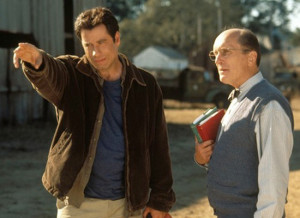 Other actors mirror his performance, turning in delightful and heartfelt portrayals. As George’s friend Nate, Forest Whitaker leaves the dynamism of movies like “Platoon” and “The Last King of Scotland” behind, creating a man impossible not to like, a man whose life ambition is to be a farmer – and perhaps get a date with Diana Ross. As Malley’s love interest Lace, the movie also gives us Kyra Sedgewick long before she gained fame as tough-girl cop in “The Closer,” a divorcee hesitant to love again, but perhaps willing to take a chance on Malley. The scenes between the two, particularly toward the movie’s bittersweet end, are powerful and captivating, made all the more so by the sweetness Sedgewick brings to her character.
Last but certainly not least, Robert Duvall has never been better as Doc Brunder, one of the only men besides Nate to stand by George when the going gets rough. There are two scenes – one, in a hospital, another in a tavern – where Duvall brings such passion and heart to his character that you really can’t imagine the movie being the same without him. Wrote one reviewer of Duvall’s performance, “These aren’t the performances Oscars are made of, but they should be.” Duvall has only a handful of scenes amounting to perhaps 15 minutes of screen time…but watching him, it’s almost impossible to disagree with this statement.
We would be remiss to mention that there is a twist in “Phenomenon,” and chances are that you won’t see it coming. However, when it does come, it serves not to disappoint, but to make sense out of the proceedings in a touching and believable way.
For a movie about transformation, “Phenomenon” tells its story with heart and emotion. Its camera shots are unassuming, painting its small, Californian town with rolling fields and country roads, lined with simple homes and familiar taverns. It has a gorgeous soundtrack, featuring such artists as Aaron Neville, Eric Clapton, The Supremes, Sheryl Crow, and the beautiful “Have a Little Faith in Me” by Jewel. But, most remarkable of all is the fact that the film seems to stir feelings of real life and real emotions in its run-time. It’s a credit to the ‘90s that movies like this came so easily, where today they are usually found off the radar. For Turtletaub and Travolta, who would go on to work on much higher-grossing films, “Phenomenon” is a definitive proof that you can make an entertaining film with interesting characters that doesn’t involve a larger than life plot and superhuman characters. Sometimes the human is much more interesting and rewarding.
– by Mark Ziobro