


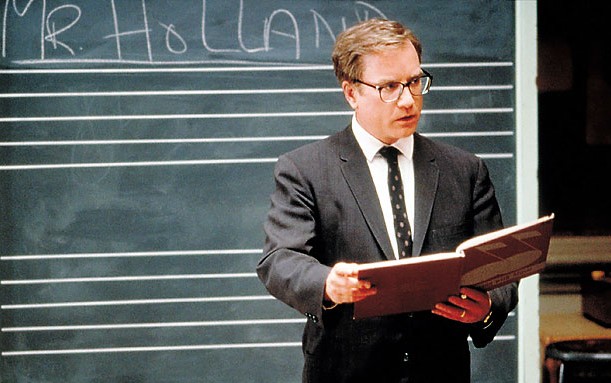
Movies centering on struggling teachers are a dime a dozen. We’ve all seen the established professional who gets in trouble and must mentor a group of problem students (“The Mighty Ducks”), as well as the dedicated, impassioned teacher who hopes to make a difference (“Dead Poet’s Society”). However, not often seen are movies involving ordinary teachers who take these jobs for reasons perhaps forgot long ago, and who question, at the end of their careers, what impact – if any – they might have had upon their own little worlds. It is in this vein that the 1995 drama “Mr. Holland’s Opus” was drawn, presenting both a believable and thought-provoking look at a high-school music teacher whose dream of writing his own ‘opus’ is pushed to the back burner amidst work, family life, and responsibilities.
The film opens with Glenn Holland (Richard Dreyfuss) at a piano, orchestrating parts of a symphony he’s been writing for years, before shifting gears to more practical matters. To pay the bills of he and his wife’s new life, he takes a job as a school music teacher. Grumbling about the obscene hour he must report to work, Holland narrates that teaching was a fall back plan on the road to be a musician he never thought he’d have to ‘fall back on.’ Struggling to connect with his students, he is a man who puts in his time at work but leaves with his students at the bell, a practice brought to his attention with reproach by the school principal (Olympia Dukakis).

However, two events force Holland to re-evaluate his role and take it more seriously: one, his wife (Glenne Headly, TV’s “ER”) announces that she is pregnant, and two, he starts to see, slowly, that he has the ability to get through to his students and still envelope himself in the magic of music. The film then chronicles thirty years in Holland’s life as a teacher, a life that spans the rock-n-roll era of the 1960s to the hip hop dawn of the 1990s as Holland, and the school, changes through the times.
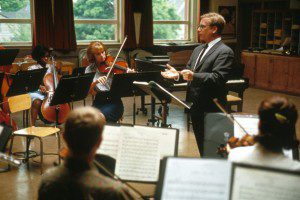
What separates “Mr. Holland’s Opus” from other movies of its type lies in its presentation, and in Holland’s progression from ambivalent part-time teacher to decided full-time mentor. At the beginning of the film, his teaching style is abrupt, classic, and by-the book. His students fail a test on music theory and he can’t understand why they don’t get it. Fast-forward a few semesters, and Holland sits at a piano, showing his students how popular songs they know and love are based off of classics written by Beethoven and Bach. Just as his love of music can’t be explained in words, he realizes a class can’t be inspired by readings from a book. He reaches several students, one, a shy and self-doubting clarinetist (Alicia Witt) and another, a boy struggling academically (Terrance Howard), who he inspires through teaching him rythym.
The film excels for many reasons, but most strongly in the hands of its lead, played splendidly by Richard Dreyfuss, who puts forth a performance as Holland that is extraordinary yet subdued, impassioned yet frustrated. Movies like “Dead Poet’s Society” are inspiring because we like to see passionate people giving their all. However, “Opus” aims more at explaining its character’s motivation, showing first a man who may not have been the best person for the job, but a man who becomes what the school, and students, need most. Dreyfuss, whose early work included supporting roles in Oscar-winning movies such as and “The Graduate” (1967), and “Jaws” (1978), garnered an Oscar nomination for ‘Best Actor in a Leading Role’ for his performance here – and it’s much deserved. As the movie requires, Holland changes throughout this film, an effort all the more believable due to the talent Dreyfuss brings to the table.
 Supporting actors bring warmth to the picture, most notably Glenne Headly, who, as both Holland’s wife and mother to a deaf son, shows competent emoting and complexity. Some reviews labeled her role as ‘thankless;’ however, the patience and challenge that goes along with being Holland’s wife requires more than just a throw-a-way role, and Headly does a good job bridging this gap. As Holland’s friend and colleague, Jay Thomas is pleasing and passionate, bringing a surprising deal of depth to a supporting character, as does Olympia Dukakis as Principle Jacobs. Rounding this out, playing Holland’s deaf son, Cole, Joseph Anderson turns in a marvelous performance, making us believe both his condition (through signing and muted vocals), as well as his frustration with a father who always has time for his students but seemingly little for him.
We all question what we do for a living. Is this what I’m meant to do? Am I on the right path? “Holland” doesn’t answer this question but ponders it, hinting that perhaps it doesn’t matter what you do as long as you do it with enough heart. At the end of their lives, people need to know that what they did mattered…that it affected someone else, no matter how small. “Mr. Holland’s Opus” understands this, confronts it, and provides a plausible explanation. It’s the story of a man who feels drawn to one path yet goes down another, and a movie that shows that good teaching takes not extraordinary talent, but compassion, patience, and time. We may not all change the world, we may not all create our “opus;” but sometimes it’s what we do on our way to rediscovering our dreams that has lasting impact.
Do yourself a favor and rent this thought-provoking and heartwarming film. You won’t be disappointed.
– by Mark Ziobro


2 Comments
Oh my gosh, I used to adore this movie. It came out when I was in a big learning sign language phase and I was in love with Marlee Matlin and I was just enchanted that they had a deaf character in this. Plus, ya know, it was really good. 😉
It’s a really great movie. A friend suggested it and I had never seen it before. It was very good, and not at all what I was expecting.