



*Contains film spoilers along with discussion/interpretation— Within the first minute of “Queen at Sea,” the audience encounters a scene that provides a clear indication of the film’s subject, though not necessarily its story. It is the kind of scene many directors might hesitate to place at the very beginning. Lance Hammer, however, chooses to start precisely there.
The film is a drama, and its subject becomes apparent almost immediately: the lives of older people and the difficult circumstances they face. Cinema, particularly European arthouse filmmaking, has explored the lives of older people for decades. What makes this film immediately striking is its opening, in which two elderly people, Leslie and Martin, are shown having sex. Leslie is played by Anna Calder-Marshall and Martin by Tom Courtenay. Their intimacy becomes the starting point for a much more complicated examination of ageing, dementia, and personal autonomy.
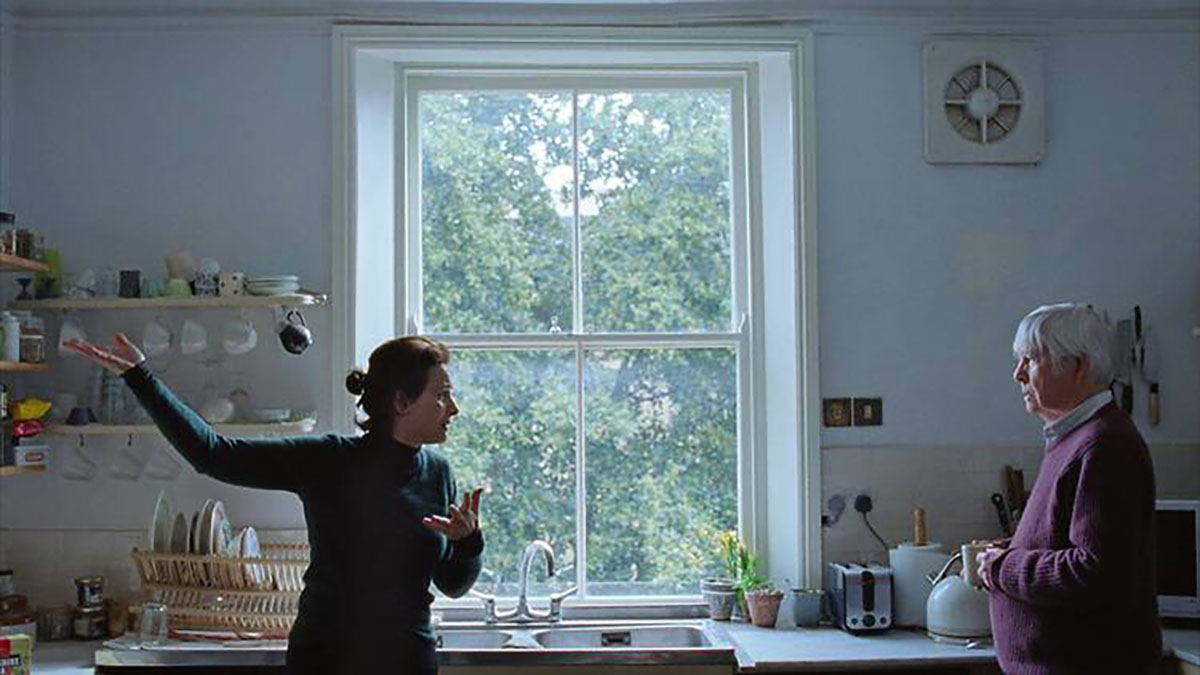
Their daughter, Amanda (Juliette Binoche), walks in on them and confronts her stepfather. Her mother has advanced dementia, and Amanda believes she can no longer make informed decisions about her own circumstances. Concerned that Martin’s actions may constitute abuse, she calls the police. Martin is taken into custody, and an investigation follows. Although the situation does not produce a straightforward conclusion, the intervention creates a painful conflict within the family.
One of the Film’s Greatest Strengths
On the surface, this may seem like a simple story. As it unfolds, however, it reveals increasingly complex questions about human psychology, respect, love, physical intimacy, and responsibility. That complexity is one of the film’s greatest strengths.
The central difficulty is that Leslie, despite her condition, continues to recognize and rely on her husband. At different moments, she appears to welcome his intimacy. Martin maintains that he never does anything Leslie does not want and insists that he does not initiate their physical encounters. From his perspective, he is responding to his wife’s wishes rather than imposing anything on her.
Amanda’s position is equally understandable. She is concerned about her mother’s vulnerability and believes protecting her is her responsibility. The possibility that dementia may affect certain impulses, including sexual desire, makes the situation even more difficult to interpret. Amanda struggles to accept that her mother might still express such desires, while Martin believes their relationship should not be reduced to a question of abuse.
Audience Left to Consider Both Perspectives

The film does not make either side entirely unreasonable. Martin has his own explanation, and Amanda has legitimate concerns about her mother’s safety. The audience is left to consider both perspectives without being offered an easy answer. It is not simply a matter of deciding who is right and who is wrong. The circumstances are much more complicated.
Eventually, Amanda decides that Leslie should be moved into a care home, a decision Martin strongly opposes. He argues that Leslie will not be happy there because he has always provided the support and care she needs. Amanda, however, believes that professional care is necessary.
After Leslie enters the care home, Martin is left alone. When the family learns that Leslie has experienced similar intimate behavior with another resident, Martin decides to bring her home. Amanda does not prevent him and eventually supports his decision. Martin assures her that the circumstances she is concerned about will not happen again, and he keeps his promise.
Understanding Tragedy Through Circumstances

Leslie’s condition nevertheless continues to deteriorate. She becomes increasingly agitated, and her needs become more difficult to manage. Amanda also grows more comfortable with Martin, and their relationship gradually softens. A social worker is brought in to help care for Leslie.
Toward the end of the film, Martin returns home after having dinner with Amanda and finds Leslie agitated and unwilling to cooperate with the social worker. He offers to take over her care. As he tries to calm her down, help her get dressed, clean up, and take a bath, we see that Leslie shows Martin the same sense of trust and willingness to cooperate. What follows is another subtle yet powerful achievement in the film’s storytelling. Gradually, the narrative reveals how Leslie’s mental state has been affected by her experience of staying and spending time at the ‘Old Home.’
Once again, the film demonstrates how effectively it explores human psychology and the complexities of life. One of the film’s greatest achievements is its ability to draw the audience into the storytelling process so naturally that the audience remains immersed in the story without noticing the subtle techniques and craftsmanship behind it. Obviously, the narrative is essential to understanding the questions the film raises and the ways in which it gradually develops and explores them.
Hammer Shows Restraint with Emotional Material
What is particularly impressive is how smoothly the storytelling progresses. There is no major difficulty in following the narrative, nor does the film create unnecessary obstacles for the audience. Events unfold methodically, with careful composition and juxtaposition. The character development and the progression of the story remain balanced throughout.
This does not mean that the subject itself is simple. Rather, the filmmaking makes a complicated human situation accessible without reducing its complexity. The story moves forward naturally, and the audience is never made to feel that it must struggle to understand the director’s intentions. It is an unusually controlled piece of storytelling.
Another remarkable aspect of Hammer’s direction is his restraint with emotional material. There are many moments when another director might rely on sentimental or emotionally heightened scenes to make the audience feel the sadness of the situation. Hammer takes a different approach. The emotions are present in the characters’ faces, their actions, and their circumstances, but the film never pushes them toward the audience. It does not insist that we feel sad or use emotional manipulation to make its point. Everything is about emotion and sentiment, yet almost nothing is presented in an overtly sentimental way. This, I believe, is one of the film’s most powerful achievements.
A Carefully Crafted Film
The use of classical music follows a similarly careful approach. It is not used excessively but appears at moments when it seems genuinely necessary. This measured placement gives the soundtrack a thoughtful quality and contributes to the film’s overall composition.
The film also works with a relatively small group of central characters: Leslie, Martin, Amanda, and Amanda’s daughter, Sara. Yet each has a clear place in the narrative. Through Sara and her emerging relationship with a boyfriend, the film introduces a younger generation, creating an interesting contrast between people approaching their nineties and those in their twenties. Amanda occupies the middle generation, connecting these two worlds, although the film’s primary attention remains with the older couple and their circumstances.
Gives its Audience Much to Consider

Ultimately, “Queen at Sea” is a carefully crafted film. Its story may not be striking in the conventional sense, but it becomes striking through its exploration of the human psyche and the complicated realities people must confront. It deals with a deeply uncomfortable subject, yet tells its story in an unusually simple and controlled manner.
Lance Hammer does not depend on exaggerated emotion, dramatic confrontation, or easy moral conclusions. Instead, he allows the characters and their circumstances to reveal the difficult questions at the heart of the story. The result is a thoughtful and quietly powerful drama that gives its audience much to consider long after it ends.