


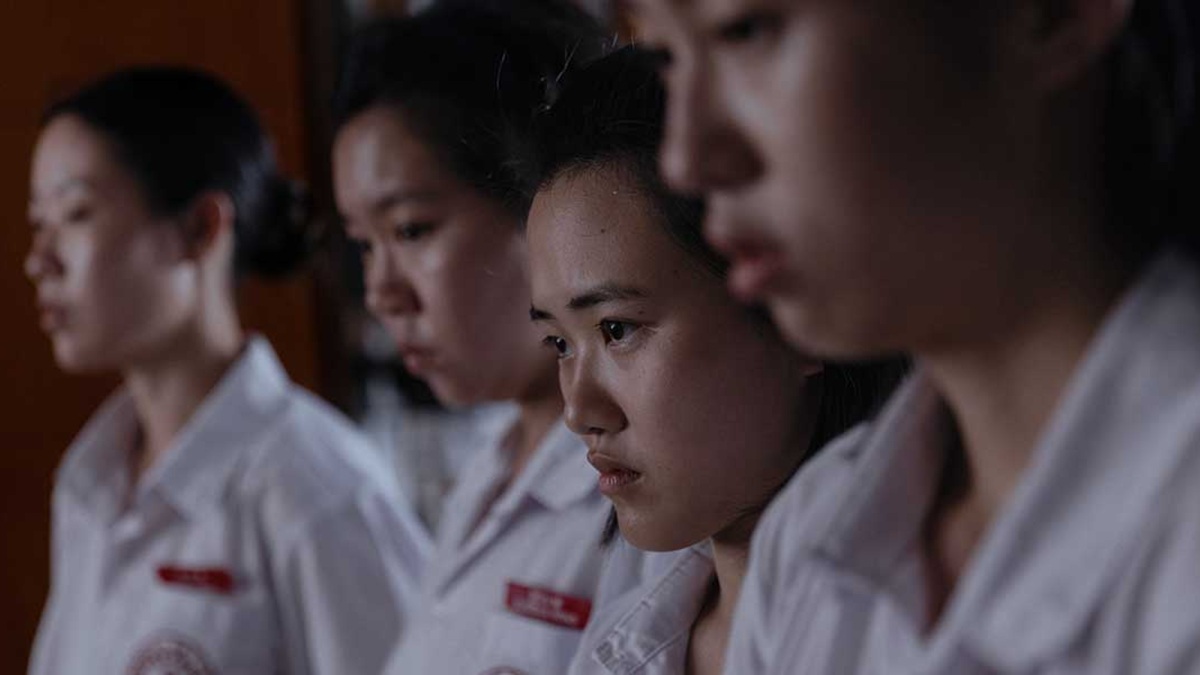
I’ve always been a sucker for stories about misfit teenagers, the kind who see the world pressing down on them and decide, in their own fumbling way, to push back. Maybe that’s why Siyou Tan’s “Amoeba” hit so close to home. As someone of Filipino-Chinese descent, I spent most of my childhood and young adolescence in a Chinese school, from age five until sixteen. I know what it feels like to live under the scrutiny of teachers who police not just grades, but behavior, clothing, even the slightest slip from uniformity.
And watching Tan’s film (her debut nonetheless!), I found myself not only moved by the characters, but also nudged by old ghosts of my own.
More TIFF Coverage: Leon Le’s ‘Ky Nam Inn’ Channels ‘In the Mood for Love’ in the Shadows of Postwar Saigon
Teenage Rebellion in a World of Conformity
Set in a fictional authoritarian girls’ school in Singapore, “Amoeba” follows Choo Xin Yu (Ranice Tay), a transfer student and dropout who reenters the system with a chip on her shoulder. Her defiance—small gestures of resistance against the school’s tyrannical order—draws three fellow outsiders to her orbit: Vanessa Scarlett Ooi (Nicole Lee Wen), Gina Wong (Genevieve Tan), and Sofia Tay (Lim Shi-An). What begins as a tentative bond soon hardens into a pact. They film each other’s lives on Sofia’s camcorder and search for a ghost Choo insists haunts her room. Egged on by Sofia’s elderly family driver Uncle Phoon (Jack Kao), the quartet fantasize about forming their own gang.
But how do you rebel in modern Singapore, where even chewing gum is illegal?
The girls’ rebellion is never grand. They don’t burn buildings or lead walkouts. Their acts are messy, naïve, sometimes contradictory—just like adolescence itself. One of the film’s most striking lines comes late, when Choo wonders aloud: “When is life going to start? Is it after secondary school? Is it when you finally realize what’s real?” It’s a question that hangs over every scene. For these girls, life seems perpetually deferred, always just beyond the horizon of exams and obligations.
The title becomes a key to Tan’s approach. An amoeba is formless, solitary, capable of multiplying itself but forever drifting without anchor. Tan has described identifying with it as a teenager: withdrawn, shapeless, yearning for connection yet terrified of exposure. That paradox seeps into the film. Even when the four girls huddle together like sisters, the sense of impermanence lingers. Amoebas may touch, but they remain islands.
A Jagged, Albeit Sincere, Marriage of the Supernatural and Coming of Age
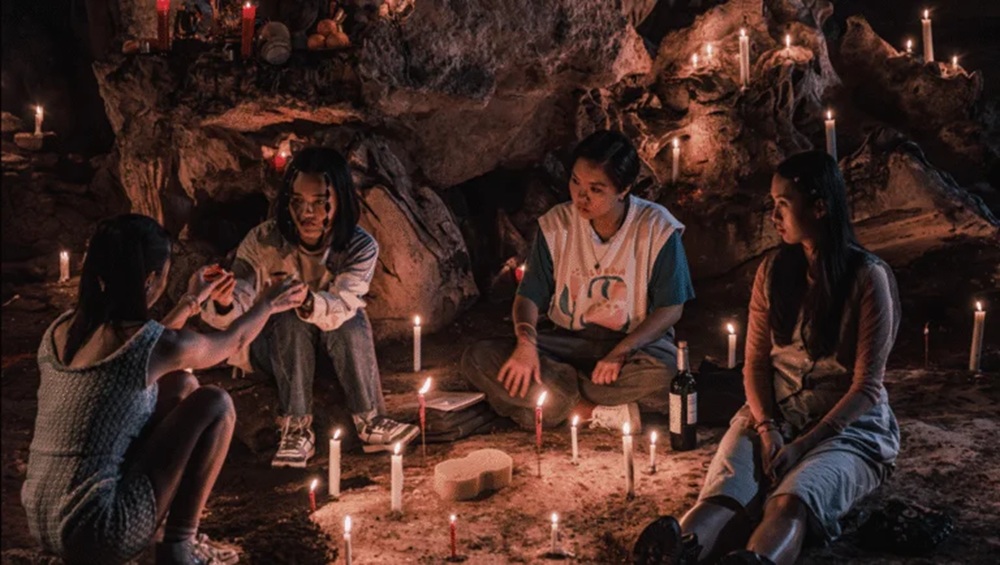
The supernatural elements—the ghost in Choo’s bedroom, the cave full of artifacts (which was shot in the Philippines)—work best when seen through that lens. The ghost isn’t just a jump-scare device but an embodiment of what’s buried: queer desire, suppressed individuality, feelings deemed “undesirable” by family and state. At times, I felt these flourishes strained against the otherwise grounded story. But rather than a flaw, I came to see them as part of the film’s jagged honesty. Teenagers are messy, after all. Their fears and longings often outstrip the boundaries of realism.
What impressed me most is how “Amoeba” situates its intimate story within a broader social reality. Singapore is a country that prides itself on multicultural sheen and economic miracle, yet here we see the cost of that success: schools that function like training camps, students who sing songs pledging obedience and virtue, constant reminders that the nation comes before the self. There’s something cutting in the way Tan stages the students’ reflections on the Merlion—the national mascot with the body of a fish and the head of a lion. They describe it as if trapped in an aquarium, gazing out at a world that stares back in judgment. For a country built on fusions and contradictions, the metaphor is chilling: multiculturalism on the surface, repression beneath.
And then there’s the texture of the film—the Singlish that flows naturally in dialogue, the slang and rhythms that mark the girls’ camaraderie. Too often, films from Singapore mute those cadences in pursuit of export-friendly gloss. “Amoeba” revels in them, making the language itself a small act of resistance.
‘Amoeba’: A Remarkably Assured Feature-Length Debut
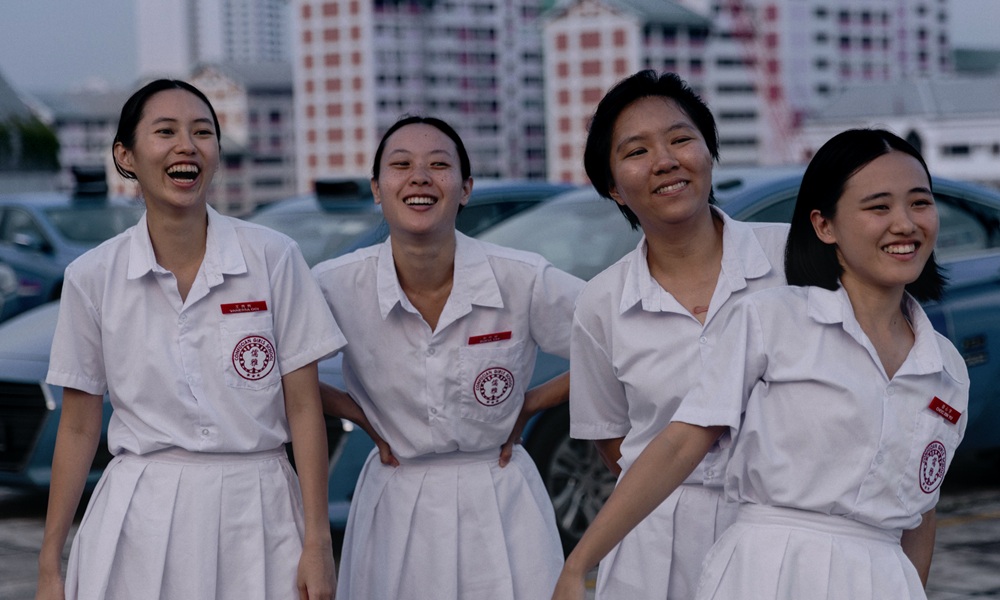
As debuts go, Tan’s film is remarkably assured. The young cast is uniformly strong, capturing the tentative bravado of girlhood—how alliances form in whispers and dissolve in silence. Ranice Tay, as Choo, anchors the group with a raw, unvarnished presence, while Nicole Lee Wen gives Vanessa a fragile restraint that feels tragically inevitable. Jack Kao, as Uncle Phoon, injects a bittersweet humor as the relic of a different era of rebellion, wistful about the gangs that once dared to openly defy authority.
If the film falters, it’s in its uneven rhythm. Even at 98 minutes (a relatively short runtime), the pacing sometimes drags, and the supernatural thread doesn’t always weave seamlessly with the social critique. Yet I never found myself disengaged. The imperfections felt oddly appropriate: “Amoeba” is, after all, about growing up in fits and starts, about identities that don’t quite align, about wanting more than the world will allow.
Watching “Amoeba,” I remembered my own teenage years of uniforms and rules, of feeling like life was always postponed for later. Tan may not have all the answers yet—what first-time filmmaker does?—but she has crafted a debut that is both tender and quietly defiant. For anyone who has ever felt like an outcast in their own home, the film reminds its audience that even amoebas, drifting and formless, can find each other in the dark. It doesn’t break the aquarium glass, but it listens to the knocks. And more often than not, it’s more than enough.

Siyou Tan’s “Amoeba” had its world premiere at this year’s Toronto International Film Festival. Follow us for more coverage.

