


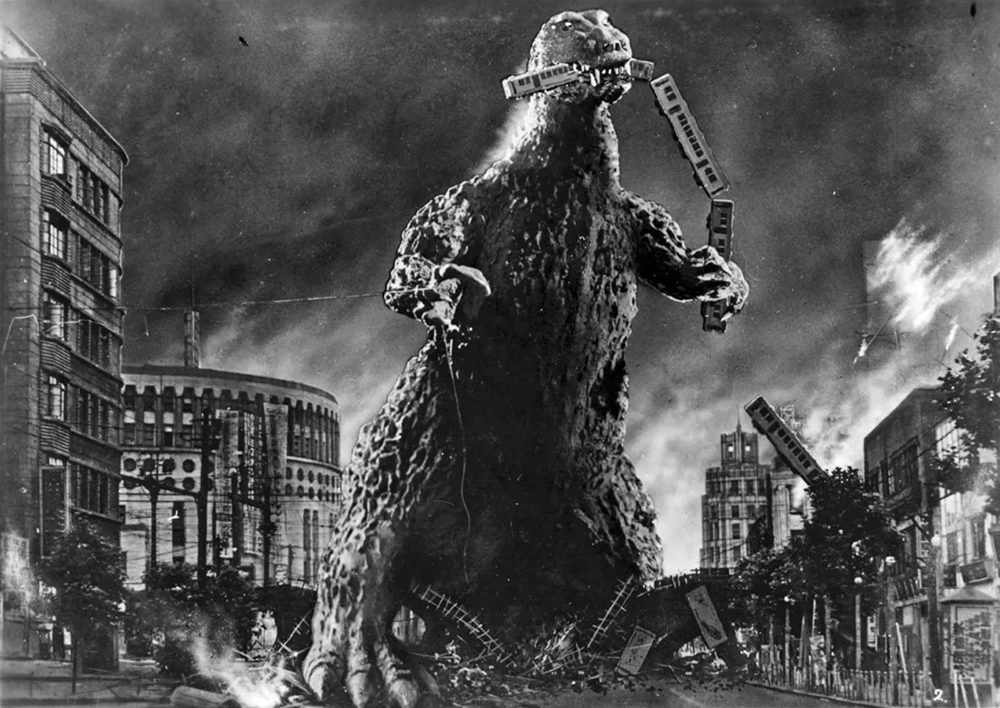
You could argue the necessity of a re-examination of Ishirô Honda’s 1954 classic “Godzilla” at the release of “Godzilla Minus One,” opening in theaters this month. However, maybe the necessity started before that. Perhaps it started with “Oppenheimer,” last summer’s blockbuster, the events from which this picture doubtless drew its inspiration. Not in the life of Oppenheimer, but in the creation of the atom bomb, which the denizen’s of Honda’s film are still reeling from at the onset of his picture. At the end of “Godzilla” we see a more conscientious answer to Oppenheimer in the hands of Akihiko Hirata’s Dr. Daisuke Serizawa. While history is more complicated than creature features, the film’s conclusion asks—for just a moment—if mankind deserved something more.
Watching this feature in 2023 is an event. On a widescreen TV, the flickering grains of light call back homemade movies of the time, present in films like “Nosferatu,” “Phantom of the Opera,” and other examples. The extra ‘wide’ screen parts cut off, utilizing cinema scope lens, add to this effect.
Even more interesting is to compare this movie’s opening—full of recounts of sinking ships and urgent cries from Japan’s citizens—to the action-packed destruction-fests of today’s action films… or even “Godzilla” sequels. Honda’s picture packs most of its tension into the discussions between government officials and the general public, fear escalating as more and more ships disappear on the Japan Sea. Whisperings begin to surface of a creature called ‘Godzilla’ (or “Gorjira,” this film’s Japanese title). Dearths of food and fishing misfortune have long been attributed to Godzilla. Then, as one older gentlemen warns, the 165-foot tall monster ultimately leaves the sea for dry land to eat people when it has run out of fish.
Of Gigantic Beasts and Small Budgets
It’s hard to separate legend from truth here, even as we have seen Godzilla, and he is indeed quite tall, monstrous, and loud. The resident scientist of this film, paleontologist Dr. Kyohei Yamane (Takashi Shimura) elaborates that “Godzilla” emits radiation (geiger counters attest to this), and that he was a creature from the Jurassic, 2-million years old. Of course this is nonsense—the Jurassic period ended 145 million years ago, and even the living trilobite he finds on shore which he claims is also 2 million years old went extinct long before that. It’s doubtful scientific accuracy is what screenwriters Takeo Murata, Director Honda, and Shireru Kayama were going for. Yamane goes up against locals who feel Godzilla is the creation of recent American hydrogen bomb tests, or else awakened by them. Who knows who is right?
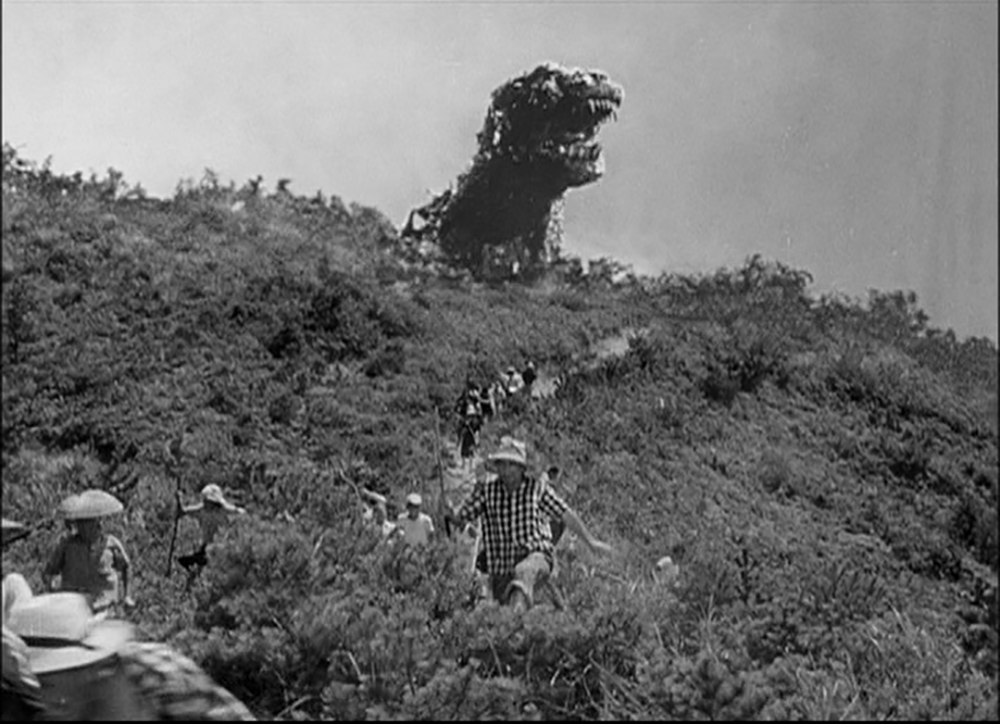
On a $175,000 USD budget, what Honda and the creative team behind this film accomplished was a marvel. The effect of the enormous Godzilla was the result of actor Haruo Nakajima wearing a 200 pound-plus rubber suit, while the sets were constructed of tiny buildings, bridges, and locations made to look as realistic as possible. The ‘thumping’ sound of Godzilla approaching is now iconic, an obvious inspiration or Steven Spielberg in “Jurassic Park.” And while we modernly see the monster’s radioactive fire-breath in full color, his colossal back plates glowing blue, here there’s something ominous about seeing it in black and white. From a technical standpoint, it hides the film’s primitive special effects, letting them work. But from the standpoint of watching “Godzilla” in the 21st century, I can’t imagine this film in color. It would lose its heart, doing our imagination’s work for us, losing much along the way.
A Cautionary Tale 70 Years Later
What makes “Godzilla” work, as worked for “King Kong,” (1933) is the monster doesn’t exist as a manifestation of evil, but a cautionary tale of the human condition. On one front, he represents the perpetual fear of the nuclear arms race, this film released only nine years after the atomic bombs dropped by the United States. Watching the politicking that obfuscated much of this tragedy in Nolan’s “Oppenheimer” shows the humdrum of the back-office machinations that led to Japan’s atomic bombing. But, for me, it wasn’t until the film “True Mothers”— viewed as part of the 2021 ‘Reel Love Film Fest’—that I saw present-day Hiroshima. Its modern beauty made that 1945 tragedy somehow more doleful… and for the first time, real. Watching “Godzilla” in 2023—maybe it was hydrogen bombs that gave him life. Maybe I was watching that atomic devastation for the first time, unfolding in real time, as the monster trekked and burned across Japan.
Like “Oppenheimer,” “Godzilla” contains lots of chatter, and often it’s easy to get lost in the process. The acting is sometimes thin and forced, and aside from its key players, most are cast aside. Shimura plays the part of the scientist who must object to the monster’s destruction to ‘study its powers,’ a cliche innumerable films have since repeated despite its lunacy. Aside him, his daughter, Emiko (Momoko Kôchi) has developed feelings for a solider (Akira Takarada), who of course wants the thing destroyed.
Emiko is in a love triangle of sorts; she’s been promised to a peculiar scientist (the aforementioned Dr. Serizawa), who has created a terrible device called the “Oxygen Destroyer.” Displaying it for Emiko, he demonstrates its ability to eradicate underwater life forms by draining the oxygen from their cells, erasing all but their skeletons.
A Classic that Holds Up Over Time
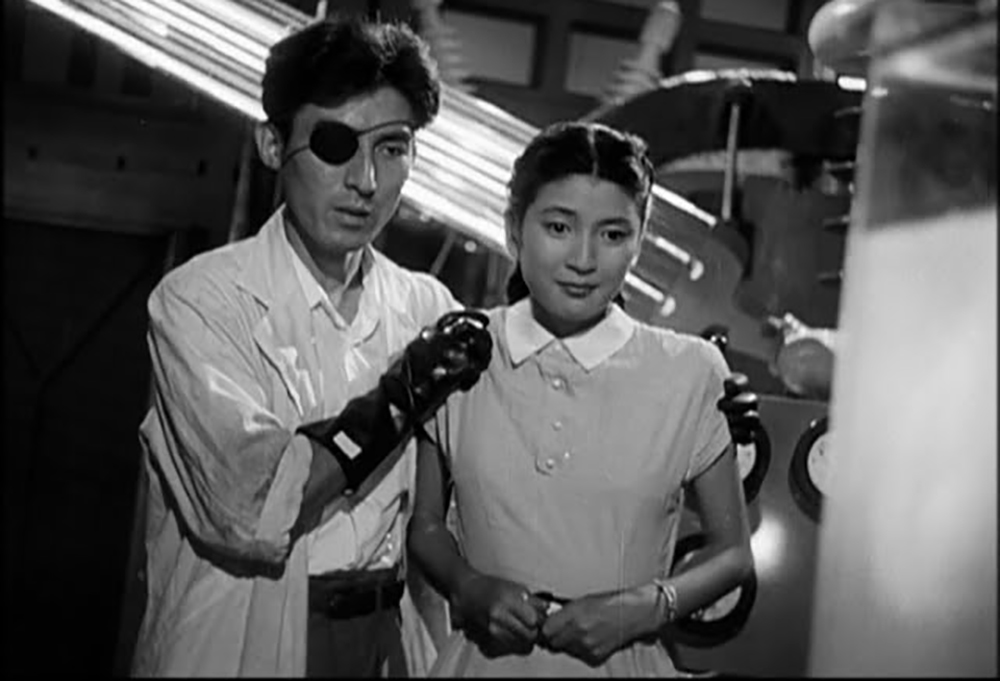
However, Serizawa doesn’t want to use the thing to kill Godzilla; in fact, he doesn’t want it used at all, until he can find a humanitarian usage. That he is forced, by the devastation caused by Godzilla, is portrayed as sorrowful duty. And even if Serizawa—with a patched eye and black, gloved hands—reminds one of the “Bond” franchise’s Dr. No., he’s anything but a mad scientist. He’s what Oppenheimer and company should have been. He represents an ideal, doubtful one real life would never proffer. He knows his device will ultimately fall into military hands, and takes unfalteringly brave steps to stop this tragedy from unfurling.
How do you rate a movie so removed from modern CGI and method acting? Renowned critic Roger Ebert called “Godzilla” ‘idiotic,’ giving it 1 and a half stars but citing its appropriateness for its time. But it’s better than that. This 1954 opener launched a phenomenon that yielded 33 sequels in the franchise (including “Godzilla Minus One”), not counting American spin-offs. That’s a legacy. What’s also a legacy is that Godzilla actor Haruo Nakajima donned the suit for an impressive 12 of them. But whatever “Godzilla” became, there’s no denying the cultural significance of its opener, nor the fact that—under it all—it’s still a pretty fun film to watch, especially given the legacy you can see unfolding.

“Godzilla” is currently available to watch on streaming. Note: for this review I watched the full Japanese version, streamed from HBO Max.
If you’re looking for more Godzilla-themed content, please peruse the following link, where I interviewed friend and local Godzilla aficionado Mike Ross on his Godzilla collection, 60 years of Godzilla, and more.

