


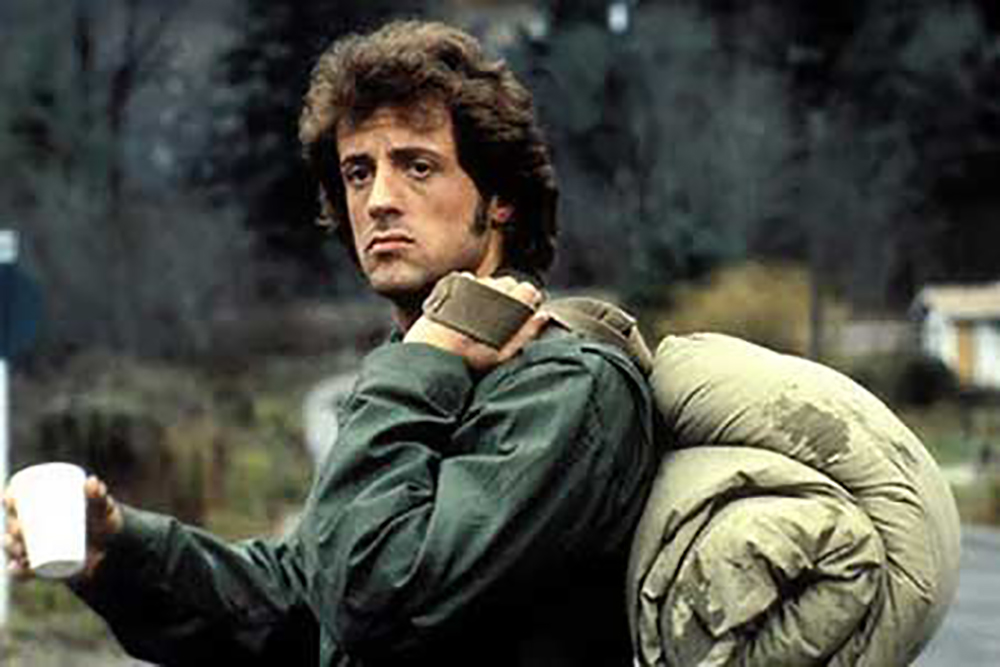
Today is Veterans Day. And with the times, things change. This is especially true of war movies. I guess you could argue ‘Rambo’ is not the first thing that comes to mind when thinking of war films. And given that the novel the character is based off of published in 1972—8 years before the American Psychiatric Association even recognized Post Traumatic Stress Disorder (PTSD) as a thing—its gentle highlighting of this condition may have been an accidental finding. But given that by the time we reach “Rambo III” John Rambo—under Sylvester Stallone—had reached Action God Status, it’s nice to rewind and appreciate the subtle and humane treatment of its subject underneath its exploding arrows and American nationalism.
Given this, “First Blood” parts 1 & 2, when taken together, may sew up the definitive war movie. Though Stallone, with his gruff demeanor and machismo persona—sweaty muscles and glistening military knives—can’t hide Rambo’s pain. It’s evident in his every glance (besides the ones where he’s grunting or killing people) and his every move. We see it in the films’ quieter moments, or the ones where Rambo is most frustrated. Rats chew at his extremities as he flees police in “First Blood;” Vietnamese soldiers gun down his new love in “Part 2.” And yes, there are points where the movies slip into absurdity (Rambo sews up his own wound with a suture needle pulled from his knife in “First Blood”), but for whatever reason, the notes of pain that line Rambo’s character are what I walk away from these two films remembering, not the bravado.
Rambo—Looking for a Country to Love Him Back
This is a much easier concept to appreciate looking solely at “First Blood,” directed by Todd Kotcheff. The poster, with Rambo holding an enormous gun, bullets wrapped around his muscular arms, is a misnomer. It’s meant, likely, to draw people to the Box Office, eager to stand behind Stallone. It has plenty of action, sure; but I can’t imagine many people relishing in this movie’s ferocity for sole entertainment. It features a loner (Stallone) who can’t catch a break in a small town. And it pits law enforcement against a former war veteran, not an action hero against a rabble of unknown enemies. Yes, the movie ambles on for too long, and its ending features too much gunfire. But underneath it lies a pain and torment that’s palpable.
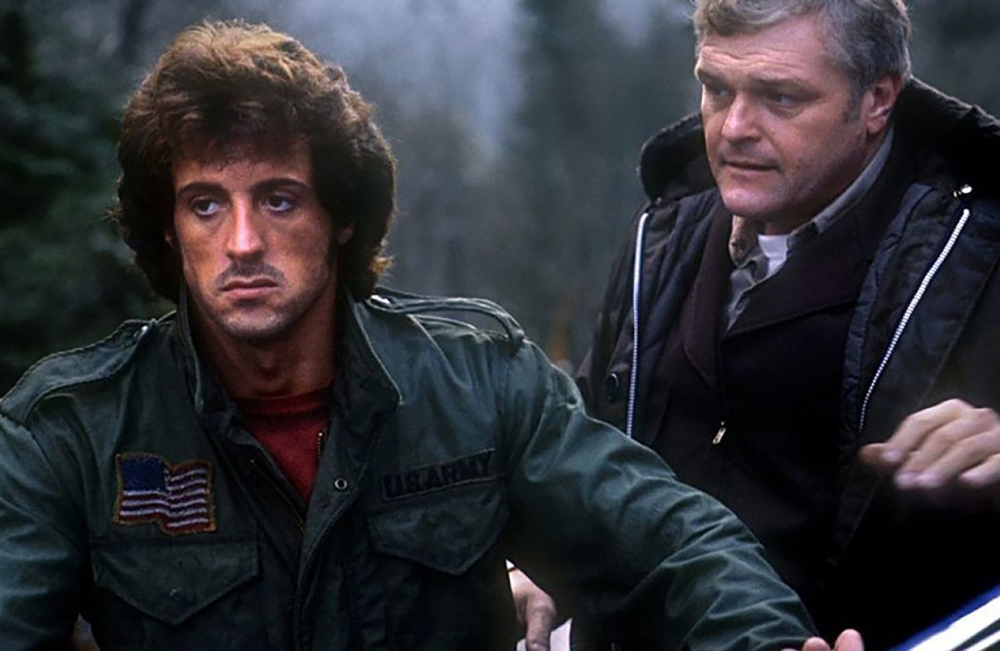
Renowned film critic Roger Ebert wrote of “First Blood” that we can’t buy this movie’s message. He also argued that the film handles its ending in “too heavy-handed a way.” His complaints were that the movie tells Rambo’s struggles instead of shows them, as was done in thought-better films like “Coming Home” and “Taxi Driver.” But I disagree for two reasons. (1) “First Blood” is arguably a more approachable film than those two and (2) Stallone’s (Rambo’s) pain is real. The ending of “First Blood” does not feel tacked on, but necessary. I wondered at the film’s beginning, as he’s wandering through the Pacific Northwest, why he does’t have a home. What happened to him? Call me a philistine, but I like that Kotcheff and Stallone take the time to do this. “Back there [in Vietnam]I was in charge of million dollar equipment. Back here, I can’t even hold down a job parking cars!” Rambo hurls at a mostly sympathetic Col. Trautman (Richard Crenna). We see the same sentiment in the end of “Part 2,” when Rambo laments that he just wants his country to love him as much he loves it.
‘First Blood’ Makes Us Rethink Post-War Treatment of Veterans
And of course there’s an element to the beginning of “First Blood” that feels oddly (or maybe necessarily) foreign. As Rambo is walking into the small town, named ironically ‘Hope,’ and is getting hassled by Sheriff Teasley (the late Brian Dennehy)—who seems to unequivocally hate Rambo—I had to ask myself, why? But of course this is a time I wasn’t part of and don’t understand. I was born in 1979 and the Vietnam War ended in ’73. But it’s no secret that the soldiers returning home from Vietnam were not treated well. First, they were soldiers of a lost war; second, they were soldiers of an unpopular war. There were no parades for Vietnam Vets; there were only insults, curses, and spitting. And this was on top of issues with benefits owed Veterans from their government that were never received.
Also Read: Review: ‘Barbarian,’ Zach Cragger’s Horror/Thriller, is an Unpredictable and Humorously Dark Ride
So watching this unravel on-screen—even in 2022—is a sight. It’s good to have context, as we got in Aaron Sorkin’s 2020 drama “The Trial of the Chicago 7,” which, as much as it is an anti-war film, is not anti-Veteran. And there are some quieter moments in “First Blood,” such as a drink at a bar between Trautman and Teasley, where both lament their behavior. We know Teasley does, for just a minute, when he thinks National Guard has killed Rambo. We’re less sure Trautman does. He trained Rambo, who then went off and fought his war and came back homeless and wracked with PTSD. “First Blood” is easier on him than maybe it ought have been. However, at the end, watching Rambo collapse into a pile of tears and anger and rage… maybe then he finally gets it too.
John Rambo—a Post-War Portrait that Slipped Through the Cracks
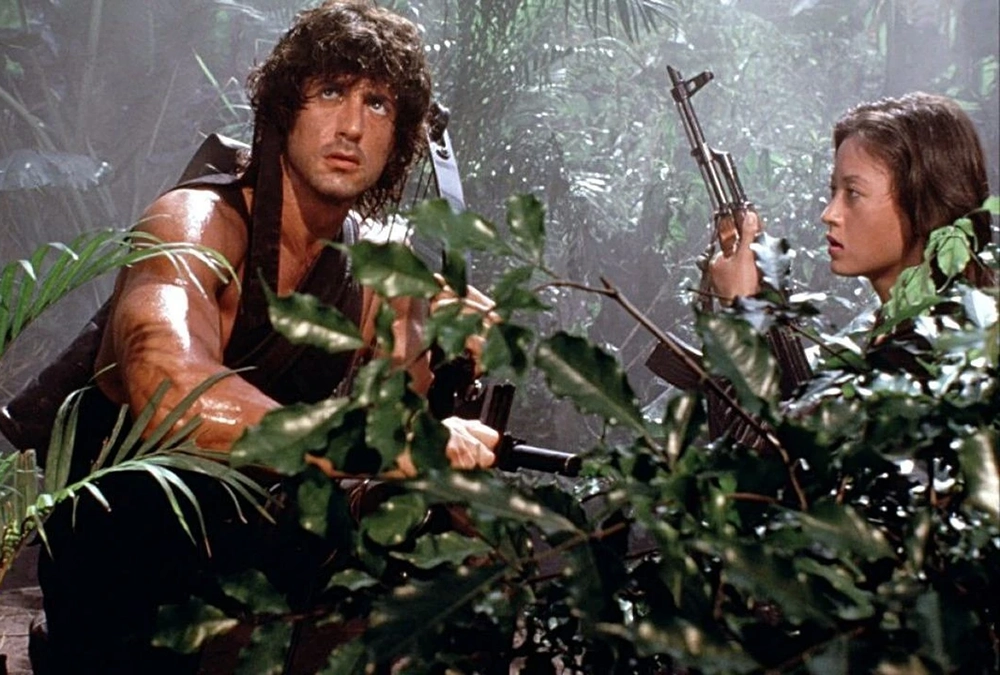
Admittedly, “First Blood” is a better movie than it ought have been. And maybe had the studio stopped at one, it would have been remembered for what it is: a sad, tragic tale of an American war hero, and not the prop for machine guns and American exceptionalism that it would become. The quieter moments of the series are its best and most exceptional. There’s a cold chill that runs through Rambo when he talks of his lost comrades and lost life. There’s a colder chill as he reminisces to Trautman about how he and his fellow soldiers would joke about a life they would have once they got home—a dream of a life that the War took for them and their country resented them for.
Rambo, as presented in “First Blood” 1 & 2 is an emblem for a past time and place. His pain is real, and his battle scars are deep, not superficial. And as we move on as a society—as yellow ribbons and “Support Our Troops” stickers adorn cars—Rambo is perhaps a symbol to remember who we once were. Not Rambo, with an M60 and bullet rounds strapped around his arm, but John Rambo, with shaggy hair, jeans, and an American flag patched on an overcoat walking resignedly into town just looking for something to eat. Modern war movies, such as “American Sniper” and “The Hurt Locker” examine soldiers whose lives were changed so profoundly by war that they couldn’t re-enter society. But perhaps “Rambo,” shrouded by machismo, guns, and explosions—in its stiller moments—painted one of the most tender portraits of Veteran hardship that cinema saw in the ‘80s. That it, and Rambo, slipped through the cracks may have been the biggest regret. Or maybe i’m just a Stallone fan. It’s one of life’s great mysteries.
Support the Site: Consider becoming a sponsor to unlock exclusive, member-only content and help support The Movie Buff!
