

Close Menu
    Facebook X (Twitter) Instagram
    Friday, June 5
    Facebook X (Twitter) Instagram Bluesky
    The Movie Buff
    • Home
    • About
      • Critics
      • Press & Testimonials
      • Friends of the Buff
      • Terms of Use
      • Thank You!
    • Film Reviews & Coverage
      • Movie Reviews
      • TV/Streaming Reviews
      • Film Festival Coverage
      • Interviews
    • Podcasts
    • Indie Film
      • Reviews & Articles
    • Advertise
    • Contact
      • Write for us
    The Movie Buff
    Feature Article

    ‘Gone Girl:’ A Commentary on the Role of Media in the Postmodern Society

    Abirbhab MaitraBy Abirbhab MaitraMarch 24, 2022No Comments4 Mins Read
    Facebook Twitter Pinterest LinkedIn Tumblr Email Copy Link
    Gone Girl
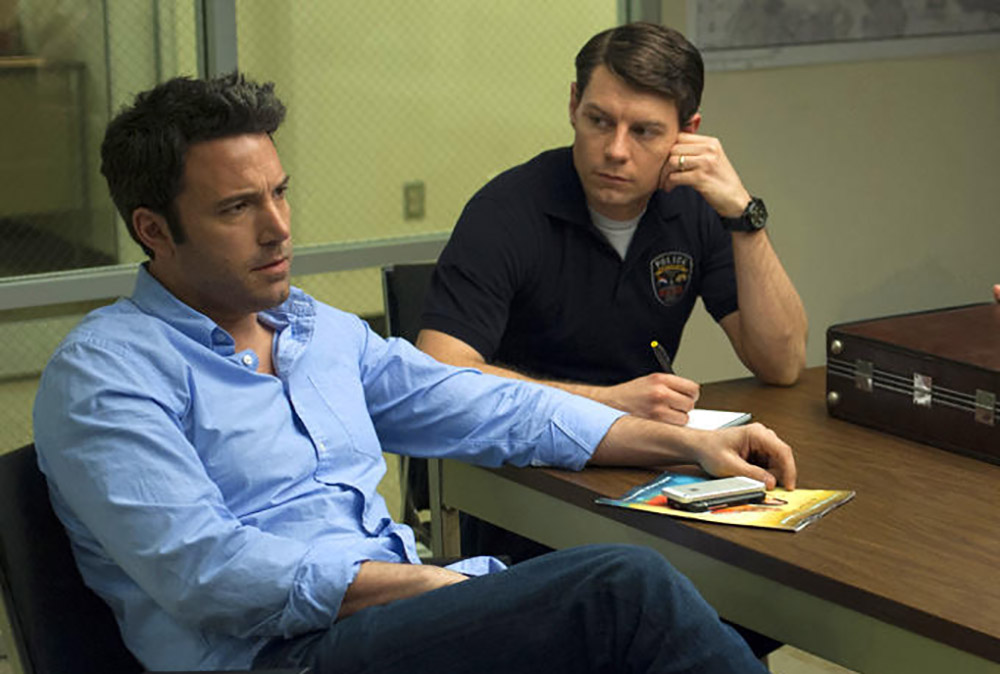
    Ben Affleck in "Gone Girl." (Photo: Twentieth Century Fox).
    Share
    Facebook Twitter Email Copy Link

    Films have the unique power of capturing different perspectives and events about our surroundings. They can speak about various contemporary world issues, critiquing and raising important questions. Often they talk about them on the surface. But few capable filmmakers can subtly drive these events and perspectives that become invisible under cover of their content. David Fincher’s 2014 film “Gone Girl” is a film just like that. It is a neo-noir mystery/thriller on a surface level, but it talks about many things on a subtextual level.  

    In the beginning, the film convinces us to believe it as a whodunit or whydunit thriller portraying Nick Dunne’s (Ben Affleck’s) events. He becomes the prime suspect in the mysterious disappearance of his wife, Amy (Rosamund Pike). But as the story progresses, it becomes clear that it’s not only about giving the answers surrounding a typical thriller’s whodunit or whydunit questions; instead, it is keener to search for answers in an undertone way, asking far more tricky and complex questions of our present-day world. 

    A Representation of a Postmodern World

    As we live in a postmodernist society where people interpret reality based on their perspective, everything and anything can be the truth here. “Gone Girl” is a beautiful representation of this postmodern world with media representation within the film. The media plays a pivotal role in our daily lives. And in postmodern society, they’re the key proponents to make people believe their preferred perspectives rather than showing the truth. Here they blur the line between the truth and the speculation, creating the space for subjective truths.  

    In the beginning, when a press conference was organized for seeking help for Amy (disappeared girl), Nick was called by the media to take a picture standing beside his wife’s missing poster with a smile. But later, that smile was interpreted as his apathy towards his wife, and he was labelled a sociopath. Also, this story became a national sensation, and Nick was declared the murderer in the media when the investigation was still ongoing. It grabbed the people’s sympathy towards the victim, Amy, and hatred towards Nick. Seeking the truth became unimportant here, and the speculations led to a witch-hunt.

    Seeking Publicity Instead of Truth

    This reminds me of the recent suicide of a famous Indian actor; in this case, the media highly publicized it only to capitalize on the people’s sympathy. Instead of asking valid questions about the incident and focusing on other important issues, they identified and witch-hunted soft targets. They make the people believe what they want them to believe. It’s often feels like they give the people a blue pill to stay in the Matrix. 

    Gone Girl
    Nick Dunne (Ben Affleck) finds himself in the midst of a media circus after his wife (Rosamund Pike) disappears. (Photo: Twentieth Century Fox).

    But the vice versa is also beautifully portrayed as how a little manipulation can divert the whole narrative. Nick shifted his entire image as a murderer, professing his innocence and apologizing for his failures as a husband in a talk show. He admitted his infidelity and made an image of a guilt-ridden husband. With this, the whole narrative of Nick, the murderer, started to meltdown. And at the end, when it came to be known that he was innocent and his wife returned to him, the media acquitted him and sympathized with him like hypocrites. 

    The Art of Exploitation; Media’s Role

    In the end, Nick asked one of the journalists why she misled people with all these absurd stories around him. The journalist answered, “I go where the story goes.” That portrays the mentality of the media personalities around any occurring incidents. It is not vital for them to find out what happened, but exploit it as an opportunity for their benefit. In the end, they give the audience a perfect ending: Amy and Nick together and news of their expected child. The past witch-hunts seem irrelevant at this point. All they want is to show a happy ending to this postmodern mystery. 

    “Gone Girl” is a detailed and nuanced study of postmodern society. And the representation of media is just a tool to showcase the mentality of the people living in it, where individual subjective reality overpowers the rational objectivity of truth, blurring the line between what is real and what is not.       

    Ben Affleck David Fincher disappearance Gone Girl media missing person postmodern Rosamund Pike
    Share. Facebook Twitter Pinterest LinkedIn Tumblr Email
    Previous ArticleReview: ‘Wings of Hope’ the Most Unbelievable Documentary You Will Ever Watch
    Next Article Review: ‘The Outfit’ Old School Gangster Style with Noir Feel
    Abirbhab Maitra
    • Facebook

    Abirbhab Maitra is a lover of films and loves to write about them. Abirbhab endeavors to analyze films for their effect, and is open to any kind of healthy discussion on films. In addition, he is also an aspiring writer.

    Related Posts

    Independent June 4, 2026

    ‘Meadowlarks’ imagineNATIVE 2026 Review: A Reunion With One Chair Still Empty

    Drama June 3, 2026

    ‘The Currents’ Review: Taking the Plunge

    Bollywood June 3, 2026

    Review: Sarthak Dasgupta’s Long-lost ‘The Last Tenant’ — Starring Irrfan Khan — Now on YouTube

    Dark Comedy June 2, 2026

    ‘Send Help’ Review: A Bizarre Mishmash of Genres and Poor Writing Sink the Island Thriller

    Feature Article May 30, 2026

    ‘Midnight Girls’ and the Filipino Cost of Surviving Away From Home

    Drama May 28, 2026

    ‘Forastera’ Review: Grief Wears a Familiar Face

    Leave A Reply Cancel Reply

    Latest Posts

    Tribeca 2026 Review: ‘The Tropic Sun and His Eyes’ Examines What Men Pass Down, and What They Can Still Repair

    By Paul Emmanuel EnicolaJune 5, 20260

    ‘Because of You: A History of Kilawin Kolektibo’ is a Proud, Filipina LGBTQ Slice of Belonging

    By Mark ZiobroJune 5, 20260

    ‘Meadowlarks’ imagineNATIVE 2026 Review: A Reunion With One Chair Still Empty

    By Paul Emmanuel EnicolaJune 4, 20260

    ‘The Currents’ Review: Taking the Plunge

    By Kevin ParksJune 3, 20260
    • Facebook
    • Twitter
    • Instagram
    • YouTube
    Bollywood
    Bollywood

    Review: Sarthak Dasgupta’s Long-lost ‘The Last Tenant’ — Starring Irrfan Khan — Now on YouTube

    By Vidal DcostaJune 3, 20260

    Sagar (Irrfan Khan), an ambitious musician rents a quaint cottage while awaiting his acceptance letter…

    ‘Laal Kaptaan’ Review: This Cult Classic Chronicles an Ascetic’s Revenge in Colonial India

    By Vidal DcostaMay 31, 20260

    ‘Kartavya’ Review: A Grim Slow-burn that Depicts the Rapid Decline of Humanity

    By Vidal DcostaMay 24, 20260

    Halfway to Halloween: ‘Shaapit’ and the Curse of Two Backstories

    By Vidal DcostaApril 27, 20260

    Halfway to Halloween: ‘Lekin…,’ a Time-Spanning Tale About Crossing Over to the Other Side

    By Vidal DcostaApril 22, 20260
    Spotlight on Classic Film

    ‘The Innocents’ Review: One of the First Haunted House Films of the Modern Horror Era

    ‘Gone With the Wind’ Review: Epic Film from the Golden Age of Hollywood

    ‘The Count of Monte Cristo’ QCinema 2024 Review: A Thoughtful, If Rushed, Study of Revenge and Redemption

    ‘Thirteen Women’ Review: A Precursor of the Slasher Genre, with a Devilishly Divine Femme Fatale at its Helm

    The Movie Buff is a multimedia platform devoted to covering all forms of entertainment. From Hollywood Blockbusters to Classic Comfort faves. Broadcast Television, on-demand streaming, bingeworthy series'; We're the most versatile source.

    The Movie Buff is also the leading supporter of Indie film, covering all genres and budgets from around the globe.

    Facebook X (Twitter) Instagram YouTube LinkedIn TikTok
    Copyright @2011-2026 by The Movie Buff | Stock Photos provided by our partner Depositphotos

    Type above and press Enter to search. Press Esc to cancel.