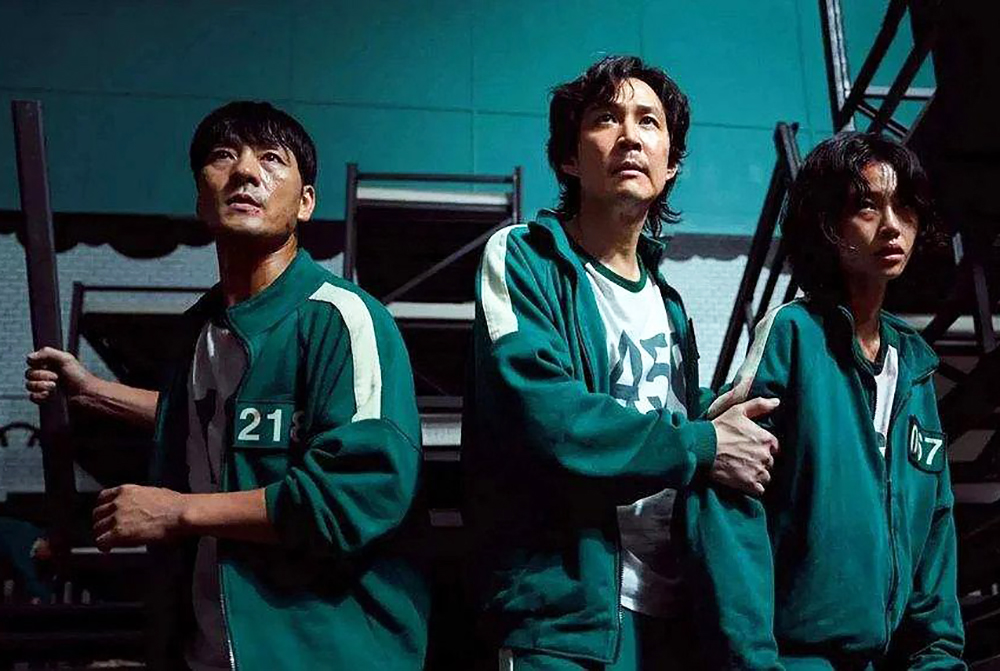
Netflix’s “Squid Game” is tantalizing. If Bong Joon-ho opened the doors for South Korean class struggle cinema to gain worldwide appeal with “Parasite,” Hwang Dong-hyuk’s “Squid Game” capitalizes on that fervor with a nine-episode tale that hits deep. With its bold yet childlike sets—and its often over-the-top sequences—the series ran the risk of being too kitschy to make an impact. However, with a stellar cast, and episodes that become more harrowing as the series progresses, “Squid Game” leaves a mark. The show takes a group of luckless contestants participating in a deadly game and makes you connect to them. You’ll love some and hate others, but that’s the point. Dong-hyuk has created a world you quickly feel part of, even if it leaves chills in your spine.
“Squid Game” involves participants taking part in a deadly game. They participate in children’s games (red light, green light and tug-of-war some of the early ones) with a catch—if they lose, they die. If they win, a handsome cash-money award prize awaits. Each of the contestants is extremely cash-strapped if not outright poor. Even if their own negligent decisions have made them this way, in early episodes we feel their poverty singularly and as something we can grasp. These peoples lives hurt. But what separates “Squid Game” from more stark dystopian films/series like “The Hunger Games” or “Battle Royale” is the participants are voluntary. A majority vote can end the games at any time; but since life is possibly worse on the outside, many choose not to.
“Squid Game’s” early episodes take pains to paint the lives of these people, and Seoul, South Korea, in abstract colors. Our de facto hero of this series is an impoverished divorcé named Seong Gi-hun, played to perfection by actor Lee Jung-jae. Like most of “Squid Game’s” players, he’s poor due to bad choices. He has a daughter and an ex-wife he is estranged from after accruing massive gambling debt, though his daughter loves him very much. His mother is ailing. Loan sharks are after his kidneys if he doesn’t pay them back. Things look bleak until he is invited to the sinister game by a broker in a subway. Except he doesn’t know it’s sinister; not until things progress. Not until red light, green light.
What works about “Squid Game” is the head-first way it inserts you into its game. The 456 players wake in a sanitary room, tucked in beds and all wearing track suits denoting their number. Gi-hun quickly meets an elderly man named Oh Il-nam (Oh Yeong-su) who is number 001, whom he bonds with. Other players include a pickpocket (Jung Hoyeon), a thug (Heo Sung-tae), a man named Ali (Anupam Tripathi) and a friend Gi-hun had on the outside, Cho Sang-woo, played coldly by Park Hae-soo. Like “The Hunger Games,” “Squid Game” will pit these men and women against each other coldly, even though the real enemy is the host(s) of the games. Or is it greed and avarice? The series is slow to pick apart at each contestant’s responsibility for their own lives, and does so excellently.

The games themselves present oddly, doubtless to cause an emotional disconnect with the audience. While the first game of red light, green light is cast in a room of childish clouds and a large doll turning her head, things soon take a bleak turn when players caught moving after the cue are gunned down. Half the players lose their lives in this first game, setting a tone for things to come. While the opening massacre doesn’t hit as macabre as it should, the events get more and more depraved as we become more connected to the characters. Episode 2, “Hell” presents an introspective look into the contestants bleak lives and why they choose to play, while a later episode, “Gganbu” is dark and deadly; it’s one of the saddest TV episodes I’ve seen in quite some time.
The acting is what makes the show, and wouldn’t have worked without its stellar cast. As Gi-hun, Lee Jung-jae is excellent. Equal parts shy and reserved yet built of stronger stuff, he is the moral voice of the group. Early connections with his daughter are sweet, and it’s truly awful when he struggles to rebuild their relationship. His connection with Il-nam and others forms the meat of the series; as such, a later episode where he struggles with a moral dilemma will break your heart.
The rest of the cast is apt. The strongest players here are Jung Hoyeon, who starts off abrasive but ends up warming our hearts, Heo Sung-tae who plays the thug Deok-su we never really stop despising, and Park Hae-soo, who plays Gi-hun’s old friend Sang-woo who we initially like, but becomes creepier as time goes by. The cast must show their complexities while also keeping the series entertaining, which they do easily. Tense moments are as tense as they are due to their acting and forced camaraderie. Amongst the cast are game-runners wearing red and a fencing mask with a shape drawn upon it; they add an eery feeling to the proceedings with their deadpan nothingness. They are led by a man named ‘Frontman’ (Tom Choi/Lee Byung-hun) who invokes fear through his sheer force.

However, “Squid Game’s” greatest accomplishment is not in the games (which, unlike “Saw,” despair and torture are not the point of), but in the stark picture of poverty and personal responsibility it ushers in. It’s also a credit to Dong-hyuk’s writing that the series’ final episode, following its winner(s) is not roses and sunshine. 45 billion won has been taken ($38M USD), but the closing episodes show tremendous guilt and depression. The only criticism I have is the final episode includes some answers, but more mystery than I would have liked. Additionally, the addition of a police detective who sneaks into the games looking for his lost brother (Wi Ha-Joon) leaves more questions than answers. However, as “Squid Game” has announced a second season, it’s forgivable. It sets up a plot for a second season that has as much believability as possible for its dynamic plot-lines.
All-in-all, “Squid Game” is a must-watch. It’s harrowing, dark, introspective, and well-acted. It takes a group of characters you know nothing about and makes you care for them. Its set-pieces are eery and foreboding, and the show carries you along with it and you often can’t stop watching. Some easy answers bring down the show’s finale slightly, but overall Dong-hyuk has created a powerful horror/class struggle that will have you wanting more while still making you think; which is, I suppose, what all good shows should ultimately aim for.
“Squid Game” is currently available to watch on Netflix via subscription.