Makoto Shinkai’s “5 Centimeters Per Second” (2007) is a refreshing take on the romance genre that disassembles the standard sanguine love story. In many ways, “5 Centimeters Per Second” is a clear precursor to Shinkai’s acclaimed “Your Name” (2017); however it is also the antithesis of that film in terms of its outlook. Here, Shinkai uses realism to give a pragmatic and almost cynical account of love in the real world. The film is composed of three short chapters that each act as a snapshot of a certain point in the life of protagonist Takaki Tohno (Kenji Mizuhashi). Together, the story follows Takaki as he deals with becoming increasingly estranged from his old flame Akari (Yoshimi Kondou as young Akari, Ayaka Onoue as adult Akari) as two grow and their paths diverge.
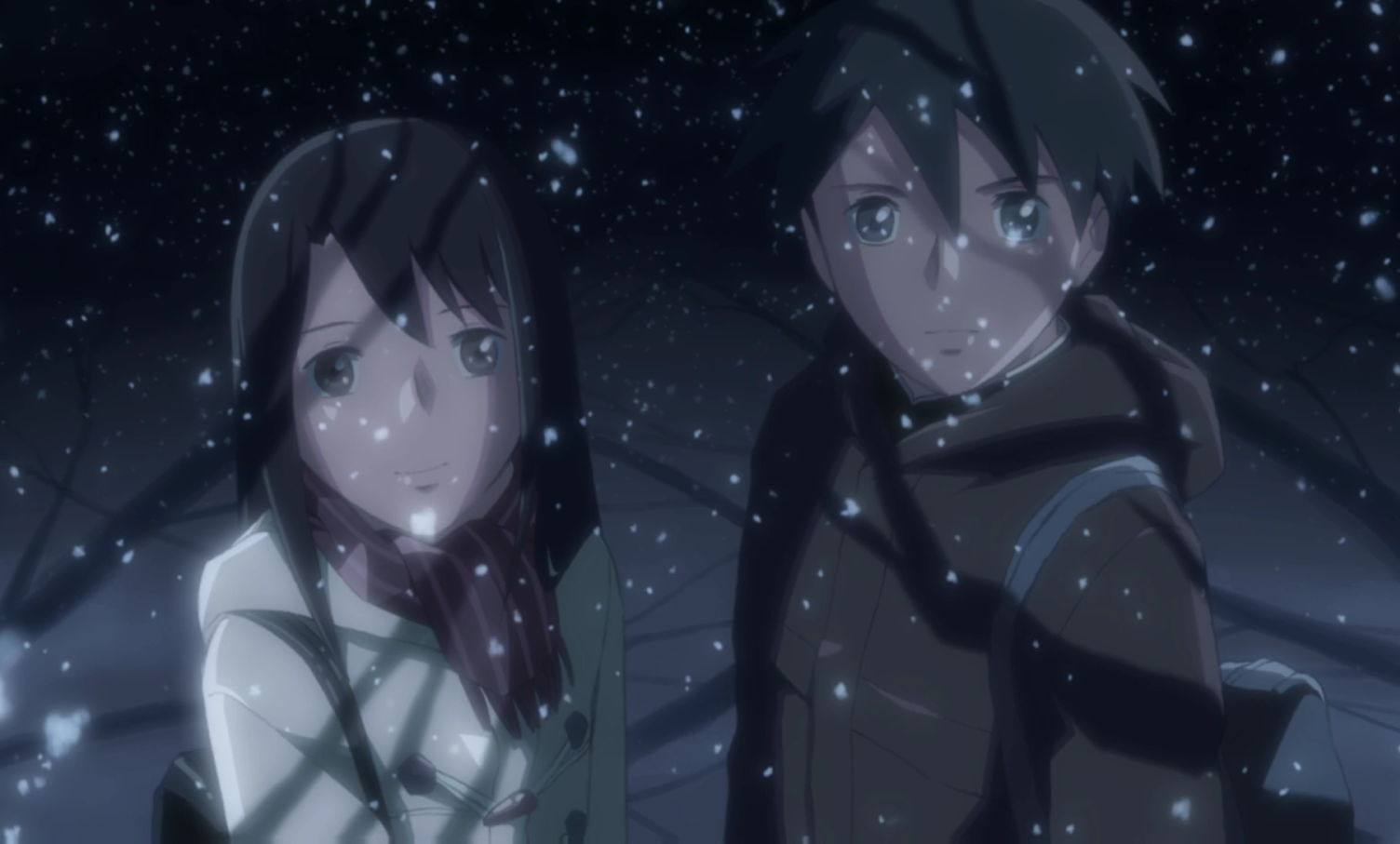
The first chapter is titled “The Cherry Blossom Blooms” and is certainly the most hopeful of the three. After Akari transfers to Takaki’s elementary school in Tokyo, the two befriend one another and quickly become an inseparable pair. Once the two have graduated, the geographical distance between them becomes a hurdle in their relationship though they manage to maintain contact by sending letters to each other. However, once Takaki learns of his family’s impending move to the other side of the country, it becomes clear that the two will soon be unable to visit each other. They arrange one last rendezvous before this happens, though a string of misfortune threatens to make Takaki miss their meeting.
This segment is filled with a naïve and optimistic energy that becomes infectious. This is achieved largely through Takaki’s voiceovers, which convey a pure and young love that is hard not get invested in—his desperation to get to Akari in time is palpable. The clean animation makes the environment both pretty and immersive. The heavy and sombre snowfall getting in the way of Takaki’s journey becomes a beautiful backdrop when the two finally reunite. You can feel the icy winds that snatch away Takaki’s handwritten love letter and the cosiness as the pair sit in front of a fire. All the while, the saccharine score (composed by Tenmon) plays softly in the background. Together, this all deludes the audience into seeing this as a classic romance plot, in which the love between the pair will somehow still triumph.
In the second chapter, titled “Cosmonaut,” we are reintroduced to Takaki as a slightly more weathered high school student. Takaki is no longer the main narrator as we follow another student named Kanae, who’s feelings for Takaki place her in a love triangle against another girl who isn’t even present. As we are shut out from Takaki’s narration for most of this chapter, we are left to wonder for ourselves just what he is thinking, just as Kanae does. Though, the dramatic irony here means that the audience understand that her efforts will be in vain and that Takaki’s heart clearly still belongs to Akari. Kanae is forced to face this when the courage she has summoned to reveal her feelings disintegrates as she accepts that Takaki will always be looking elsewhere.
The star-studded night sky is a focus in this chapter and while giving the visuals another chance to shine, it is also key to the theme of this segment. It’s a lonely sky but it is still what connects everyone. Takaki often stares into the night as if wondering what Akari is doing somewhere under the same stars. The idea of exploring space in search of something vague or even unknown in the distance is also used and compared to the search for love. Though ironically, both Takaki and Kanae’s searches have left them unfulfilled, two members in a triad of love gone to waste.
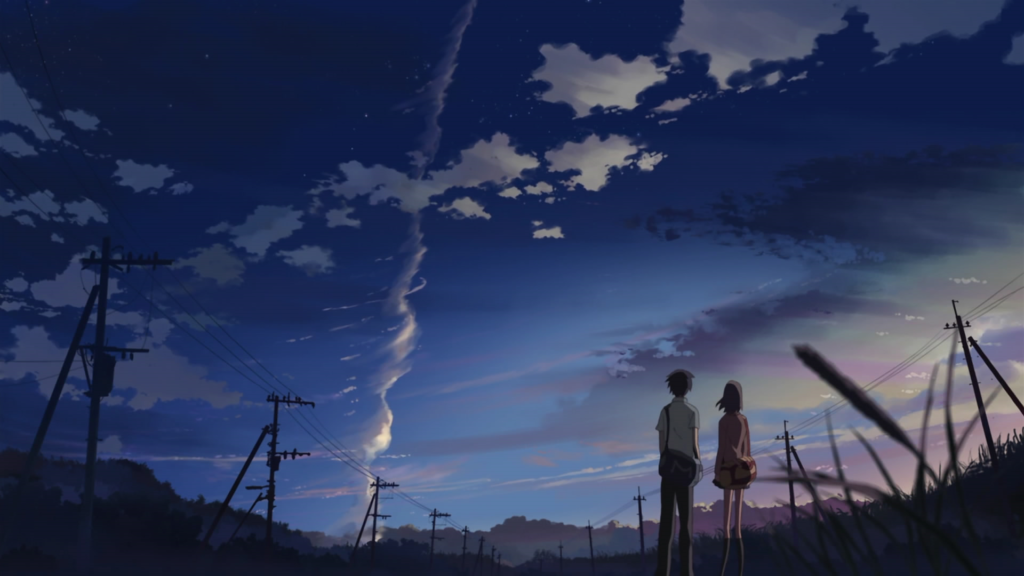
“5 Centimeters per Second” is the titular final chapter of the film is also the most compact. Set in the adult years of Takaki’s life, this segment swaps the natural environments of the first two for the dense streets of Tokyo. Locations such as a train crossing encased in cherry trees are so well-rendered, down to the steepness of the terrain, that they feel like places you’d recognise if you saw their real-life inspirations. The city is alive and packed with crowds and towering buildings but there is a bigger sense of loneliness and isolation than ever.
When we see Akari again, she is engaged to another man and has long moved on from her youthful romance with Takaki. Although she still reminisces about this past, it is little more than a fond memory. Meanwhile, Takaki has still not been able to make the same progress and has not let go. Holding on has left him with a romantic infirmity. We see that Takaki has remained distant and indifferent, even in his new relationships, carrying his unfulfillment with him and spreading it onto those who try to get close to him. Chasing his romanticised love story has left him bitter and permanently dissatisfied.
In a climactic montage to “One More Time, One More Chance” (performed by Masayoshi Yamazaki), Takaki appears to almost always be looking for Akari everywhere he goes, double-taking passers-by and scanning crowds. At the same time, Akari casually goes about her life. This hammers home the disconnect between the two and builds to a bittersweet final scene that upends the romantic climax we’ve been programmed to expect. It is both subtle and tragic but somehow also cathartic. The real question is whether the journey to get there feels worth it in the end.
A notable weakness of the film is in the lack of depth in its story. Even in its 1-hour runtime, there are points that feel thin and padded out, especially during the second chapter. This shouldn’t be the case for a feature already this short. Beyond the themes of the film, there is not much to propel it forward or to retain interest.
The approach used to tell the story also means that there isn’t much opportunity for the three central characters to become truly memorable. The bland character designs also don’t do much help with this either. Whilst in the case of Akari, this works in the favour of the story (as she becomes as much a stranger to us as she does to Takaki), neither Takaki nor Kanae are well-rounded by the film’s end. Even with Takaki’s compellingly bleak arc, the character doesn’t quite feel multi-layered and doesn’t hint at having any identity beyond what Shinkai’s themes require.
The subversive sentiments of “5 Centimeters Per Second” cement the film as a maverick in its genre. The pessimistic depiction of love and vibrant visuals are its biggest triumphs and although other aspects such as the story and characterisation fall short, this is a worthy entry in Shinkai’s filmography.