Based on a 1980s Japanese short story, Lee Chang-dong’s “Burning” (2018) starts as a slow-spreading ember but blazes into a wildfire the moment you look away. This hypnotic and multi-layered thriller offers no easy answers and will have you questioning everything long after the credits roll.
“Burning” fuels itself by providing the audience with all the breadcrumbs and potential clues they may need to come to an understanding of the plot and characters, without ever offering any definitive answers. This is all achieved through director Lee Chang-dong’s meticulous control over exactly when and how each piece of information is conveyed. Everything—from seemingly throwaway lines of dialogue to apparently inconsequential details—all feel so deliberate. More perplexing is just how multifaceted each of the lead trinity of characters are.
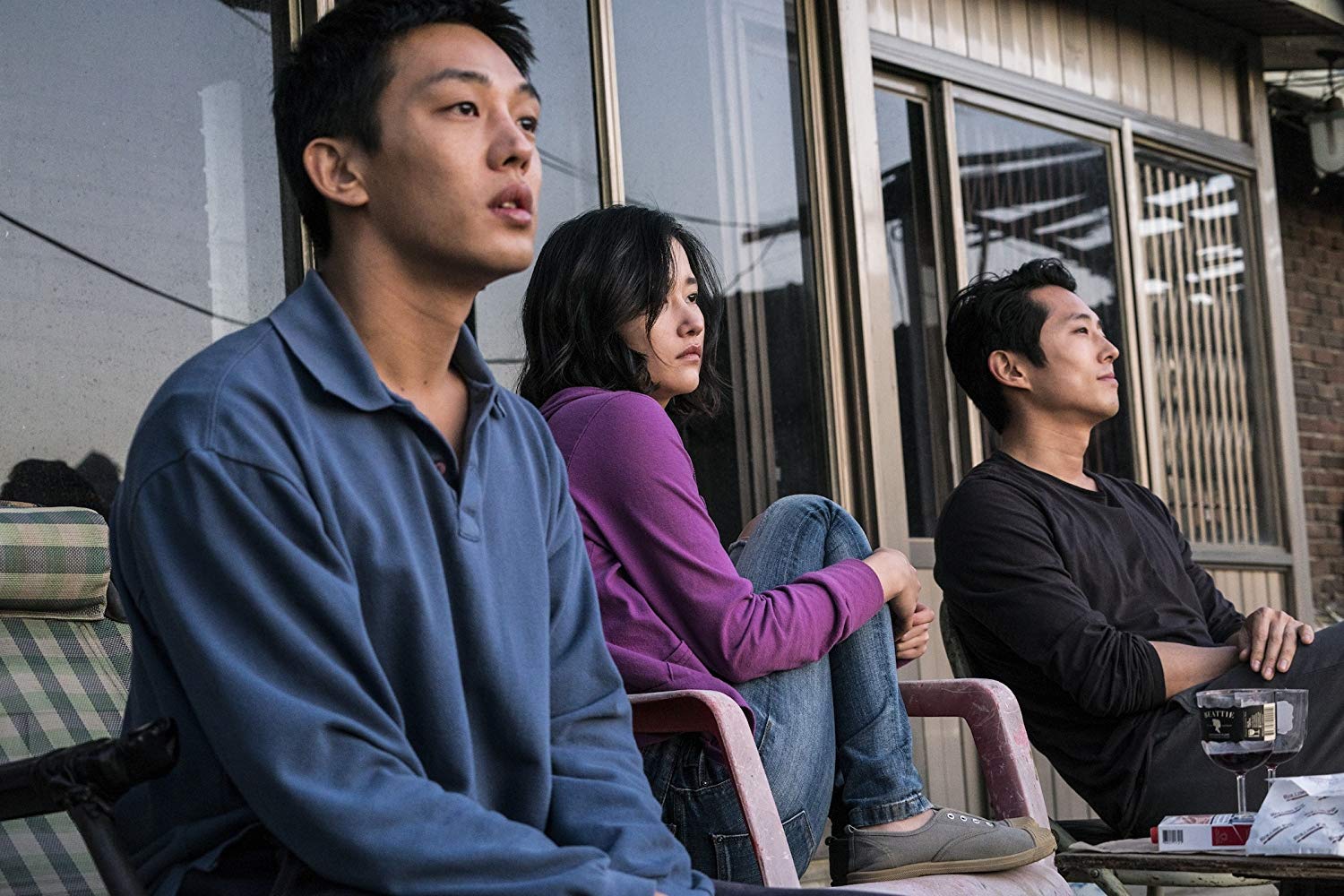
In a chance encounter, protagonist Jong-su (played by Ah-in Yoo) runs into childhood acquaintance, Shin Hae-mi (Jong-seo Jun). Despite apparently never paying Hae-mi much attention back then, Jong-su now becomes besotted and is caught in a tense love-triangle along with eerily cool and enigmatic newcomer Ben (Steven Yeun), who Hae-mi meets on self-discovery trip to Africa. On the surface, this may be a very recognisable story with very recognisable archetypes—however Lee Chang-dong’s complex characterisation subverts this into a much more twisted tale with less conventional dynamics. The root of all this is what all three lead characters have in common—an ennui that gives way questionable traits, which prevent the audience from rooting for any of them or trusting them as sources of information as this mystery unfolds.
The plot is largely propelled by conversations between these characters…but what is the audience to make of it all when all three are unreliable? Jong-su lives listlessly as an uninspired writer and appears somewhat hollow until his fiery passion for Hae-mi offers a chance to fill that void. Yet, Jong-su isn’t simply the underdog in a classic love-triangle. The character’s actions seem driven by a scathing obsession with Hae-mi that isn’t quite romanticised. Perhaps this is more of a lustful and possessive fixation that clouds the character’s perceptions and makes him difficult to trust unreservedly.
Meanwhile, the seemingly free-spirited and naïve Hae-mi desperately searches for ways to overcome her emptiness (or ‘Big Hunger’ as she refers to it) through ways such as learning to act. After revealing that the key to her acting is to simply forget the truth, it becomes harder and harder to tell just how much of the truth the character manipulates. Finally, Ben’s ennui comes from a very different place to the other two primary characters. He’s living as a Gatsby-esque playboy with excessive wealth and a life free of concern or consequence. The character is clearly detached from reality, even before the audience learn that Ben has the most unsettling way of filling his ‘Big Hunger.’

Over the 148-minute runtime, the film routinely throws the audience a new jigsaw piece every now and then; but because of the unreliability of any of the characters, you may not know what to do with them or where to place them. New information sheds a different light on things you may not have even thought were significant, making you second-guess your second guesses and sending you into the state of paranoia not unlike that experienced by the protagonist.
At the core of this discomforting story are brilliant performances from the entire cast, who manage to effectively convey different layers to their characters simultaneously, often granting the audience multiple interpretations of what they see and hear. Steven Yeun especially is a treat to watch, giving a haunting portrayal of Ben that steals every scene (much like the character who becomes the centre of attention in any space he occupies). Introduced abruptly and out of nowhere almost 40 minutes into the film, Ben is thrown in as an alien interloper, causing a complete tonal shift. The character’s intoxicating presence injects the rest of the film with a constant sense of dread that can be felt even when he is physically absent from a scene. Steven Yeun’s sinister smile is both disarmingly charming and menacing. He is even able to elicit buckets of unease and intrigue with a simple chuckle or a yawn—it’s pure nightmare fuel.
On top of this is some top-notch tension building by director Lee Chang-dong, coupled with a maddening score by composer Mowg. The best example of this is during the third act, which features a slow-moving pursuit sequence between two characters that will have you holding your breath longer than even you knew you could. The film toys with your anxiety, lingering on the most uncomfortable moments and only moving on at its own pace. It’s an anxiety-inducing watch, even in repeat viewings—and believe me, repeat viewings will be necessary.
“Burning” is an unhinged and elaborate puzzle-box that leaves the audience with a lot to unpack. The subdued style of the film rewards the patient viewer, but the slow pace and lack of overt payoffs may not be for everyone. Much of this experience is retroactive…rethinking and digesting scenes rather than reacting to events as they happen. Though, it is this ambiguity that is key to “Burning” being a truly unique film and a masterful psychological thriller.