

Close Menu
    Facebook X (Twitter) Instagram
    Saturday, March 7
    Facebook X (Twitter) Instagram Bluesky
    The Movie Buff
    • Home
    • About
      • Critics
      • Press & Testimonials
      • Friends of the Buff
      • Terms of Use
      • Thank You!
    • Film Reviews & Coverage
      • Movie Reviews
      • TV/Streaming Reviews
      • Film Festival Coverage
      • Interviews
    • Podcasts
    • Indie Film
      • Reviews & Articles
    • Advertise
    • Contact
      • Write for us
    The Movie Buff
    Drama

    Eastwood Questions Familial Love and Racist Intolerance in the Excellent ‘Gran Torino’

    Mark ZiobroBy Mark ZiobroMay 10, 2018No Comments5 Mins Read
    Facebook Twitter Pinterest LinkedIn Tumblr Email Copy Link
    Gran Torino
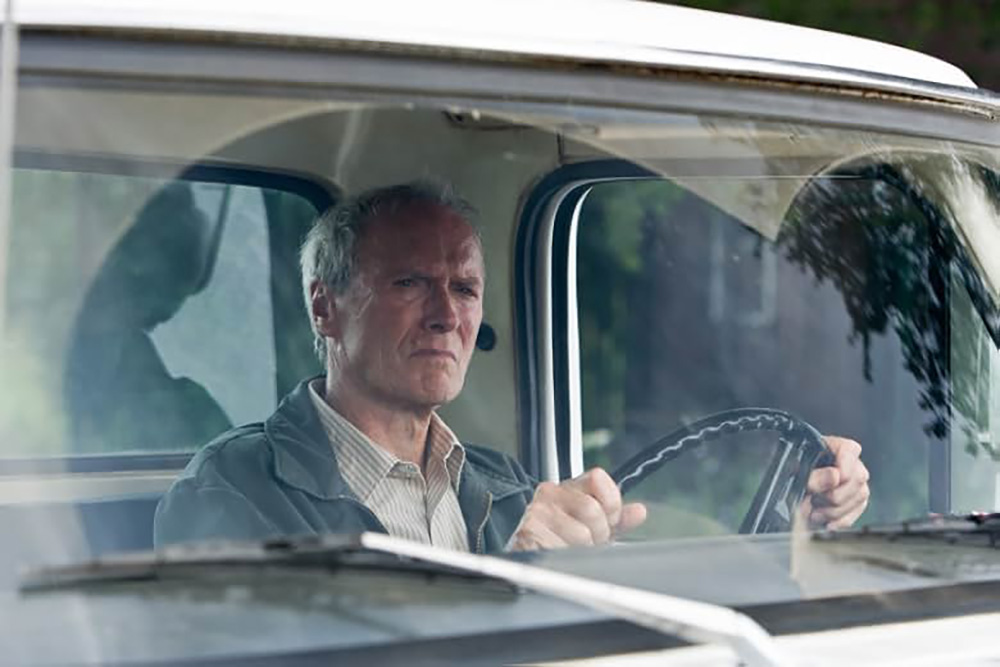
    Clint Eastwood in "Gran Torino." (Photo: Warner Bros. Entertainment Inc., 2008).
    Share
    Facebook Twitter Email Copy Link

    At the opening of “Gran Torino” we see a stone-faced Walt Kowalski (Clint Eastwood) standing alone at the front of a church at his wife’s funeral. There’s no emotion in his eyes; he’s more concerned with his grandkids’ lack of proper mass attire than his wife’s passing. His demeanor continues to a reception at his house afterwards, where he scoffs at offers from his sons to help, while his granddaughter complains about the lack of service on her cell phone. A knock at the door, showing a young Hmong boy from next door inquiring if Walt has jumper cables solidifies his character: “Have some respect, zipperhead. We’re mourning here.” 

    “Gran Torino” is directed by Clint Eastwood in his first starring and directorial role since “Million Dollar Baby.” You’d be hard-pressed to believe at the film’s opening that by it’s conclusion you’d feel not only respect for Kowalski, but love, and that Eastwood would be able to take a practically irredeemable character and do just that. Of course, the whole effort is nuanced wonderfully, with performances, a script, a score, and a sharp focus that never wanes. ‘Dirty’ Harry Callahan may be Eastwood’s most iconic role… but Walt Kowalski may very well be his richest and best. 

    Kowalski is a Complex Character

    The film succeeds in its stellar character development and the way it compares Walt’s typical American family with that of the Hmong family next door. Walt hurls epithets at whoever will listen, and even some that won’t. He wishes the ‘gook’ family from next-door would just up and leave. But we see the elder mother of the Hmong tribe utter similar wishes of Walt. “Gran Torino” is smart, and brings these worlds crashing together in an unlikely way. The young boy, Thao, tries to steal Walt’s prized 1972 Gran Torino for a forced gang initiation. When Walt throws the gang off his property, his rifle held at deadly aim, he inadvertently saves Thao’s life, setting in motion a course of events that shake the very fabric of his sheltered, racist existence. 

    The meat of “Gran Torino” lies in the chemistry between Kowalski, Thao (Bee Vang), and Thao’s sister, Sue, played by Ahney Her. It’s the small revelations that make it work; such as Sue recognizing that as old school as he is, Kowalski represents a different life to her than her traditional and über strict Hmong family. Kowalski learns too, in a series of events such as being brought a near endless supply of food for saving Thao’s life and a tour of a Hmong family gathering that leads to an odd revelation – he has more in common with these people than he does his own family. 

    Eastwood Makes His Arc Believable
    Gran Torino
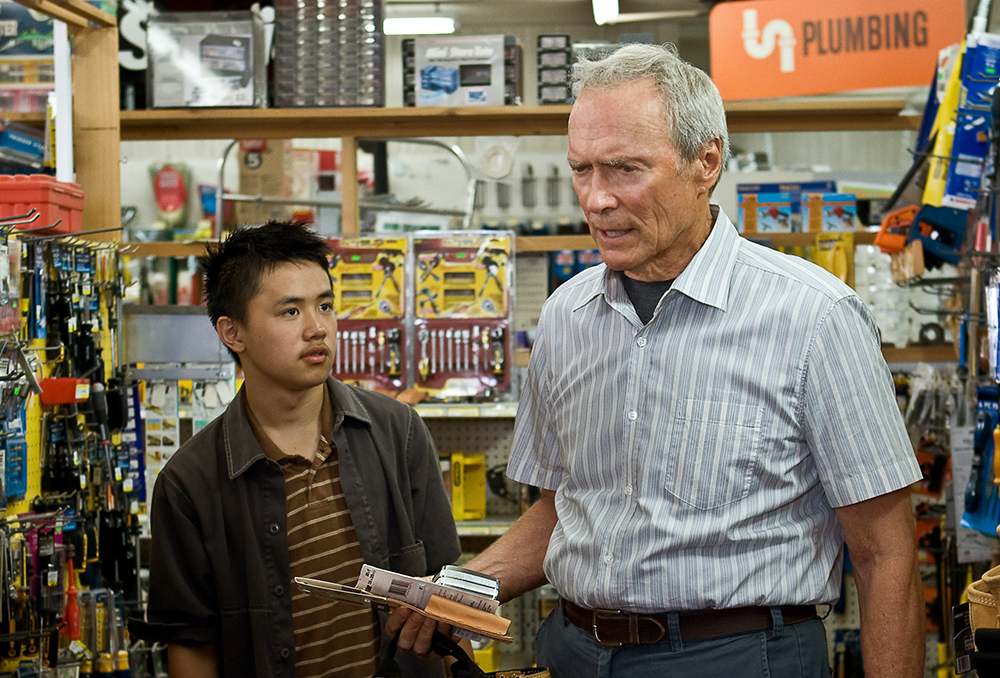
    Bee Vang and Clint Eastwood in “Gran Torino.” (Photo: Warner Bros. Entertainment, Inc., 2008).

    Kowalski’s ensuing bond with Thao (whom he refers to as ‘Toad’) leads to some of the nicest scenes of the film, with the former showing Thao how to fix things around the house, clean his vintage car, and even how to act like a man and win a date with a beautiful Hmong girl from the neighborhood. 

    The acting and character development are all well done, with a majority of the film taking place at the hands of Thao, Sue, and Walt respectfully. Eastwood makes a smart decision and plays Kowalski close to the chest. One could imagine this character—bitter, jaded, and racist—falling apart in the hands of a lesser actor. Kowalski’s arc isn’t so much that he’s capable of change, but that he’s capable of love, and Eastwood makes us believe the transition. 

    In early conversations with a town priest (Christopher Carley) who urges Walt to go to confession, we see demons that he can’t let go. “The thing that haunts a man the most is what he isn’t ordered to do,” he recounts of his time spent in the Korean War. Walt doesn’t believe he can find absolution for these sins. But he does, in a scene that is shot perfectly, standing outside a battered apartment complex, in an emotional portrayal by Eastwood that defies his legend as a slick action hero. As a director, Eastwood spends so much time layering his character – and his bond with Thao—that the event, which won’t be hinted at here—exists as an end unto itself that closes the movie with perfect power and finality. 

    Choosing Love

    Gran Torino
    Ahney Her and Clint Eastwood in “Gran Torino.” (Photo: Warner Bros. Entertainment Inc., 2008).

    But most of all, “Gran Torino” has it’s heart in the right place. This is not a film that celebrates prejudice, nor a film that offers family feuds as entertainment, but one that simply details real things that happened, things its characters regret, even if they can’t change them. The film is rife with symbolism and meaning, and Eastwood’s focus as a director and an actor have never been sharper. In the most unlikely way, you feel empathy for Walt Kowalski. The film’s opening presents him as emotionless, jaded, and cloaked in a cloud of prejudice. But somewhere along the line you understand him, see what he’s capable of, and, impossibly, start to like him. “Gran Torino’s greatest achievement is the seamless way that Eastwood brought you there.


    "Santosh" has a rating of B from The Movie Buff staff

    Bee Vang Clint Eastwood crime family gang Gran Torino Hmong loyalty racist Walt Kowalski
    Share. Facebook Twitter Pinterest LinkedIn Tumblr Email
    Previous ArticleThe Commuter (PG-13)
    Next Article Avengers: Infinity War (PG-13)
    Mark Ziobro
    • Website
    • Facebook
    • X (Twitter)
    • Instagram
    • LinkedIn

    Mark is a lifetime film lover and founder and Chief Editor of The Movie Buff. His favorite genres are horror, drama, and independent. He misses movie rental stores and is always on the lookout for unsung movies to experience.

    Related Posts

    Drama March 4, 2026

    ‘Rosemead’ Review: A Mother and Son Stare Down the Barrel in a Tragic Eye-Opener

    Independent March 2, 2026

    The Short Film ‘Jam Boy’ by Sriram Emani is Rich with Culture and Social Commentary

    Horror March 2, 2026

    ‘Scream 7’ Review: A New Chapter as the Franchise Rewrites the Rules

    Drama March 1, 2026

    “Wuthering Heights” (2026) Review: A Preposterous Retelling, Rich in Aesthetic Yet Weightless in Text

    Action February 26, 2026

    ‘Man on Fire:’ Violent and Unforgiving, but Features Both Denzel and Fanning at their Best

    Romance February 24, 2026

    Review: Rough Sex and Rougher Relationship Dynamics Intertwine in the Risqué ‘Pillion’

    Leave A Reply Cancel Reply

    Latest Posts

    ‘Sisa’ Review: When ‘Madness’ Becomes an Act of Resistance

    By Paul Emmanuel EnicolaMarch 6, 20260

    ‘Rosemead’ Review: A Mother and Son Stare Down the Barrel in a Tragic Eye-Opener

    By Vidal DcostaMarch 4, 20260

    The Short Film ‘Jam Boy’ by Sriram Emani is Rich with Culture and Social Commentary

    By Mark ZiobroMarch 2, 20260

    ‘Scream 7’ Review: A New Chapter as the Franchise Rewrites the Rules

    By Holly MarieMarch 2, 20260
    • Facebook
    • Twitter
    • Instagram
    • YouTube
    Indie Film Highlights

    ‘Rosemead’ Review: A Mother and Son Stare Down the Barrel in a Tragic Eye-Opener

    By Vidal DcostaMarch 4, 20260

    “Rosemead” is based on “A dying mother’s plan: Buy a gun. Rent a hotel room.…

    The Short Film ‘Jam Boy’ by Sriram Emani is Rich with Culture and Social Commentary

    By Mark ZiobroMarch 2, 20260

    Review: Rough Sex and Rougher Relationship Dynamics Intertwine in the Risqué ‘Pillion’

    By Vidal DcostaFebruary 24, 20260

    Interview: Filmmaker Sriram Emani on Exploring Self-Erasure and Breaking Patterns in his Debut Short ‘Jam Boy’

    By Vidal DcostaFebruary 20, 20260

    Acclaimed Violinist Lara St. John Talks About ‘Dear Lara’ Doc in Post SBIFF Interview

    By Mark ZiobroFebruary 16, 20260
    Spotlight on Classic Film

    ‘The Innocents’ Review: One of the First Haunted House Films of the Modern Horror Era

    ‘Gone With the Wind’ Review: Epic Film from the Golden Age of Hollywood

    ‘The Count of Monte Cristo’ QCinema 2024 Review: A Thoughtful, If Rushed, Study of Revenge and Redemption

    ‘Thirteen Women’ Review: A Precursor of the Slasher Genre, with a Devilishly Divine Femme Fatale at its Helm

    The Movie Buff is a multimedia platform devoted to covering all forms of entertainment. From Hollywood Blockbusters to Classic Comfort faves. Broadcast Television, on-demand streaming, bingeworthy series'; We're the most versatile source.

    The Movie Buff is also the leading supporter of Indie film, covering all genres and budgets from around the globe.

    Facebook X (Twitter) Instagram YouTube LinkedIn TikTok
    Copyright @2011-2025 by The Movie Buff | Stock Photos provided by our partner Depositphotos

    Type above and press Enter to search. Press Esc to cancel.
