


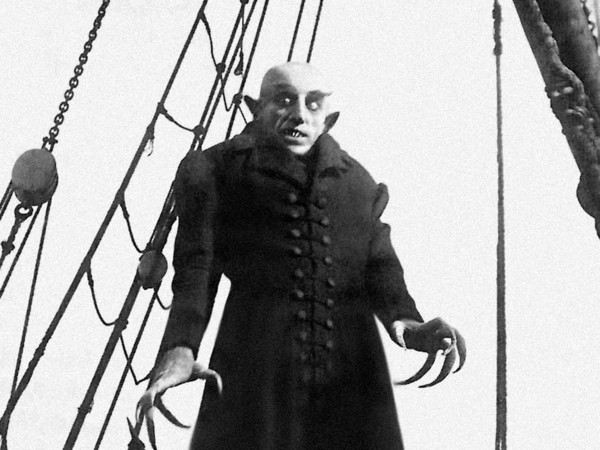
Vampires have been represented in many different forms over the years in cinema. Their continued presence (even amidst critic outcry in regards to the “Twilight” series) shows audiences’ fascination with vampires isn’t going anywhere anytime soon. There’s quite a difference, however, between the representation in films like even Anne Rice’s “Interview with the Vampire” and dated period pieces like Carl Theodor Dreyer’s “Vampyr.” It’s in this vein that the classic 1922 film “Nosferatu,” directed by F.W. Murnau, falls. However, with more a disjointed scope, a sporadic score, and a wide lens, “Nosferatu,” while excellent cinema, may appeal more to classic film buffs than those looking for a good scare.
The basic plot here is that a real estate salesman, Hutter (Gustav von Wangenheim) is sent to Transylvania to negotiate a deal with Count Graf Orlock (Max Schreck) to purchase some property in Hutter’s hometown. His voyage to Orlock’s ‘estate’ is filmed eerily; treacherous paths and a certain fear of Orlock’s castle that not even the locals dare venture to. Upon meeting up with Orlock, it becomes clear the man is not what he seems, and Hutter may be in over his head. In the creepiest line from the movie, Orlock narrates to Hutter that his wife “has a beautiful neck.” It manages to send shivers down our spines.
For this review I watched “Nosferatu: Original Version” and it is presented fully in its original filming style, with no apparent digital or film upgrades ‘added’ to modernize it or make it more palatable. This is a compliment. Much of the film watches as though it was filmed through a 35mm film reel; you can almost here the humming sound in the background as though you’re watching a home movie, and not at all a blockbuster.

The film is silent, titled throughout in the same ilk as “Phantom of the Opera,” placards detailing characters’ speech and thoughts. The coloration of the film is superb. We’re presented with a grainy film, cast in pinks, blues, sepias, and greens. These take us through the quaint village that is the protagonist, Hutter’s home. Decaying brick buildings and 1920’s adornments line the houses, cobblestone streets the town squares. Likewise, Orlock’s castle is filmed in an otherworldly style; the interior seems elaborate and stately, with marble tiled floors, high roofs, immense archways, and archaic doors.
The writers for “Nosferatu” are credited as Henrik Galeen and Bram Stoker, and it’s clear that the film is based almost shot for shot off of Stoker’s 1897 novel, which is, honestly, one of the film’s downsides. Hutter in this film is every bit Jonathan from Stoker’s novel, his wife Ellen (Greta Schröder) likewise channeling Mina from the same book.
While the set pieces of “Nosferatu” are well done, if you’ve read “Bram Stoker’s Dracula” you know rather sufficiently what is going to unfold, and it takes away of some of the mystery of the film. That in itself is fine if you are okay with viewing “Nosferatu” through an artist’s lens. Watching the film’s grainy colorization, in tandem with its eerie set pieces and long shots (the best of which portrays Orlock casting an haunting shadow amidst a wall, his long, clawed hands stretching before him), gives viewers a sense of escapism and entry into a time period of film forgotten from modern audiences whose ideas of vampires involve actors like Brad Pitt, Tom Cruise, and, modernly, Robert Pattison. Watching “Nosferatu” is like stepping back in time through a portal. Unlike vampires of new, Orlock doesn’t finish his victim with blood running from his greedy chin, but rather his work known only through tiny puncture holes about his victims’ necks, which they write off as mosquito bites or some such anomaly.
 What I didn’t overly enjoy watching this film is the score, which is bombastic and ill fitting to the film. At the film’s beginning, for instance, it’s as if F.W. Murnau didn’t trust us to believe from Hutter’s face that he is excited to travel to Transylvania for work, surrounding his film with loud, almost marching-type music. This same motif is repeated at the film’s critical ending, which works to subtract from the creepiness that is abound. “Nosferatu” would have been better served with low droning organs and humming bass to highlight it’s scarier portions. Overall the score subtracts from the greater experience.
All in all, “Nosferatu” holds up as the classic it is, and is certainly a good way to spend the Halloween season if looking for old-fashioned horror. As a silent film it’s artistic, solid, engaging. As a classic vampire film, however, I feel that the 1932’s “Vampyr” offers a more authentic and eerie presence than offered in “Nosferatu,” despite Schreck’s flawless make-up, acting, and screen presence here.

