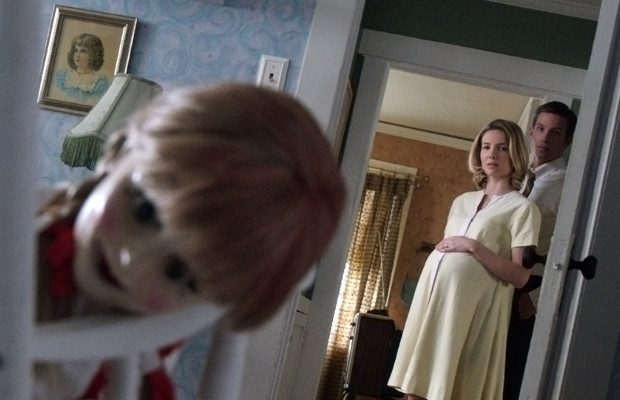
Do viewers remember that creepy doll named ‘Annabelle’ from 2013’s “The Conjuring?” Well, regardless of your enjoyment of her, she’s getting the origins treatment. The film opens with background explaining that dolls can both be children’s toys and conduits for inhuman spirits.
The film, based before the account with Ed and Lorraine Warren’s case files, follows a young couple, Mia (Annabelle Wallis) and John (Ward Horton). The couple, who are expecting a baby, are one’s average church-attending folks, and John is training to be a doctor. As a present, John gives Mia a rare, vintage doll to finish her collection. It’s Annabelle – the creepy, rosy-cheeked porcelain doll in a white wedding dress. The next-door neighbours’ daughter, Annabelle Higgins (Tree O’Toole), ran away to join a cult, and one night she returns to slay her parents. In their brutal wake, Higgins and her boyfriend also invade Mia’s house and conjure a malevolent spirit, and use the Annabelle doll as a conduit.

The haunting starts out innocently – rocking chairs and sewing machines have minds of their own. The frequently absent husband John blames it on pregnancy hormones and the anxieties of the brutal attack. When things get worse after moving from Santa Monica to Pasadena, he suggests marriage counseling – even though priest blessings seem to do a better trick. As you can tell, he’s not smart.
Mia isn’t much smarter. At one point, she gets John to throw the doll in the trash – but when she finds Annabelle later in one of the boxes after moving, she doesn’t think to throw her back in the trash. What’s more bothersome about these characters is that they don’t pursue anything. In one instance, Mia and John find drawings that suggest a threat to Mia’s baby, which they assume were drawn by kids in the apartment building. They contemplate asking the young children’s parents about it, but never pursue. Also: The two kids are literally the only two people we see in the apartment for the entire film, other than Mia, John, and Evelyn (a great Alfre Woodard).
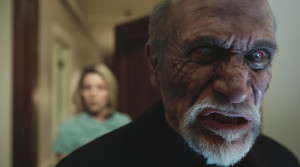 Unintelligent character decisions aside, the writing isn’t half-bad. It has a lot of demonic material and the tone feels like a mix between “Rosemary’s Baby” (perhaps the character name Mia is a nod to Mia Farrow) and “Insidious.” The expansion of the “Insidious” universe was great. Granted, the expansion of that universe made historical inaccuracies even more prevalent. The only truth about this film is that Annabelle is an inhuman spirit and that she’s a real doll. Otherwise, it’s a fictional but creative story. The inconsistency within the Warren’s universe is confusing. In “The Conjuring,” Annabelle Higgins was murdered at seven years of age; in this film, she is a satanic cultist killed in her early twenties. It’s a more malevolent origin, but it suggests a lack of care from filmmakers.
There’s some poignancy in characterization, specifically found in the character of Evelyn. There’s also psychological horror thrown in for good measure. This doesn’t make “Annabelle” a creepy doll horror in the traditional sense. It has more layers, but it doesn’t have doll catch-phrases or the pitter-patter of doll feet in the apartment. The chills “Annabelle” musters are notable in eerie imagery and basement scenes. Before the Pasadena apartment, the film is only sporadically scary. The apartment building adds a creepier vibe.
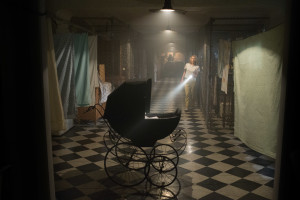 Director John R. Leonetti brings his own style to the film and emulates James Wan’s stylesimultaneously. He uses a lot of bizarre zooms, even in conversations. The zooms exaggerate certain physical features like a comic strip might. The zooms are indicative of his style and experience as a cinematographer. He rouses unease with these shots, but most are empty images of her doing absolutely nothing. The heightened unsettling score is designed to offer a sense of depth that isn’t there.
– by Daniel Prinn