


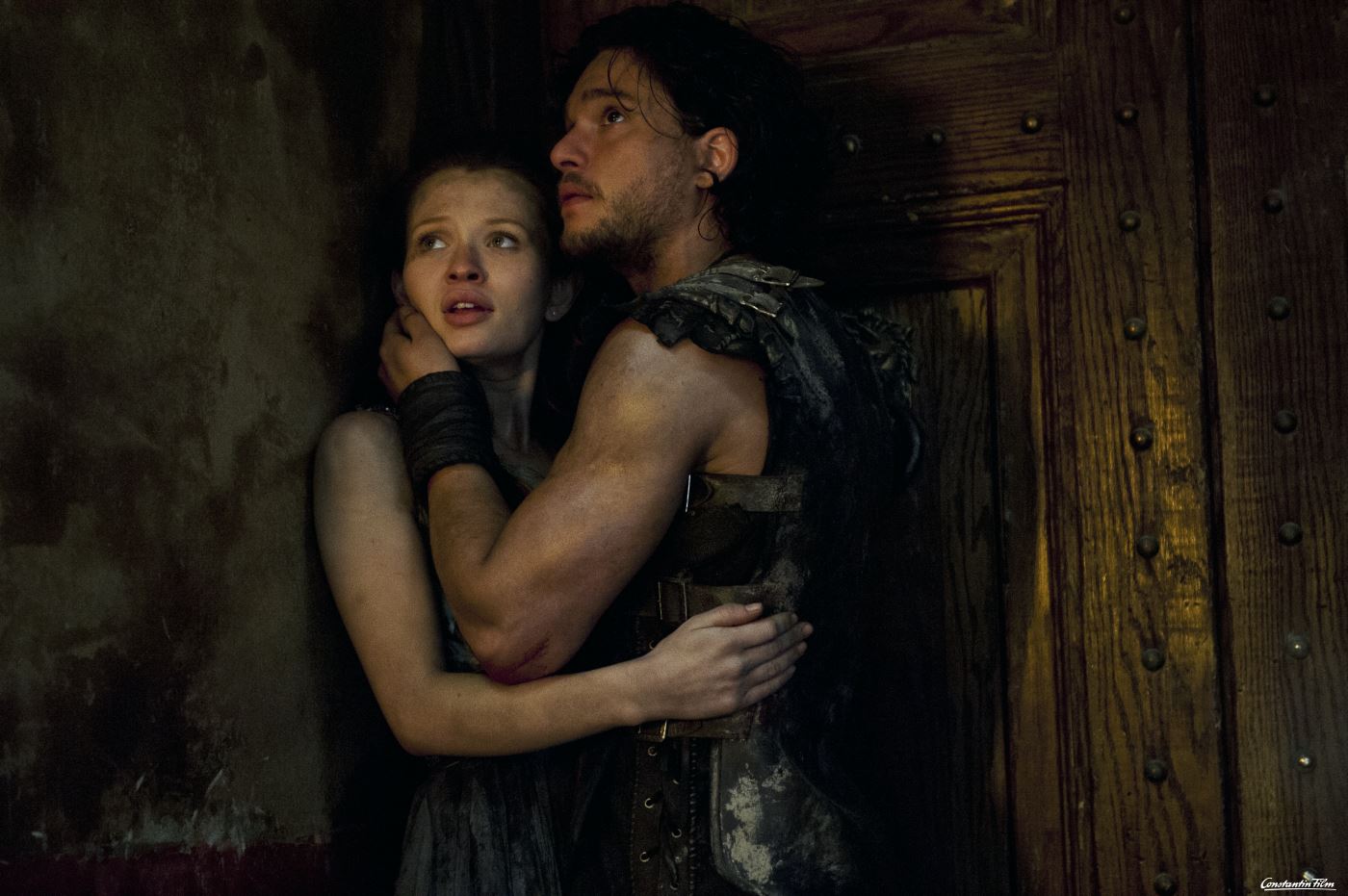
Director Paul W.S. Anderson steps into new territory with “Pompeii” after directing a deadly fast car race (“Death Race”), aliens and predators (“AVP: Alien vs. Predator”), and mutated creatures (three of the “Resident Evil” movies). “Pompeii” has been described as a mix between “Gladiator” and “Titanic” – a good marketing statement considering those are both ‘Best Picture’ winners and successful at the box office, (“Titanic” being wildly successful). It’s easy to see why people might think of “Gladiator,” because there are indeed gladiator scenes and it follows a gladiator; its “Titanic” connections are because of the class differences between two lead love interests, and because this is a disaster film. However, “Pompeii” doesn’t have as much Oscar potential as those two films.
Milo – a.k.a. The Kelt (portrayed by Kit Harington) – is a slave-turned-gladiator who comes to Pompeii to entertain the people with a fight to the death. He finds one thing in Pompeii that he was not anticipating – the love of the Princess of Pompeii, Cassia (Emily Browning). Cue the love triangle, because corrupt Roman Senator Corvus (Kiefer Sutherland) has his eyes set on her hand in marriage. Milo soon finds himself in a race-against-time to save Cassia, risking his life as Mount Vesuvius erupts and Pompeii crumbles around him.
The fact that the relationship between Milo and Cassia is described as true love is funny considering the little they actually talk to each other. Because of that, this feels like a Disney fairy tale romance, but not particularly the charming kind. At least the relationship in “Titanic” is believable because they spend a lot of time together (enabled by the film’s runtime), but the couple here shares little more than twenty minutes of screen time; an hour or two real time. They’re likeable enough, but their chemistry is only okay because of that. Kit Harington is good in his role, as a slave-turned-gladiator who is the last of his villagers – the Horsemen. When he was young, he witnessed his villagers killed by Romans. His motivation is revenge, his love for Cassia, and survival. I can see some action movie star potential in him.
Emily Browning is good as Cassia, too; the pretty Australian portraying an independent woman who is putin an awkward position having to choose between an unhappy but good life with Senator Corvus, or a happy life with Milo, even if it doesn’t have guaranteed economic greatness. Love still seemed simpler in 79 A.D., at least the falling in love aspect of things. I mean, they hardly know each other; she’s just amazed by his kindness, and Milo sees a beautiful, independent woman. All just have to question the realism of the fictionalized romance.
Kiefer Sutherland sports a weird British accent that’s unidentifiable and inconsistent (mostly when he projects his voice), but he’s pretty good as the villain. Corvus came to Pompeii with plans of investing in the City of Pompeii, and he just happened to run into Cassia after they met in Rome. Coincidence? I think not. Anyway, Jared Harris and Carie-Anne Moss are patriarch and matriarch of royal family of Pompeii. The cast’s a good ensemble. Adewale Akinnuoye-Agbaje (TV’s “Lost”, “The Bourne Identity”) portrays Atticus, a fellow gladiator in the town of Pompeii who is one fight away from freedom. Freedom and survival are his drive, and I think he is the most interesting character out of the bunch. It’s funny that even in non-prison movies, when a new gladiator (Milo, is said to be the best) is on the block, he always gets challenged by big brutes. I find it funny.
The characters are fictionalized because the historical accuracies are based on a first-hand-account by Pliny the Younger. He couldn’t know these characters, and the relationship developments are so tailored for the big screen they couldn’t be true. I’m not saying the characters are bad, I’m just saying that if they didn’t have them, the volcano eruption would just be depicted on the Discovery Channel. People are coming to see this because it’s a disaster film with blockbuster visuals, great production design, and sets that are built just so they could get destroyed; woo-hoo! It has one of the unwritten rules of disaster films; if the floor is crumbling, a character has to jump over it in a car (a horse in this case) in slow motion. I don’t think W.S. Anderson could resist doing that.
 The gladiator scenes are actually exciting, too, sometimes brief – which I’m a fan of because if it’s a lesser villain against a main character, the audience knows who will win – so it’s nice that those fights don’t get dragged on. The editing during these scenes is good, not too quick and during some fights there are some far away shots. The disaster aspect of this is exciting (it isn’t a fun disaster film like “The Day After Tomorrow” because, keep in mind, this is true), and it’s a fairly accurate portrayal of the eruption by the end of it all. I learned there was an initial eruption on August 24, 79 A.,D.; and then another the next day that was much more powerful, even though in the film it’s depicted as a powerful one erupting, and then a few others eruptions as they try to escape. For the audience, the disaster aspect is about thirty or forty minutes I’d guess; in real time, this lasted about 25 hours.
Another inaccurate portrayal is that it portrays Pompeii as the only city that’s affected; Herculaneum and Stabiae were also affected by the eruption, but only Pompeii is mentioned. And heck, I don’t even clearly remember the name of the volcano (Vesuvius) being said. The eruption is foreshadowed by the volcano bubbling, and by horses going crazy when earthquakes occur. In all, thirteen thousand people died from the eruption, and it all happened so fast most citizens were cemented in place (because of the mix of rain and ash, turning them into statues so to speak) until the site was uncovered in 1595 – over 1,500 years later! Fascinating, right? Anderson depicts this tragedy with accuracy as far as the disaster goes; using blockbuster visuals, a good score, and a great cast work to lift a fairly weak surrounding story to out of the ashes.
– by Daniel Prinn

