


Ah, the common North American zombie movie; such a delightfully mutable species. One of the very few predominantly-horror subgenres to enjoy mainstream success, zombie films likely have their versatility to thank for the relatively recent explosion of their appeal. From their obscure B horror origins in the 1930s and ‘40s (like “White Zombie” or “I Walked with a Zombie”), to the subversive social commentary of George A. Romero’s films (notably “Night of the Living Dead” in 1968, and 1978’s “Dawn of the Dead”), through knock-off, Italian-produced gore-fests (spawning a handful of cult classics, like Lucio Fulci’s 1979 “Zombie”), the camp horror of “Dead Alive” (AKA “Braindead,” directed in 1992 by Peter Jackson of “the Lord of the Rings” fame) and Sam Raimi’s 1980s “Evil Dead” films, up to modern revivals and reinventions, the zombie genre has seen it all. But for every decent offering of the past decade, like a “Shaun of the Dead” (2004) or “Zombieland” (2009), there are literally hundreds of lousy pretenders. The latest entry, billing itself as a zombie romance, is “Warm Bodies.” While it isn’t the first of its kind, “Warm Bodies” presents enough new territory to satisfy jaded zombie fans, and successfully manages to walk the line between its disparate genre inspirations.
We open in an airport, firmly within the obligatory zombie apocalypse scenario. Via voice-over narration, we are introduced to ‘R’ (Nicholas Hoult), a thinking zombie who can’t quite recall his name. Unlike others of his kind, R feels compelled to collect various relics of civilization, which he hoards in a makeshift home inside a grounded passenger jet. R even has a sort of friend, ‘M’ (Rob Corddry), with whom he shares daily grunting “conversations.” Despite his higher brain functions, R still spends his days shuffling around and eating living humans, just like the other zombies.

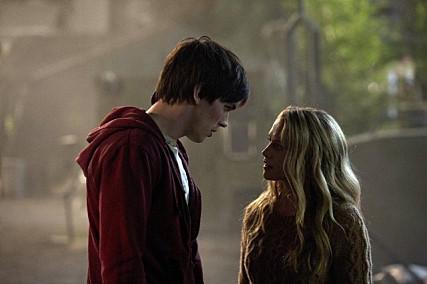
That all changes, however, when he spots pretty blonde Julie (Teresa Palmer), part of a community of human survivors. Instead of eating her, R protects Julie from the other zombies and brings her to his airplane home. There, his attraction to Julie inspires him to regain his ability to form words, as he attempts to court her with the aid of music (and a little help from the memories gleaned from eating her ex-boyfriend’s brain). Soon, they become close, and Julie hopes to prove to the rest of the survivors that the zombies can be cured, but human prejudice – and the advance of a feral subset of desiccated zombies, called “bonies” – threatens to drive them apart.
On paper, “Warm Bodies” should never have worked. Trying to blend and two genres, let alone such divergent ones as horror and romance, is always a challenge. The first half of the film also relies heavily on voice-over, which can be grating and boring if overused. Still, somehow it comes together. Jonathan Levine (best known for helming 2011 cancer comedy “50/50”) directed and adapted the screenplay from Isaac Marion’s 2001 novel of the same name, and both deserve credit for veering from too-easy genre stereotypes, and offering some genuinely sweet moments between Julie and R. Hoult and Palmer do a fine job of making this unorthodox pairing work, and with a pleasant dearth of necrophilia jokes. Although their relationship screams “friend zone” for most of the film’s duration, the handling of the romantic element still blows away previous attempts at zombie romance, like “Zombie Honeymoon” (2004) or “Boy Eats Girl” (2005).
“Warm Bodies” isn’t perfect. The third act panders to the typical zombie fan’s expectations by featuring lots of gunplay and plenty of human-versus-zombie action, much of which feels tonally out-of-place. Everything is tied up a bit too simply and predictably, when there was ample room to be more daring with this unique brand of zombie apocalypse. Still, it’s nice that the plot didn’t go full “Romeo and Juliet,” or try to emulate the vaguely-similar “Twilight” films. It’s not an instant classic of the genre, but it’s an appealing, offbeat oddity that is likely to join the ranks of films like “Cemetery Man” (1994), “Fido,” and “Slither” (both 2006) in satisfying future zombie fans looking for something just a little bit different.
– by Demian Morrisroe

