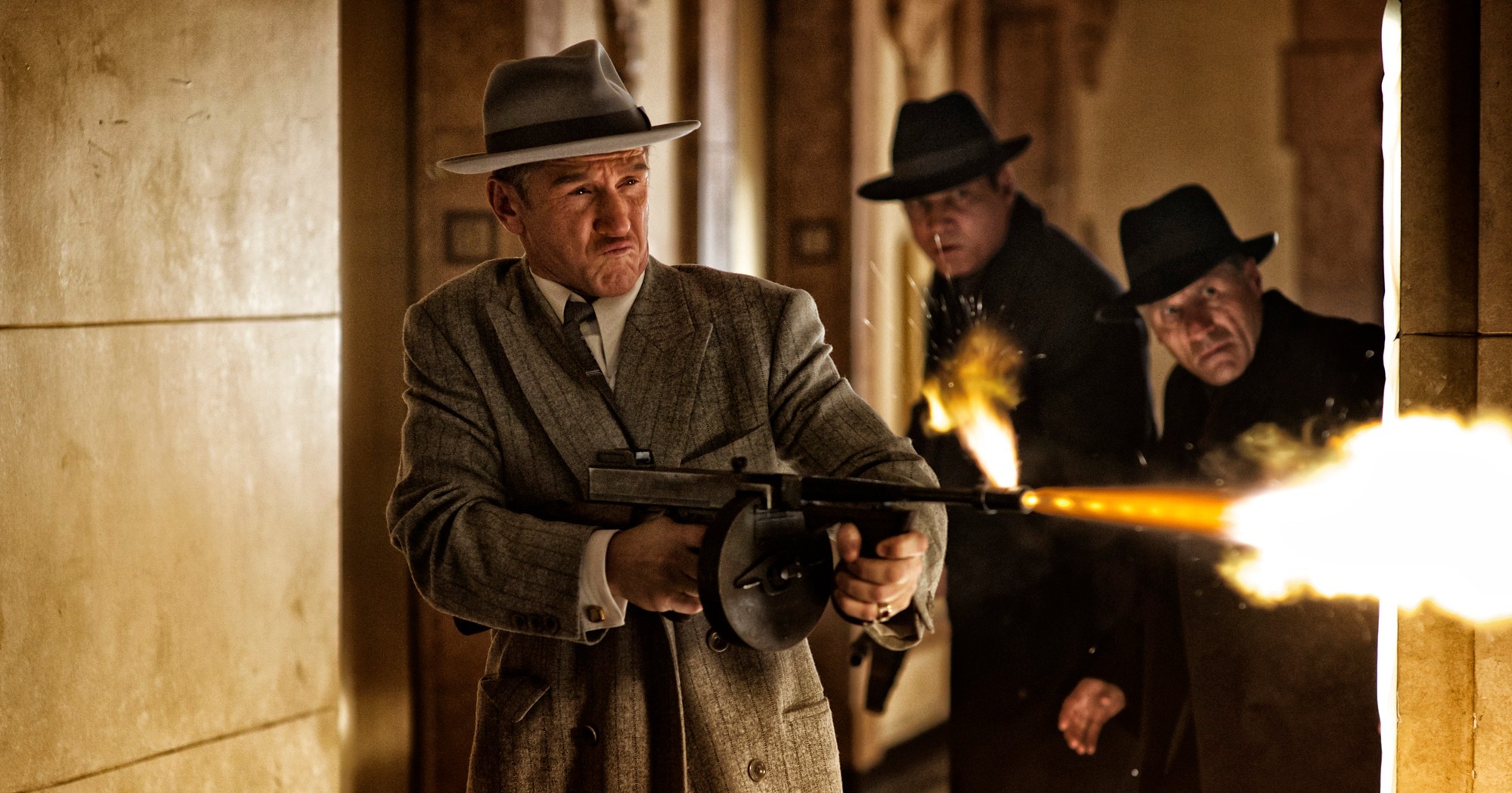
American moviegoers have enjoyed an ongoing love affair with crime dramas for more than eighty-five years. Before the “Don’ts” and “Be Carefuls” of the post-1934 Hays Code censorship era, film fans were thrilled by the lurid violence of such hits as “Underworld,” “The Public Enemy,” and “Little Caesar.” The 1940s saw the rise of film noir, with the likes of “The Big Sleep” and “Double Indemnity.” Even if you haven’t seen these films, their fundamental aesthetic is permanently ingrained in the American psyche. Heist films and mobster flicks have remained popular; virtually every American is at least passingly familiar with “Goodfellas” or the “Godfather” series. The seductive draw of the seedy underbelly of society is undeniably entertaining. So how does the latest genre offering, “Gangster Squad” measure up? “Gangster Squad” looks great and has style to spare, but shallow characters and repetitive violence render it hollow.
Los Angeles, 1949. Mobster Mickey Cohen (Sean Penn) controls the city, with police and his criminal rivals unable to stand in his way. But one cop, John O’Mara (Josh Brolin), draws attention on both sides of the law when he braves one of Cohen’s brothels to rescue a young woman. The perps walk, but the head of the department asks O’Mara to form a private group of clean cops willing to break the law in order to attack Cohen’s operation. O’Mara finds himself a practiced gunman, a technical expert, and a handful of others for his team.
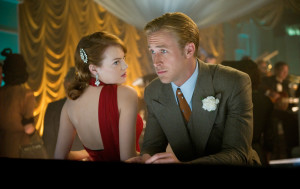
Fellow officer Jerry Wooters (Ryan Gosling) is reluctant to join until he witnesses the death of a friend in the crossfire of a Cohen-ordered hit on a rival mobster. Finally, with the consent of O’Mara’s pregnant wife, the squad takes on Cohen’s operation. After a few successful actions, however, Cohen is willing to kill whoever it takes to find the identities of the squad members. Complicating matters is Wooters’ affair with Cohen’s main squeeze, Grace Faraday (Emma Stone), and the squad are led into a trap that threatens to undo their efforts to curb Cohen’s burgeoning empire.
It is immediately apparent that “Gangster Squad” possesses eminently high production values. The costumes are excellent, the sets are all vividly realized, and authentic period music and jargon combine to sell the setting particularly well. At the outset, we also get some snappy dialogue as Wooters flirts with Grace, and all signs point to a well-made film. As the plot wears on, however, the cracks begin to show. Once the squad has formed, we get a series of rapid-fire set-pieces that do little to advance either story or character. The squad tries to break up an illegal, Cohen-run gambling operation, sneak into Cohen’s mansion in order to plant a recording device in his television, chase down and capture a truck carrying a load of heroin, and mount a rescue operation to reclaim some captured members.
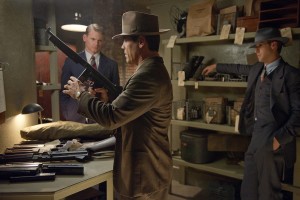 These vignettes (and others) are crammed together in the second act, without any break from the action. What would have worked better as a montage ends up eating too much of the film’s run-time, and there is so much gun-play that even adrenaline junkies will be desensitized to the violence by the time the drawn-out climactic battle rolls around.
The film’s other major weakness is its paper-thin characters. Each of the main players is almost cartoonishly one-dimensional. O’Mara is the honest cop torn between his duty to his wife and his commitment to law and order. Wooters wants to protect Grace, just as their relationship threatens her safety. Cohen declares himself the embodiment of progress and calls L.A. his destiny. This is as much depth as we get about any of these individuals. It’s unfortunate that such a talented group of performers are stranded by insipid dialogue and a script that feels the need to over-explain simple elements. Sean Penn’s performance is certainly vigorous, but Cohen is such a one-note character that his spittle-soaked rages wear thin far too quickly.
If you’re in the mood for a gangster film, you can do much better than “Gangster Squad.” For 1940s L.A. crooks and cops, look no further than the fine 1997 adaption of James Ellroy’s “L.A. Confidential,” or for a more neo-noir vibe, visit Roman Polanski’s “Chinatown” (1974) instead.
-by Demian Morrisroe