Whether referencing songs, television, or movies, the remake seldom compares to the original. The 1957 black and white classic, “Twelve Angry Men” was selected for preservation in the United States Film Registry by the Library of Congress as being culturally, historically, and aesthetically significant. It features all-time cinema legends Henry Fonda, Martin Balsam, and Ed Begley to name a few. The story and the various symbolism portrayed have been discussed and dissected throughout the many years in film studies across the world. With all of that pedigree, it’s a daunting task at best to recreate such an all-time classic.
Forty years later, I fell in love with the remake and as such, decided to check out the original. While it’s a great film deserving of its accolades and iconic status, I consider the 1997 version not so much of a remake but a new film with its own distinct entity.
The first difference in the two movies is the use of contemporary actors. While the original featured iconic veterans of screen, most people nowadays are unfamiliar with Henry Fonda’s role in “The Grapes of Wrath” or Ed Begley’s Academy Award winning performance in “Sweet Bird of Youth.” With actors that everyone nowadays is familiar with, the story and the characters becomes more relatable.
The other major difference is the employment of a multi-race jury (which as such develops a new set of drama for the film). The original is accurate – a jury in 1957 consisted solely of white men. That was the law of the time and that’s how the film was done. In 1997, a multi-colored jury is the commonality, and this facet adds to the driving force and interaction of the characters.
The setting for the film is one of, if not the most, simple in movie history, and that’s not an exaggeration. There are no explosions or car chases. There are no torrid and steamy love scenes. There are no vampires or werewolves. The entire movie, save for a minute at the beginning and a minute at the end, takes place in a sequestered jury room in an old courthouse (where the air conditioner is broken and its revealed to be the hottest day of the year) and is done entirely in real time, something fans of the hit television show “24” will love, as such the tension and drama completely unfold in just over an hour of time.
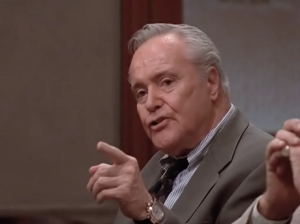
Twelve jurors, none of whom are identified by name, have been dispatched to render a judgment in the trial of a young Hispanic man who has been accused of the premeditated murder of his physically abusive father. The friendly banter between them at first reveals they think it’s a clear cut case – the boy is obviously guilty of the murder – and that a quick guilty verdict (and subsequent death sentence) will be announced in time for the men to return to their everyday lives. The jurors take a poll to see where they stand and are shocked to discover that one man, juror #8 (played by Jack Lemmon) is in favor of a not-guilty verdict. The other eleven are dismayed as the gentle-speaking juror makes the case that since a man’s life is on the line they have a responsibility to at least have a discussion about the trial.
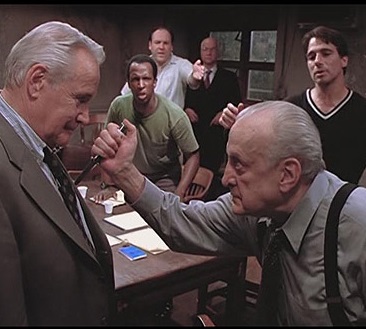
Spearheading the opposition is the hot-headed and cantankerous juror #3 (George C. Scott) who feels the case is open and shut and there is no room for debate. Since a unanimous verdict is required, the jurors have no option but to review and discuss the evidence. It quickly becomes obvious that some of the jurors had already made up their minds (some as early as the first day of the trial) that the defendant was guilty and paid little if any attention to the court proceedings. Joining #3 in leading the pro-guilty jurors is the sophisticated and highly educated juror #4 (Armin Mueller-Stahl), Nation of Islam loudmouth and bigot juror #10 (Mykelti Williamson), and juror #7 (Who’s the Boss’s Tony Danza). As the discussion unravels, it is found that many in favor of a guilty verdict are doing so for their own personal vendettas.
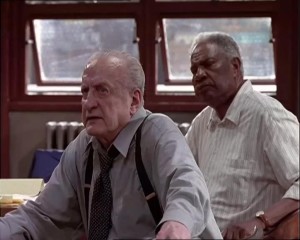 The jury foreman (Courtney B. Vance) politely advises that juror #8 can “tell us what he thinks and we can show him where he’s probably mixed up.” Each of the eleven jurors begins to make the case for why they feel the boy is guilty. Lemmon’s character, in a passionate and logical way, reminds them that it’s not up to the defendant to prove he is innocent but for the prosecution to prove that he is guilty.
The personalities and characteristics of the men are slowly revealed; some are weak and timid while the strong personalities dominate and bully the others. Many appear to be conforming to the peer pressure of a guilty verdict. Lemmon, while standing alone, continues to remain stoic in his thoughts. He is unsure of the guilt or innocence of the defendant but believes more discussion is involved rather than sending him to death with such a cavalier attitude as many of the others seem to not mind doing. His strong character and obvious wisdom cause the elderly juror #9 (Hume Cronyn) to switch to a not-guilty verdict, advising he has done so because Lemmon is standing alone and though he feels the boy is probably guilty, he agrees further discussion is in order.
Wishy-washy advertising executive juror #12 (a beardless William Peterson in a pre-CSI role) proposes that “it’s up to us to convince this gentleman that we’re right and he’s wrong” but the plan quickly falters as the opposite unfolds. Juror #8, who has now gained the support of a former slum-resident (Dorian Harewood), an immigrant watchmaker (Edward James Olmos), and a blue collar stiff (The Soprano’s James Gandolfini), begins to pick apart the various aspects of the trial and one by one sway the once stalwart opposition into changing their minds and turning on each other. Tension between the once cordial men nearly turns to blows, giving the viewer the terrifying thought that these types of actions and mindsets are really what goes on in a jury room when judging a human life.
The acting is utterly phenomenal. The ability to portray real people – not a surefire detective or a crime fighting superhero – but regular everyday people who are forced to draw upon their own soul is not an easy task. The film is virtually nothing but dialogue. No one watching will be distracted by half-naked dames or fiery gunfights. More modern stars like Jack Lemmon and George C. Scott deliver as would be expected, but you will be amazed at the dramatic talents of TV sitcom star Tony Danza, and mesmerized by the breathtaking performance of Mykelti Williamson, noted for Bubba in “Forrest Gump” and Baby-O in “Con Air.”
The original is worth watching, but check out the remake and you’ll see why it’s one of my all time favorite films.
– by Matt Christopher