


If you’re familiar with the science fiction films “Blade Runner” (1982), “Minority Report” (2002), or “The Adjustment Bureau” (2011), among many others, then you know something of the work of the late American sci-fi author Philip K. Dick. Adaptations of Dick’s works have transported viewers to the glittering neo-noir vistas of the cyberpunk subgenre, forced us to contemplate free will, and asked us to identify just what it is that makes us human. Not all of Dick’s properties have retained their philosophical core on the silver screen, however. His 1966 short story “We Can Remember It for You Wholesale” spawned an imperfect-but- entertaining Arnold Schwarzenegger action vehicle in 1990, titled “Total Recall.”
While director Paul Verhoeven (best known for helming 1987’s “RoboCop” and the 1997 adaptation of Robert A. Heinlein’s “Starship Troopers”) brought his typical campy charm to the proceedings, and the over-the-top special effects (for which the film received an Academy Award) still hold up more than two decades later, this very loose adaptation of the source material seemed ripe for retelling. Along comes a remake of the 1990 version, with a hefty $125 million budget and all the CGI bells and whistles. Unfortunately, this new “Total Recall” is nothing more than a clunky, unoriginal rehash of tired genre tropes.
Following global chemical warfare, only Australia, now known as the Colony, and parts of Europe, known as the Federation, remain habitable. Colin Farrell stars as Douglas Quaid, a poor laborer from the Colony who travels to the Federation via a sort of massive subterranean elevator, called the Fall, for work. Plagued by nightmares and an indeterminate longing, Quaid decides to visit ‘Rekall,’ a company that offers a sort of mental vacation via fabricated memory implantation. Quaid decides that he’d like to be supplied memories of secret agent operations, but as soon as he’s plugged in, a squad of armed guards arrives. Employing skills he didn’t know he had, Quaid kills the guards and returns home to his wife, Lori (Kate Beckinsale). Quaid soon learns that he isn’t who he thought he was, and neither is his suddenly homicidal wife.
 The acting ranges from horrid (Beckinsale’s antagonist is dragged down by some seriously corny faux-gruff dialogue that never hits) to passable (Jessica Biel as Melina, a member of a resistance movement fighting the Federation). Colin Farrell does his level best with a script that sees him embroiled in constant chases and shootouts, most of them inconsequential. A character with dual identities should have presented an interesting challenge for him, but it just doesn’t work as-written.
The production design is particularly galling. Not because it is bad––its mélange of “Blade Runner” and “Minority Report,” along with a bit of “I, Robot” (2004), a dash of the cyberpunk anime “Ghost in the Shell (1995), and a even some video game flavor à la “Deus Ex: Human Revolution” (2011) works surprisingly well––but because it is constantly obscured by garish, overused pastel lens flares (blame J.J. Abrams for popularizing the effect in the 2009 “Star Trek” reboot). Similarly, the action sequences are rote, shaky-cam affairs from hand-to-hand combat, to shootouts, to the pair of bloated chases (in the which the protagonists make momentary escapes by jumping down onto moving objects over and over again).
The biggest offense, however, is just how little regard the film has for its audience. Simple, unambiguous plot details are continually over-explained via flat dialogue. It seems that director Len Wiseman (helmer of the first two misbegotten “Underworld” films, also starring Beckinsale, his wife) figured that cribbing a few iconic images from other sci-fi films (and not only sci-fi is mined for material; one scene is lifted in its entirety from 2002’s “The Bourne Identity”) and distracting from the rest with noisy action sequences would be enough.
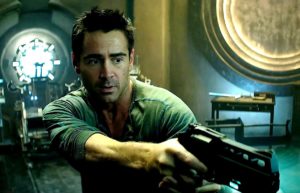 The few attempts at some kind of larger meaning––the lone scene that raises the possibility of all the events having been in Quaid’s head, and a Matrix-lite discussion of how people find meaning in their lives––suffer from an utter lack of any setup or followup. None of these disparate parts fit together.
Anyone looking for a solid sci-fi actioner is better off watching any of the other films mentioned above. For those seeking slightly brainier fare with less CGI, try Alfonso Cuarón’s harrowing “Children of Men” (2006) or the ultra-low-budget brain twister “Primer” (2004). Only the undiscerning and easily pleased will find anything redeeming about “Total Recall.”
– by Demian Morrisroe

