

Close Menu
    Facebook X (Twitter) Instagram
    Tuesday, October 27
    Facebook X (Twitter) Instagram Bluesky
    The Movie Buff
    • Home
    • About
      • Critics
      • Press & Testimonials
      • Media Partners
      • Terms of Use
    • Film Reviews & Coverage
      • Movie Reviews
      • TV/Streaming Reviews
      • Film Festival Coverage
      • Interviews
    • Podcasts
    • Indie Film
      • Reviews & Articles
    • Advertise
    • Contact
      • Write for us
    The Movie Buff
    Drama

    Review: Aronofsky’s ‘Black Swan’ Takes Cues from Metamorphosis Literature

    Biljana SkopljakBy Biljana SkopljakJuly 24, 2020No Comments4 Mins Read
    Facebook Twitter Pinterest LinkedIn Tumblr Email Copy Link
    Share
    Facebook Twitter Email Copy Link

    A symbolic masterpiece, “Black Swan” by Darren Aronofsky (and with Natalie Portman and Mila Kunis as leading actresses), is turning ten this year since its release in 2010. With years gone by, I can only appreciate it more now than I could when I was in high school, restrained by my tender years and lack of theoretical knowledge. And I can only hope that you, dear reader, will be able to appreciate my modest contribution to the literary interpretation of this film, even though it’ll be subjective, partial and flawed, just like everything in this world.

    Little did Ovid know that the myth he wrote about in the third book of his “Metamorphosis” would create the very base of today’s postmodern reality. Its timelessness has only been supported by Jung’s theory of collective unconscious and proven by its constant reuses in literature and art during two whole millenniums. And as an inexhaustible source of expression, I understand that the myth of Narcissus is probably one of the as-good-as-many approaches to describe the idea behind “Black swan.” To prove you that this is completely feasible, I’ll have to start from the beginning. Let’s proceed.

    Mila Kunis in a scene from “Black Swan” (Fox Searchlight Pictures, 2010).

    If we examine the myth of Narcissus, we see the direct correlation between it and the concept of metamorphosis. The myth of Narcissus narrates about a young man called Narcissus, who was cursed at birth to live for as long as he wanted, but with one condition: he mustn’t see his own reflection. Narcissus was also blessed with incredible beauty and many were in love with him. He despised and rejected anyone who loved him, which is why one of his most passionate admirers, nymph Echo, was in great pain. Eventually, she became so shut down by her love suffering, that she kept withdrawing herself and turned into a stone that could only whisper.

    Narcissus, on the other hand, fell victim to his destiny: he once saw his reflection in water and fell in love with himself. The impossible love with himself resulted in his death. The prophecy was fulfilled. This is what the myth of Narcissus and Echo tells us on its superficial level. But on a deeper, more profound one, this myth is a story of a metamorphosis of reality and existence into voice and picture. Those are the techniques that combined, amongst all the other forms of artistic expression, are used only in literature and cinema. Having explained this dichotomic correlation (the Myth of Narcissus—metamorphosis; metamorphosis—Echo-voice and Narcissus-picture), I can only conclude that you can see more clearly why it’s acceptable to interpret cinematic works as if they’re in fact literary works.

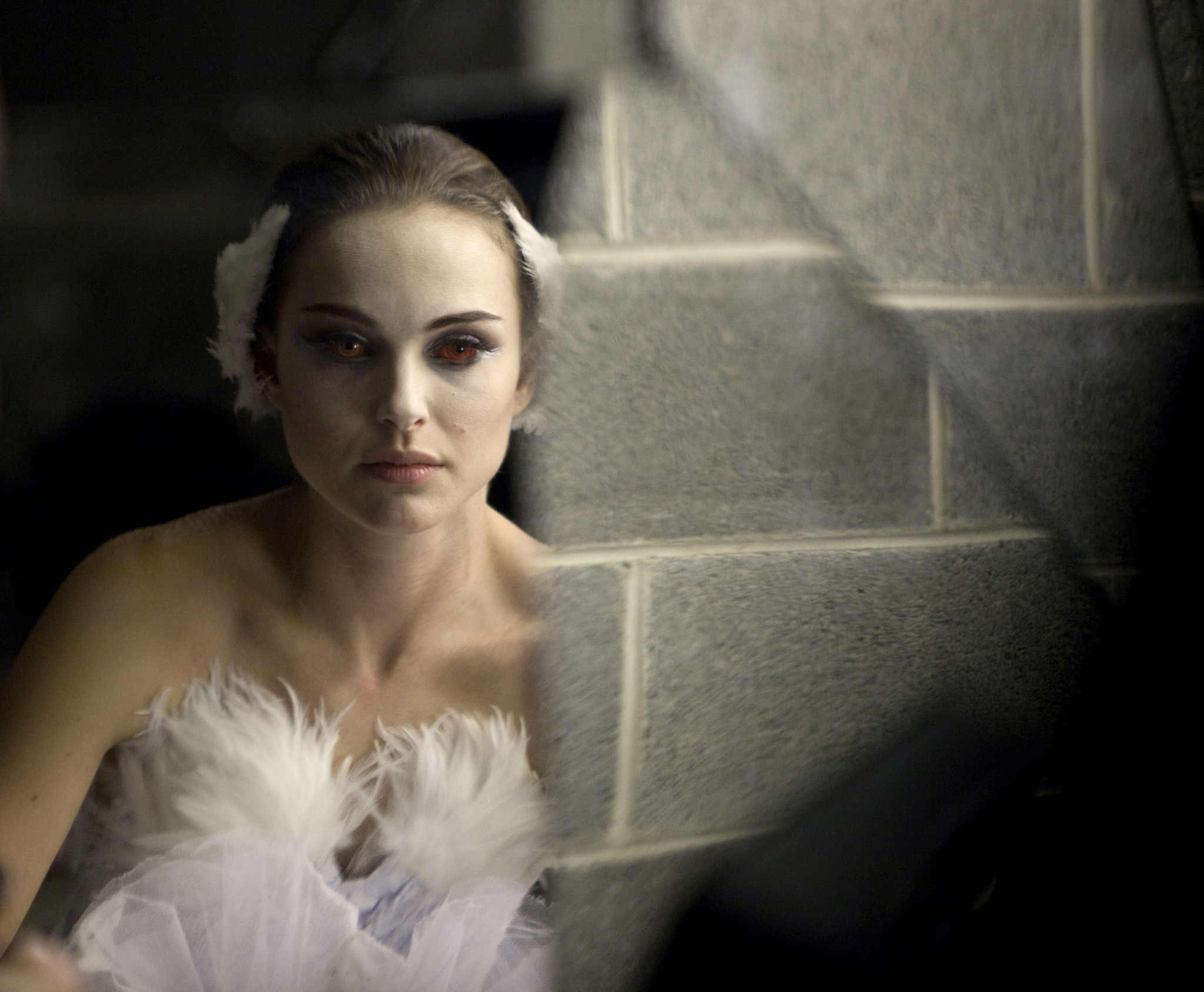
    Now let’s take a look at one concrete film, the above-mentioned “Black Swan.” The reason I chose this one is because it embodies the myth of Narcissus in a more explicit way than majority. The story of this film revolves around a young woman, Nina, that as a professional ballerina, is competing for the role of black swan for Tchaikovsky’s “Swan Lake.” Being gracious, fragile and innocent, Nina is chosen for the role of white swan, after being criticized for her lack of dominance, confidence, and sensuality; characteristics that her opponent, Lily, personifies. Determined to get the main part in the ballet, Nina undergoes a journey of transformation from a white to a black swan. In order to secure the role of black swan, convinced she’s stabbing Lily in a hallucination, in reality Nina stabs herself.

    The self-evident Nina’s metamorphosis is a superficial example of the one we saw in the myth of Narcissus. Her major similarity to Narcissus is their inner identity-imitation dualism. This conflict tells us more about both of them: both Narcissus and Nina share a deep contempt towards the idea of imitation. They felt attraction, repugnance or both when encountered with their doppelgängers, and not wanting to coexist but rather to become one, they die.



    Black Swan drama Mila Kunis Natalie Portman Swan Lake White Swan
    Share. Facebook Twitter Pinterest LinkedIn Tumblr Email
    Previous Article(Rock and) Roll With It, Baby; Movies About Music and Musicians
    Next Article Review: ‘Palm Springs’ an Unexpected Gem from SNL’s Andy Samberg
    Biljana Skopljak
    • Website

    Biljana's friends call her Nietzsche because she likes to break tables of values. Her film reviews are a part of her project "Case of Wagner," in which she combines philosophy, film and literary theory.

    Related Posts

    Drama October 26, 2026

    ‘Sense and Sensibility’ (2026): The Art of Adapting a Classic 

    Adventure October 22, 2026

    ‘Tenzing:’ A Well-Crafted Film That Brings a Mountaineering Legend to the Screen

    Film Festival October 11, 2026

    NYFF 2026: ‘Bucking Fastard’—Mara and Mara for the Twin

    Leave A Reply Cancel Reply

    Latest Posts

    ‘Prince of Darkness’ Review: John Carpenter’s Attempt at Mixing Horror with Advanced Physics Barely Passes as Watchable

    By Matt DeCristoOctober 27, 20260

    ‘Sense and Sensibility’ (2026): The Art of Adapting a Classic 

    By Anwar ShahadatOctober 26, 20260

    Review: ‘Yokai Monsters: 100 Monsters’ is a Vintage Japanese Horror Where Humans Have It Coming

    By Vidal DcostaOctober 26, 20260

    With Russell Crowe and Ethan Hawke at the Helm, ‘The Weight’ is a Thoroughly Engrossing Watch

    By Jacob DunstanOctober 25, 20260
    Follow Us
    • Facebook
    • Twitter
    • Instagram
    • YouTube
    • Bluesky
    • LinkedIn
    Bollywood
    Tribute

    Beyond the Archetype: a Look at the Characters Immortalized by the Late Nana Patekar

    By Vidal DcostaOctober 20, 20260

    A regular fixture and familiar face in cinema and stage, versatile actor Nana Patekar passed…

    An Unusual Ghost Story, ‘Phillauri’ is Bollywood’s Answer to ‘Corpse Bride’

    By Vidal DcostaSeptember 20, 20260

    ‘The Great Grand Superhero’ is More Effective than ‘The Happening’ in Promoting Green Living

    By Vidal DcostaJune 23, 20260

    Review: Sarthak Dasgupta’s Long-lost ‘The Last Tenant’ — Starring Irrfan Khan — Now on YouTube

    By Vidal DcostaJune 3, 20260

    ‘Laal Kaptaan’ Review: This Cult Classic Chronicles an Ascetic’s Revenge in Colonial India

    By Vidal DcostaMay 31, 20260
    Spotlight on Classic Film

    ‘The Innocents’ Review: One of the First Haunted House Films of the Modern Horror Era

    ‘Gone With the Wind’ Review: Epic Film from the Golden Age of Hollywood

    ‘The Count of Monte Cristo’ QCinema 2024 Review: A Thoughtful, If Rushed, Study of Revenge and Redemption

    ‘Thirteen Women’ Review: A Precursor of the Slasher Genre, with a Devilishly Divine Femme Fatale at its Helm

    The Movie Buff is a multimedia platform devoted to covering all forms of entertainment. From Hollywood Blockbusters to Classic Comfort faves. Broadcast Television, on-demand streaming, bingeworthy series'; We're the most versatile source.

    The Movie Buff is also the leading supporter of Indie film, covering all genres and budgets from around the globe.

    Facebook X (Twitter) Instagram YouTube LinkedIn TikTok
    Copyright @2011-2026 by The Movie Buff | Stock Photos provided by our partner Depositphotos

    Type above and press Enter to search. Press Esc to cancel.