Watching the film version of Maria Friedmanâs Tony-winning revival of âMerrily We Roll Alongâ is a strange exercise in dual consciousness. Youâre seeing a Broadway triumphâa reclamation of a famously bruised musicalâbut youâre also watching something that openly wrestles with the limits of being filmed at all. For anyone who never made it to New York, and especially for viewers like me watching from across the world, this release is a gift. Yet it also reinforces the reality that theatrical electricity, once flattened to a screen, can spark but rarely roar.
This is part of the tension baked into any pro-shot stage musical. The medium promises breadth, depth, and perspective, all those cinematic tools we expect from film. Meanwhile, the material it captures serves to do the opposite: narrow the world into a frame of bodies and spotlights and orchestrated intimacy. Stage acting aims to carry; film acting to register. A pro-shot sits uneasily between the two, negotiating compromises scene by scene. And with âMerrilyâ, we see that same negotiation quite impossible to ignore.
Even so, I found myself moved more often than not. Perhaps itâs against my better judgment, but Friedmanâs âMerrilyâ earns its praise, and on film it remains one of the most stirring interpretations of the Stephen SondheimâGeorge Furth musical to make the leap to a broader audience. Wherever its limitations show, the performances and material more than compensate.

The Backward Spiral of Friendship, Fame, and Self-Betrayal
Usually movies begin with characters exuding the innocence of youth. âMerrilyâ, in its notable narrative structure, opens at the hollowed-out summit of success: 1976 Bel Air, where composer-turned-Hollywood power player Franklin Shepard (Jonathan Groff in a career-best performance) hosts an opening-night party filled with strangers who speak in compliments like currency. His mistress Meg (and the star of his latest film) flutters beside him as sycophants circle. The scene is manic, almost ugly in its theatrical excess, as though the musical wants you to suffocate inside Frankâs triumph.
At the corner, we see a woman apparently affected by alcohol, whom Frank introduces to Meg as Mary Flynn (Lindsay Mendez), his âdeepest, closest, best friend in all the world.â We immediately get a clue to an uneasy friendship, from which the narrative gradually reveals. As âMerrilyâ rolls backward through the years, we watch friendships disintegrate in reverse. This gambit forces us to feel the loss more acutely; we see consequences first, then trace the wound back to its source. Itâs a portrait of corrosion presented as restoration.
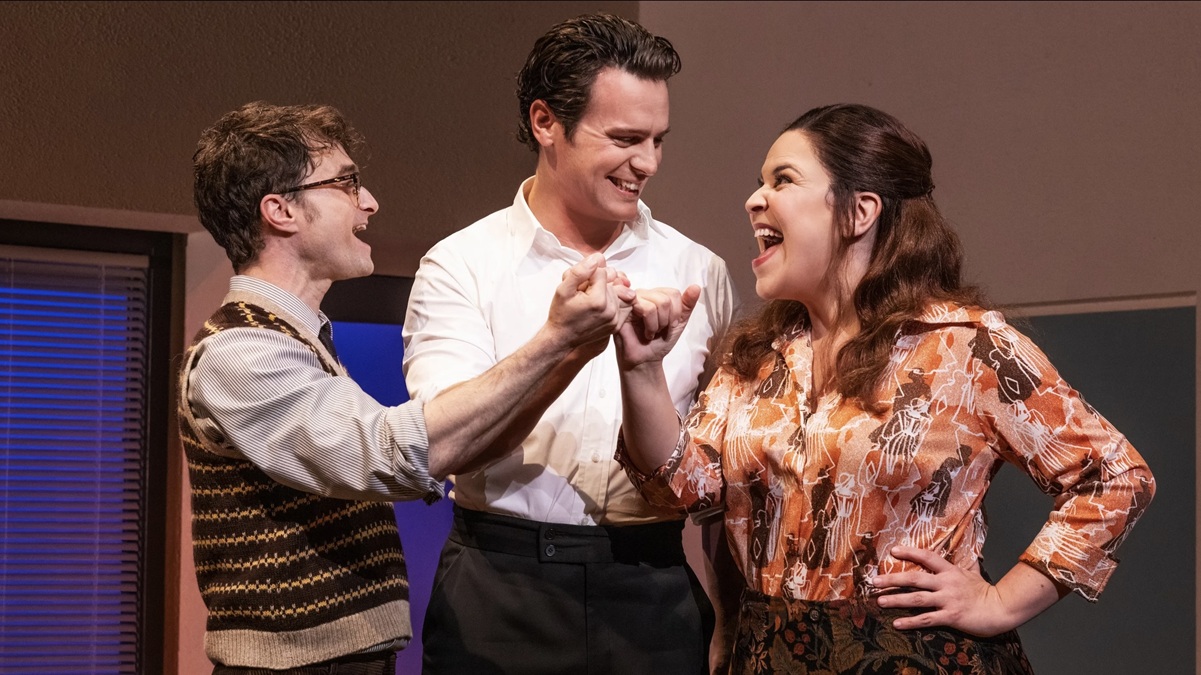
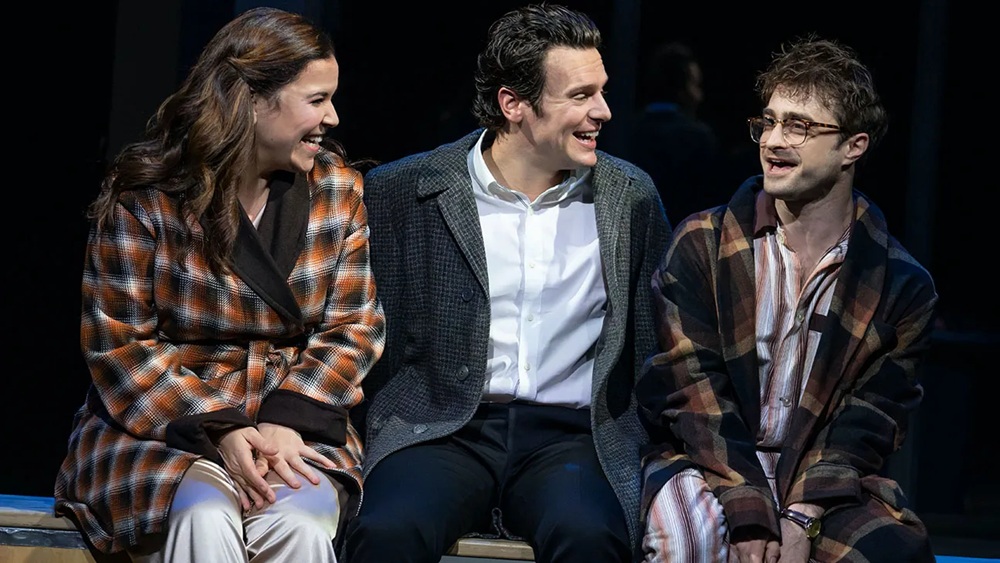
Frankâs relationships with his two closest friends, Mary and Charley Kringas (Daniel Radcliffe), provide the emotional axis of the piece. Mary, a writer who harbors unspoken feelings for Frank, dulls her disappointments with alcohol and barbed humor. By contrast, Charlie, Frankâs lyricist and partner, grows increasingly unsettled by Frankâs compromises. As the years rewind, the musical moves from rupture to tenderness, a choice that might feel both deeply moving and occasionally disorienting. But that tension is what I think works well. Youâre aware the ending isnât a beginning at all, but a memory frozen before the fall.
Groff, Radcliffe, Mendez: A Trio That Holds the Center
Part of the playâs resurgence rests on its three leads, and the camera confirms what theatergoers have been saying for years: this is career-best work, each performance fine-tuned for a generation that understands ambition as both fuel and poison. Groff plays Frank with a simmering contradiction, the charisma of someone who dreams big and the blankness of someone slowly realizing what those dreams have cost. On stage, he radiated; on this film, the subtleties come forward. Thereâs a quiet devastation in his eyes as we move from fame to idealism in reverse. Groffâs Tony win wasnât a coronation; it was recognition that he understands this man from the inside out.
Radcliffe, long past the trappings of childhood stardom, continues the streak of eccentric, thoughtful choices that have reshaped his career. As Charley, heâs both the conscience and the comic engine of the show. His patter song, âFranklin Shepard Inc.,â is a marvel of breath control and emotional clarity, a meltdown performed with the precision of someone whoâs spent years thinking about when exactly a friend becomes a burden. The camera loves him here; it catches things an audience in the balcony never could.
Meanwhile, Mendez is heartbreaking as Mary, perhaps the role in âMerrilyâ most likely to be flattened in the wrong hands. Her Mary is not just lovesick; sheâs someone who has lived too long with an unrequited truth. The film captures the smallest tremors of her yearning, how she watches Frank with a kind of resigned hope, how she tries to smother affection in sarcasm only to have it leak through anyway. She gives the show its bruised emotional center.
And around them, Friedman directs with a steady hand, letting friendships unravel not through spectacle but through the performersâ small implosions. When the chemistry works (and it often does), the film feels less like a stage capture and more like an intimate record of three artists tunneling into a shared wound.
Sondheim at His Sharpest, Tunick at His Most Generous
Adapted from the 1934 play of the same name by George S. Kaufman and Moss Hart, âMerrily We Roll Alongâ has always been the Sondheim problem child. Itâs a show audiences wanted to love but struggled to access. One remembers how its original Broadway run shut down after only 16 performances. Every revival attempts a small miracle: to solve the puzzle without sanding down its melancholy.
Friedmanâs production, first staged in London before becoming a sensation in New York, comes closest to cracking it open for contemporary viewers. Her approach is tender without being sentimental, wry without being cynical. And in this filmed version, even with all the challenges of translating a theatrical grammar to the screen, her clarity still shines.
On the other hand, the score is among Sondheimâs most haunting, and hearing it in this production is a reminder of how deceptive its simplicity can be. Songs like âNot a Day Goes By,â âGood Thing Going,â and âOld Friendsâ reveal different facets depending on where you are in your life. They sound nostalgic, then bittersweet, then quietly devastating. Jonathan Tunickâs orchestrations are lush without overwhelming the voices.
Under his supervision, the opening number blooms into a jazzy, freewheeling swirl that wouldnât feel out of place at a Manhattan Transfer performance. Itâs one of the rare moments where the filmâs medium shift actually enhances the experienceâthe mix is crisp, warm, and layered. If anything survives the translation without compromise, itâs the music.
âMerrily We [Droll] Alongâ: A Medium at Odds With the Material
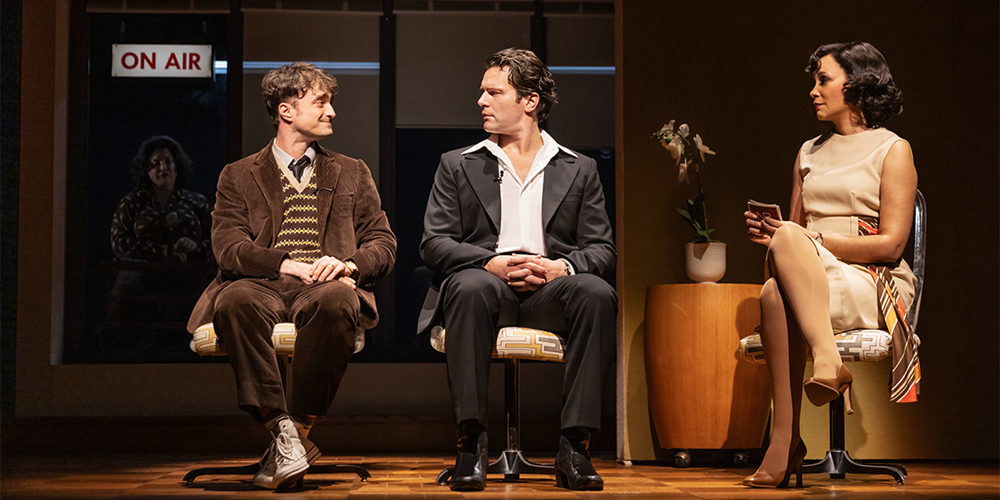
Still, a filmed stage production can only do so much. Some choices here are surprisingly distracting. Characters looking directly into the camera jolted me out of the story more than once. And what may have read as a playful staging choice in person becomes unnervingly literal on screen. The set, designed to evoke the fluidity of time, feels boxed in. Youâre aware of its constraints in a way you rarely notice in a theater, where the mind fills the gaps.
When you consider similarly pro-shot plays like âHamilton,â one can see how it avoided these pitfalls by leaning into a documentary-like immediacy. Friedmanâs âMerrilyâ, by comparison, feels more static, occasionally too faithful to spatial arrangements that were never meant to be scrutinized up close. You sense the production fighting its own architecture.
Costumes and lighting, too, read differently on film. Moment-to-moment transitions that soared onstageâespecially the time shifts between scenesâlose some of their punch. Instead of expanding, the world of the play contracts, and the camera canât quite compensate.
And then thereâs the odd cultural footnote hanging over this release: Richard Linklaterâs long-gestating film adaptation, which he plans to shoot over twenty years to match the storyâs timeline. We wonât see his version until 2040. Until then, this pro-shot stands as the definitive moving-image record of âMerrilyâ. Itâs a placeholder, in a sense. But then, itâs an unusually strong one.
Does It Work? Enough to Matter.
So, is this âMerrilyâ enough? For now, yes. As a play, Friedmanâs revival remains a landmark, a rare instance of a misunderstood work being granted a second artistic life. But as a film, I strongly feel that it never fully transcends its stage-bound origins. Even so, it doesnât need to in order to resonate. The emotional spine remains intact. The performances are exquisite, the score is spellbinding. And even when the camera misbehaves, the story refuses to collapse.
For a musical preoccupied with timeâhow it warps ambition, corrodes ideals, and rewrites friendshipsâthis filmed version becomes its own commentary. It captures a moment, imperfectly but earnestly, before it passes into theatre legend. âMerrily We Roll Alongâ may not be the perfect cinematic adaptation we get, but itâs a âMerrilyâ worth having.
And in the end, that may be the greatest compliment to what Friedman, Groff, Radcliffe, and Mendez achieved. Theyâve given the show a version that breathes on screen, holds its shape, and honors the late Stephen Sondheim with a clarity he would have been massively proud of.


“Merrily We Roll Along” had its theatrical release on December 5, 2025. Follow us for more coverage.