






Durga Chew-Boseâs adaptation of Françoise Saganâs âBonjour Tristesseâ dazzles on the surface, soaking in the golden light of the French Riviera with a painterly precision. Thereâs an intoxicating sensuality to the way the film indulges in its setting, much like Otto Premingerâs 1958 version. For one, Maximilian Pittnerâs cinematography captures the regionâs effortless allureâyou can almost feel the salty breeze and taste the languid decadence in the air.Â
But as with that adaptation, the aesthetic pleasures come at a cost. While visually sumptuous, Chew-Boseâs adaptation often skims over the novelâs sharper psychological edges, leaving behind a film that is captivating to look at but lacking the emotional weight that made Saganâs story endure.
A Riviera Dream, A Hollow Reality
Lily McInerny stars as Cécile, a precocious teenager spending the summer with her widowed father, Raymond (Claes Bang), and his latest girlfriend, Elsa (Naïlia Harzoune). Their days are a blur of sun-drenched leisureâswimming, drinking, smoking, and flirting with abandon. Their life is one without consequences, a kind of careless hedonism that suits them both. Raymond, ever the charming rake, makes no effort to discipline Cécile or curb her flirtation with the neighbor boy, Cyril (Aliocha Schneider).Â
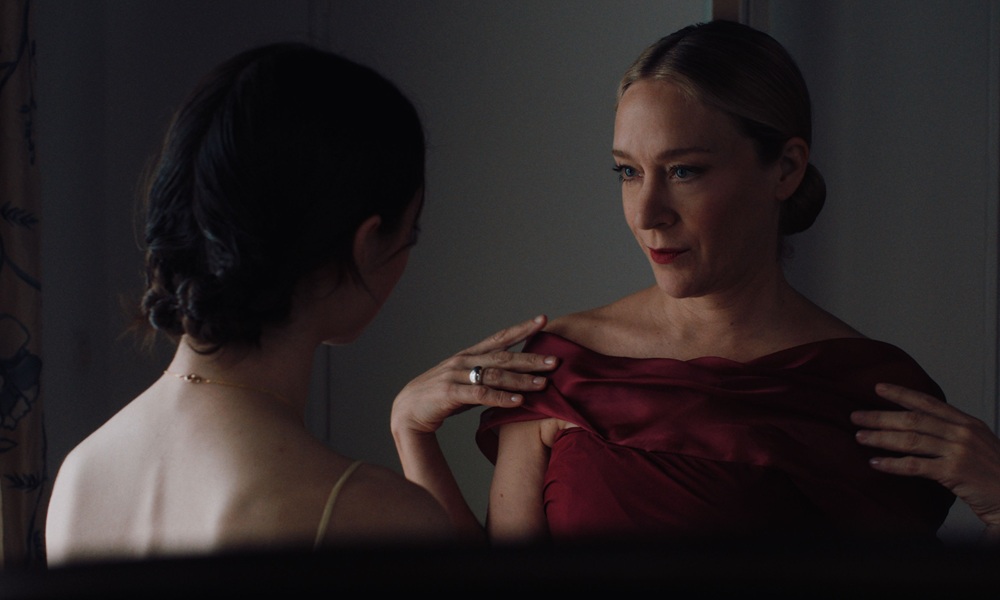
Then, into this fragile idyll arrives Anne (Chloë Sevigny), an old friend of Raymondâs late wife, bringing with her a sense of structure, responsibility, and quiet authority. Anneâs presence upends the household dynamic, particularly when she and Raymond announce their plans to marry, forcing Cécile into a reckoning with the idea that summerâboth literal and metaphoricalâmust eventually end.
More MoMI Coverage: âDesert of Namibiaâ: A Neurotic Portrayal of Dissociation and Emotional Disconnect
Narrative Choices Expose the Missing Weight of Regretâand an Enigma Left Underexplored
While âBonjour Tristesseâ is a story rich with dramatic potential, this adaptation never fully capitalizes on it. Unlike the novel, which opens in medias res with Cécile reflecting on the events of that fateful summer from a colder, more detached present, the film follows a straightforward, linear structure.
The loss of this framing device is a missed opportunity; Saganâs decision to structure her novel this way gave it a sense of melancholic inevitability, forcing readers to consider why things happened rather than what happened. It also positioned Cécile as a more reflective narrator, allowing the weight of her choices to settle in as something she would never quite escape. Without this narrative layer, the film feels curiously weightless, moving from scene to scene with an air of inevitability but little real emotional urgency.
Thereâs also a frustrating vagueness to the filmâs handling of Anne, a character whose complexity should have been an asset. The novel paints her as both a stabilizing force and an emotionally fragile woman, someone whose strict adherence to order is as much a defense mechanism as it is a virtue. Her unraveling stems from deep emotional wounds, exacerbated by Cécileâs schemes and Raymondâs insouciance.Â
Here, however, Anne remains something of an enigma. The film hints at her struggles but never fully commits to exploring her mental state. Sevigny, always an arresting screen presence, does her best to inject nuance into the role, and there are moments where she suggests a well of hurt beneath Anneâs composed exterior. But without a stronger script to support her, Anneâs emotional arc feels less like a slow, painful dissolution and more like an unfortunate plot development.
âBonjour Tristesseâ: A Beautiful Shell Without a Beating Heart
Despite these shortcomings, the film is not without its pleasures. As mentioned, Pittnerâs cinematography alone is reason enough to watch, capturing Côte d’Azur with a sensuousness that borders on intoxicating. On the other hand, Lesley Barberâs piano-rich score complements this mood beautifully, evoking both the playfulness of youthful indulgence and the quiet ache of growing up. And while the film itself doesnât always rise to the occasion, Sevignyâs performance remains its strongest asset. Her Anne is just as enigmatic as Deborah Kerrâs, if not more. Whatever the case, Sevigny brings enough raw intensity to certain momentsâparticularly in the later scenesâthat she almost compensates for the scriptâs reluctance to fully explore the character.
But when all is said and done, this âBonjour Tristesseâ remains a beautiful yet hollow experience, a film that captures the surfaces of its world but not the depths. Itâs a respectable debut from Chew-Bose and a handsomely crafted one, but it never quite justifies its own existence in the shadow of both the novel and the 1958 film. Either bold reinvention or deeper psychological insight could have given it a reason to stand on its own, but without either, it fades into the backgroundâmuch like the fleeting summers its characters so desperately cling to.


“Bonjour Tristesse” screened in this year’s First Look, the annual film showcase of the Museum of the Moving Image (MoMI). The festival runs from March 12 to 16, 2025. Follow us for more coverage.




