Watching Ariana Grande and Cynthia Erivoâs powerhouse performances in âWickedâ (directed by Jon M. Chu from a screenplay by Winnie Holzman and Dana Fox) was akin to watching Muhammad Ali and Joe Frazierâs legendary boxing match of 1971. Granted, Grande and Erivo didnât throw a single punch.
But like Ali and Frazier in that pivotal fight 50 years ago, youâre watching two people in their absolute prime giving it everything theyâve got, their talent and prowess creating a spectacle that transcends the norm. And when the dust settles, you simply feel awfully lucky that you were here to witness it.
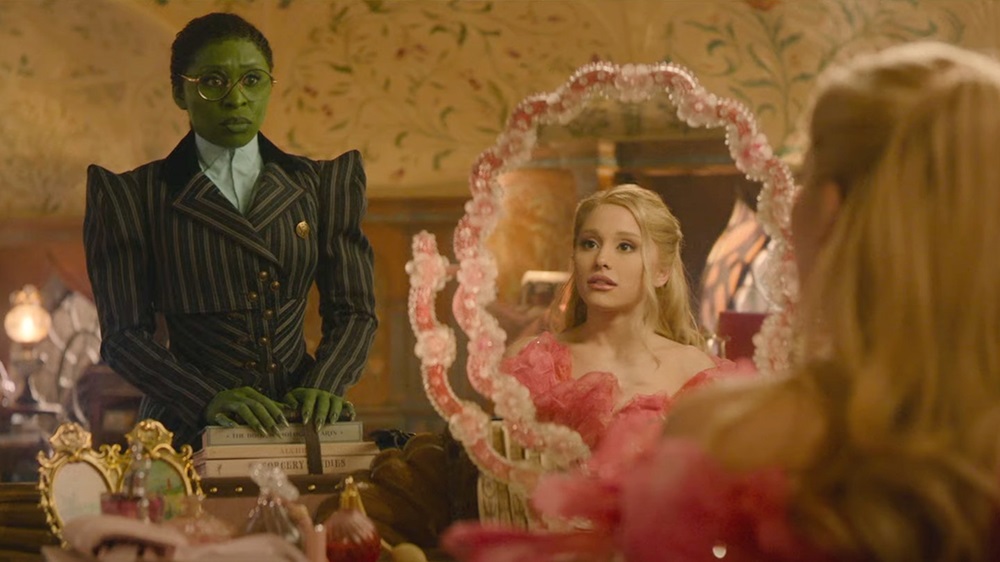
The bulk of âWickedâ takes place at the magic college Shiz University, where Galinda and Elphaba (Grande and Erivo, respectively) attend classes. A friendship evolves throughout the film between the two, though Galindaâs jealousy of Elphabaâs magic lends a sinister edge to their relationship. At times you wonder if Galinda isnât befriending Elphaba in preparation for doing something horrible to her. When dashing new student Fiyero (Jonathan Bailey) arrives at the school, romance is afoot. But does he love shallow Galinda or the more complex and moral Elphaba?
Yes, Galinda may be âThe Good Witchâ but Elphaba is truly the more virtuous of the two, always looking out for her paralyzed sister Nessarose (Marissa Rose) and standing up for the animals in the film.
The Film’s Themes and Visuals
The CGI in the film is impeccable, from the steampunk-style technology to the abundance of anthropomorphic creatures throughout. Dr. Dillamond (voiced by Peter Dinklage), a spectacle-wearing talking goat professor at the university, is an especially adorable character. Dinklage gives Dillamond an optimism and joy for teaching underscored by world-weariness; like a sweet, loving grandfather who keeps a happy face around the kids and grandkids but finds himself haunted by wars and other traumatic events in his past.
Speaking of wars and trauma: if youâre expecting this film to be a light and fluffy musical, the complex thematic layers âWickedâ tacklesâespecially in the second halfâmight surprise you. There are subtle (and not-so-subtle) themes of racism, animal rights, and the creeping insidiousness of fascismâall topics that were covered in L. Frank Baumâs Oz books. Baum was socially progressive in some ways, having been a staunch ally of the womenâs suffrage movement and an animal lover. He also understood the dangers of fascism and how it always comes slowly and quietly, taking hold only when good people donât stand against it.
The Two Stars: A Closer Look
Thereâs been a lot of malice thrown Grande’s way through the years. Even so, one can’t deny her colossal talent. Sure, Taylor Swift is the current queen of pop, routinely drawing crowds big enough to have their own ZIP code; but Grandeâs not just a triple threat; sheâs a quadruple threat (acting, singing, dancing, and impressions).
Anybody whoâs seen Grandeâs appearances on Saturday Night Live knows sheâs a true chameleon, able to lose herself in any role she takes on. As Galinda Upland, she manages to be charming despite the fact that her character is bratty and narcissistic beyond belief. And in the film, sheâs always accompanied by her gay friend Pfannee (Bowen Yang in a hilarious performance), who hangs on her every word and fashion choice like sheâs Nostradamus.
On the other hand, Erivoâs Elphaba Thropp (whoâs destined to become the Wicked Witch of the West) serves as Galindaâs antithesis. She has lived a hard life, her green skin condemning her to a life of a pariah and outcast. Her father even hates her but tolerates her.
Having to live a life of isolation and constant bullying, Elphaba developed misanthropy, rarely talking to anyone and burying herself in books. Erivo portrays her splendidly, giving Elphaba gravitas that makes the audienceâs heart break for her throughout the film. Her magic is powerful, which, of course, makes her even more terrifying and strange to those around her.
A Love of Film History
Director Chu obviously has a great love of film history, giving so many great nods to the past throughout âWicked.â Thereâs a Busby Berkeley-style musical sequence set in Shiz Universityâs library (which has so many revolving rooms and rotating shelves that it would give M.C. Escher nightmares) thatâs reminiscent of the dance sequence from 1937âs âReady, Willing and Able,â where Ruby Keeler and Lee Dixon danced atop a giant typewriter. Here, that sequence is magnified by 100, and to say that dazzles would be a massive understatement.
Later in the film, thereâs a Bob Fosse-style dance number, the players contorting their bodies in that slithery geometry that Fosse loved so much. The scene feels like something out of Fosseâs film âSweet Charity.â
Thereâs also a terrifying sequence where two of the characters are running down a hallway as hands come crashing through the walls and windows, which reminded me of that haunting scene in Jean Cocteauâs 1946 film âBeauty and the Beast.â In that film, the main character runs through a corridor as phantom hands grab at her from the walls at every angle.
âWickedâ: An Epic Experience
The word âepicâ gets tossed around a lot these days. Every big-budget film released in the last few years promises to be âan epic experience.â
âWicked,â however, justifies that claim. Chuâs love of film is infectious. This musical (just the first part of whatâs shaping up to be a glorious two-parter) has so many soaring musical numbers, plot twists, great characters, and touching moments that you walk out of the theater realizing that youâve TRULY seen an epic film.
“Wicked” was theatrically released in the United States on November 22, 2024. The sequel, “Wicked Part Two,” is scheduled to be released on November 21, 2025. Follow us for more coverage.