





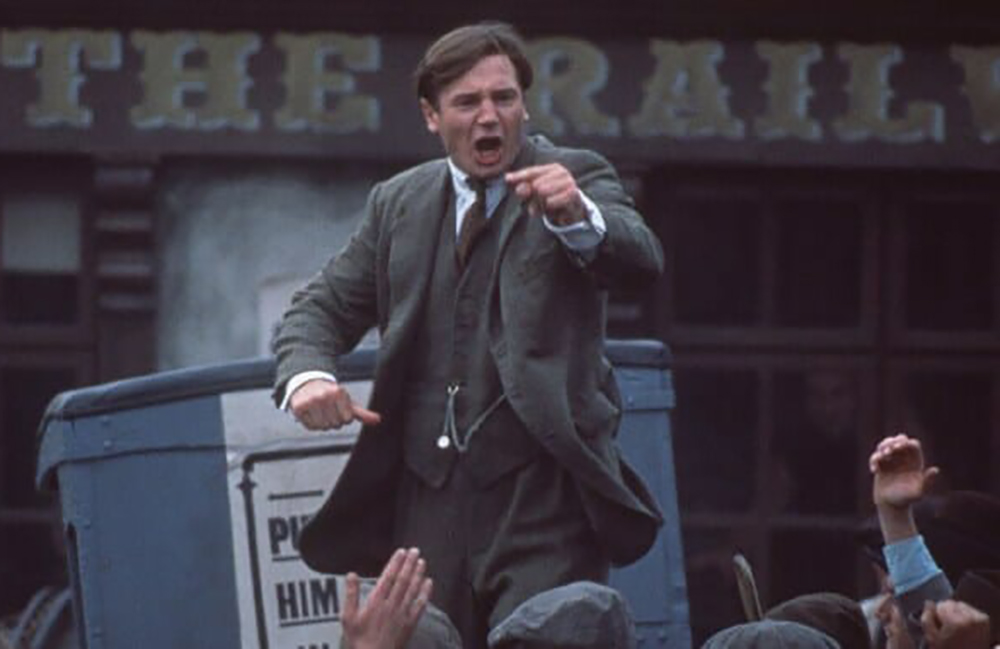
âMichael Collins,â the 1996 biopic starring Liam Neeson and âThe Wind the Shakes the Barley,â from 2006 are perfect complementary films on Irish oppression. When Ireland was divided into two countries â the âfree stateâ and Northern Ireland â Britain achieved its goal of polarization and division. âBarleyâ showed more empathy for the Irish Republican Army after Collinsâ actions, whereas âMichael Collinsâ shows more empathy for the Free Staters. But both build a solid picture of English oppression, Irish resilience, and the tragedies that lined both. That Neeson â as Collins â doesnât own this film but plays alongside it is one of its major strengths.Â
âCollinsâ professes to be a biopic, and in that it succeeds â kind of. Weâre introduced to Michael Collins (Neeson) at the filmâs beginning at the âEaster Rising,â the latest in Irelandâs then-hopeless campaigns at revolution. The Irish are defeated by the British easily; itâs a miracle that Michael Collins â along with Harry Boland (Aidan Quinn) â arenât killed at the following executions. They donât deem Collinsâ a ring-leader. Maybe the should have. But no one saw the leader he would become, who would re-imagine revolution for the coming future.Â
A Violent Yet Saddening Film
Where âMichael Collinsâ shines is in showing the para-military tactics â namely guerrilla warfare â that would set Collins apart from other, failed attempts. He makes an early contact from the Dublin Castle (Stephen Rea) who would give him the advantage. After a clandestine theft of Castle files, Collins begins strategic hits on high-ranking officials to dampen the ability for England to gather spy-fed intelligence. Where military incursions failed, his IRA executes officials quickly and surreptitiously, then disappear into the crowd. All around them the dress of the times â namely menâ suits and elegance â quiet the violence where a military uniform would have highlighted it.Â
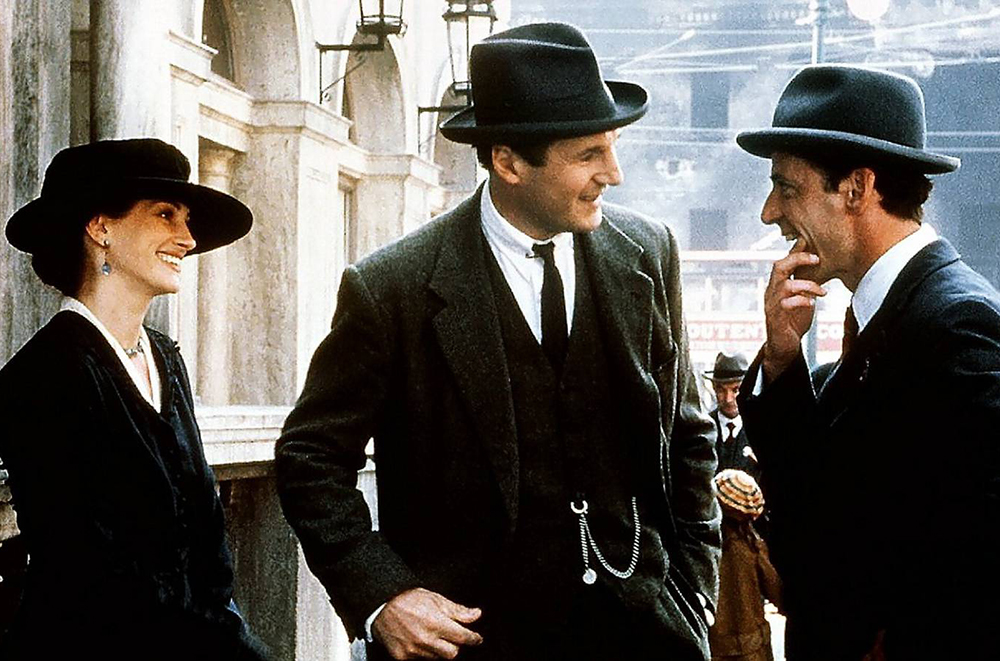
The film â directed and written by Neal Jordan (himself born in Sligo, Ireland) â certainly looks the part. If it falls, slightly, itâs in its ambitious script and terse pacing. The film, at 2 hours and 13 minutes, introduces Collins almost immediately as a force to be reckoned with, and doesnât take the time to build him from a shadow to a hero. Collinsâ importance to the rebellion is earlier hinted at by Eamon de Valera (Alan Rickman), but not spelled out. Collinsâ friendship with Boland is, even as the film introduces a love interest, Kitty (Julia Roberts), who comes between them. They vie for her affection; but what I gathered from these scenes is the divide Boland and Collins would become victim of, as the former championed the Irish Republic and the latter wanted peace and supported an Irish free state.Â
Some Thin Development Harms ‘Collins’
Thereâs also the issue that Jordanâs screenplay doesnât take the pains it should to show the utter brutality of the English. Of course some (like Reaâs Ned Broy) donât fare too well, but the film lacks the barbarism of Ken Loachâs âBarleyâ and assumes â sometimes wrongly â that the audience will know the history of Englandâs oppression against the Irish. We see shootings and executions, but not what led up to them. And Jordan sandwiches this against great set pieces, but actors who seem in a hurry to get where theyâre going. Rickmanâs de Valera â as Robert Ebert suggested â is inserted into this narrative as the necessary âIrish villain.â
But thatâs not the whole truth. If we learned one thing from âThe Wind that Shakes the Barelyâ â or history â itâs that these things are never simple. Weâre dealing with personalities that want the same thing â a free Ireland â but have different visions of how to get there. The fact that de Valera eulogized Collins later in life shows he may have seen his missteps. But what Jordanâs film sidesteps mostly is that England caused these hardships. Irelandâs reaction to oppression is not the greater story, but one twisted to political ends.Â
An Important Film, Nonetheless
But all that aside, âMichael Collinsâ is a strong film. Neeson â 3 years off of the timeless âSchindlerâs Listâ â still has that charisma that made that film a success, but here looks the part of Collins through and through. His mannerisms, his not overly-Irish accent, even his hair weave⦠he looks the part of the reluctant patriot, and looks equally heartbroken over his slow division with del Valera, Bolond, etc. One scene stuck out: as he chastises a group for executing a free stater â their enemy in their eyes. âHe was one of US,â he shouts. Heâs not wrong. Collins reached a point where he wanted to avoid war, and wisely knew that England was pitting them against each other.Â
The rest of the players, from Quinn, to Rickman, to Roberts (as well as a host of characters such as âGame of Thronesââ Charles Dance and Irish regular Brendan Gleeson) make the film memorable. Jordanâs Dublin strikes as a place to remember, and I donât doubt that James Joyce would have been proud. Its hallmarks of elegance (pinstripe suits, top hats, and pocket watches â often rode atop leisure bicycles) hammer home the time period of a simpler time in a way that is interrupted and prostituted by violence all too well. You can imagine a simpler existence where pints at the pub and fiddle songs lined Irish history rather than bloodshed and moral trials.Â
Watch Alongside ‘The Wind that Shakes the Barley’ for a Full Perspective
But âMichael Collinsâ is a solid movie. Itâs enthralling, which it needs to be, and sad, which it ought. Neeson leads a film that dabbles in reluctance, and Jordan paves the road in shadows, dreariness, and hope. It earned rightful Oscar nominations in cinematography and score, and ends the way history foretold. The film is currently on Amazon Prime. Watch this alongside âBarleyâ for a survey on Irish history, and a masterclass on empathy of both sides â and how Ireland â as Collins narrates â was forced to hate, and hated for that demand. The film makes you regretful for the past and at once understanding, which undoes the filmâs mistakes and leaves you with a dolor that is palpable. A solid film not to be missed.Â
“Michael Collins” is available to rent on Amazon Prime and other networks.Â




