Struggles for freedom have heroes on both sides, and the best movies on the subject donâtâ sugarcoat, but depict real men and women and the unthinkable actions they often perform in the name of liberty. The 2006 epic “The Wind the Shakes the Barley,â by Director Ken Loach is such a movie, a film that, in vibrant colors, paints the cold, harsh epoch of 1920s Ireland and follows a group of ordinary men and women who turn to violence to free themselves from English rule and cruelty at the hands of stationed British soldiers, better known as the âBlack and Tans.â
The film follows a group of villagers in County Cork, centering on two brothers, Teddy OâDonovan (Pádraic Delaney) and Damien OâDonovan (Golden Globe Nominee Cillian Murphy) who take up arms against the British in the face of enormous cruelty. For Teddy, perhaps a born leader, the decision to do so was clear. For Damien, slated for medical school in London, the decision was less so. However, the murder of one of their childhood friends at the hands of Black and Tans launches Damien into action. The brothers, along with others, join the Irish Republican Army and take up arms against the British, engaging in guerrilla-type warfare in a town they used to call their home.
âThe Wind That Shakes the Barleyâ takes great pains to recreate 1920âs Ireland, and the result is nothing short of captivating. However, itâs a tragic recreation, as the lush, sweeping hills of Ireland, the dress of the period, and the quaint, familiar bars and taverns of Cork are interspersed with fear, violence, and combat. In one scene, a group of men stand around a pool table, enjoying pints and playing billiards. However, British soldiers quickly invade, making them stand at attention as they buy drinks for themselves, paid for by money stolen from Irish commoners. However, the scene quickly changes from violence against the Irish to violence by the Irish. IRA members sneak guns into the pub and take out the British soldiers as they drink their beers in a back room.
Loachâs film is a hard oneâand though it makes efforts to paint the Irish Civil War in a positive light, itâs hard to ignore some of the historical barbarism that lines both sides of the struggle. Restrictive English rules (such as the Irish not being allowed to meet in public, even for sporting matches), abuse, and brutality are common occurrences. Likewise, English retaliations against the IRA, including beatings, tortures such as finger nail pullings, and executions are especially hard to bear. However Loach shows both sides, highlighting barbarism at the hands of the IRA, as we witness executionsânot just of British hostiles, but of Irishmen viewed as traitors to their country, who are summarily executed by men who they thought were their friends.

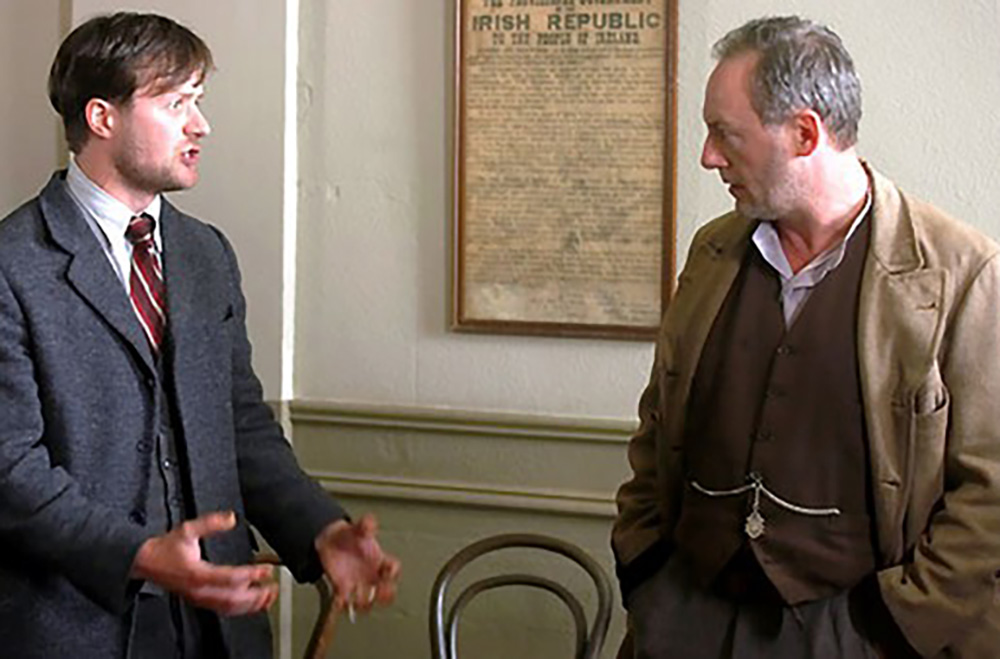
A good deal of âBarleyâ centers on the often-strained relationship between Teddy and Demian, as well as painting the political climate of the time in exquisite detail. These scenes are helped, or rather, perfected, by the marvelous acting brought to the table by âBarleyâsâ exceptional cast. For instance, as the violence escalates, Teddy and others let pass certain inequities, such as poor citizens being extorted by money lenders, because to fight such deeds would become time consuming and interfere with arming their soldiers. We understand their point, yet canât help but side with passionate townsfolk like Dan (Liam Cunningham, “Clash of the Titans,”) who reproaches IRA members for selling out their own just like the English. The political debates and arguments of these men and women arenât acted, but experienced; the performances come off every bit as authentic as watching real men and women going through the throes of trying to liberate a country while losing their souls in the process.
The gem of âThe Wind That Shakes the Barleyâ is doubtless Cillian Murphy, who, with an upbringing in Cork in his youth seems as if he was born for the role of Damien. His early ambivalence to get involved in the war quickly becomes replaced with a loyalty for family and country unflappable by seemingly any test or occurrence. Scenes where he must carry out the IRAâs often-monstrous tasks donât roll effortlessly off his back, but are worn as duty and heartache. âIâve studied anatomy for six years, and now Iâm going to shoot this man in the heart,â he remarks in one regretful contemplation. His character tragic, he attempts to build a normal life with his new spouse Sinead (Orla Fitzgerald), but his love of country and love of family often come in stark contrast as he navigates an impossible road. âBarleyâ was released in 2006, a year after Murphyâs appearance as Scarecrow in âBatman Begins,â but the performances couldnât be more different. Murphyâs Damien feels younger, more vibrant, and more impassioned. Itâs easily his best performance to date.
This is not an easy film, or one that audiences will take lightly. Unlike other war epics of its ilk like âThe Patriot,â its ending is not clear cut or a cause for celebration. Irelandâs struggle for independence would sway back and forth many times, with even the countryâs most respected leaders such as Michael Collins coming under fire for results that left Britain still partially holding the reins. What Loach has done in the making of âThe Wind That Shakes the Barleyâ is to dramatize and recreate the pains â both political and emotional â that have lined the lives of those who fought for Irelandâs freedom. Its focused lens, its spot on social commentary, and the exceptional acting brought from nearly every cast member makes it an easy recommend and a wonderful picture to behold. To watch âBarleyâ is not to feel you are watching a movie about Irish history but to feel you are a part of it. That such a film was produced in 2006 only makes its success that much more captivating.