





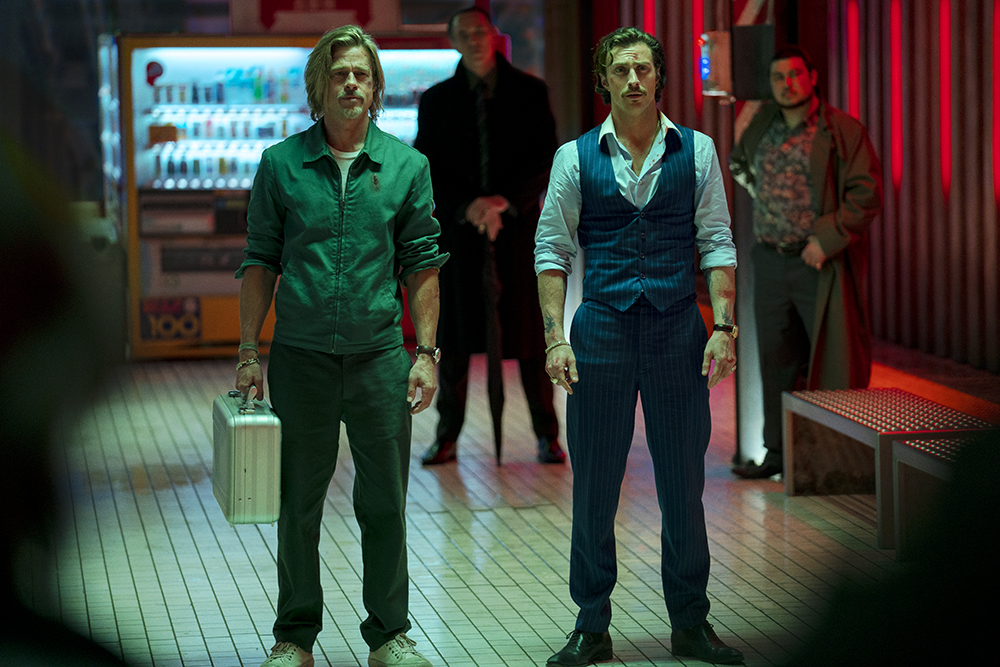
David Leitchâs adaptation of KÅtarÅ Isakaâs novel, “Bullet Train” is yet another Hollywood all-star gathering that leads to a disappointing final product. As it poorly emulates Tarantino and Guy Ritchie, the action picture ends up as a cartoonish mess and exhausting watch more than an entertaining popcorn flick.
After co-directing “John Wick” (2014), the kickstarter of a high-tension franchise, Leitch has had his hands full. Three years after such success, Leitch delivered the Charlize Theron-led feature, “Atomic Blonde,” which was exhilarating and a big surprise to me because I didnât expect to enjoy it to the degree that I did. Its well-crafted action set pieces were elevated because of Theronâs energy and badass performance â in the process, downgrading the negative aspects one might have of the film.
A Film That Departs Greatly from the Trailer
However, after the film’s release, the directorâs personal filmography (not counting his producer tags) went entirely downhill. Leitch took the helm off Tim Miller and directed the sequel to the 2016 R-rated hit “Deadpool.” And although there are some enjoyable moments in the film, “Deadpool 2” ended up being an extremely annoying and exhausting experience at the cinema, primarily because of Ryan Reynoldâs schtick and being way less clever than it thought it was.
This same experience can be translated in some way, shape, or form onto “Bullet Train.” The trailer presented itself as a high velocity âbeat ’em upâ with tons of the flash and neon style that was present during his previous features, particularly “Atomic Blonde.” In addition, it has multiple Hollywood stars covering every inch of the screen (Brad Pitt, Aaron Taylor-Johnson, Brian Tyree Henry, Bad Bunny, etc). And the final product contains all that, plus more, for better or worse â mainly for the latter. “Bullet Train” had the potential to be a high-pulse and entertaining popcorn flick. On paper, the movie had plenty of aspects going its way aside from the talented cast. Nevertheless, Leitchâs direction and Zak Olkewiczâs script are all over the place. This causes the film to be exhausting and muddled. It continually introduces its array of characters into the bloody and action-packed mix.
The Film’s Tarantino and Ritchie Stylings Don’t Quite Find the Mark
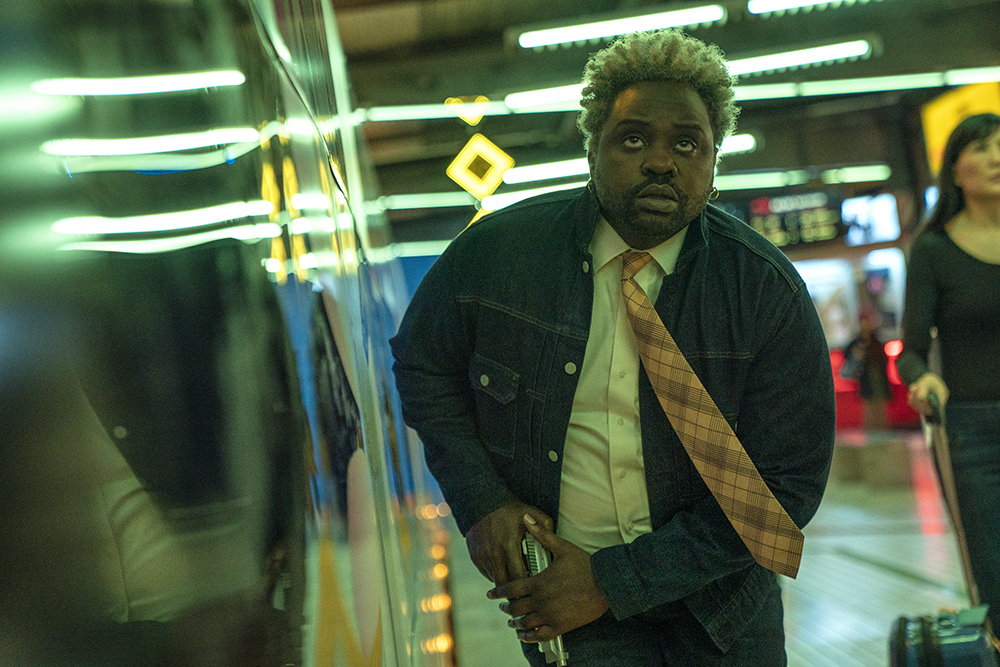
“Bullet Train” revolves around an assassin code-named Lady Bug (Brad Pitt), who has done way too many gigs that have gone off the rails. He doesnât want to quit entirely. However, he wants a job that is tamer than his previous ones and one that goes according to plan. However, fate has other plans, and his latest, which requires the simple task of boarding a bullet train in Tokyo, finding a specific briefcase, and getting out to the next stop possible, might be his most death-defying and dangerous. Unfortunately for him, heâs not the only person searching for that briefcase. Multiple lethal adversaries from around the globe gather on the worldâs fastest train with the same purpose. Leitch channeled his inner Quinten Tarantino and Guy Ritchie for this project, which isnât a good sign. It totally feels like a person trying too hard to emulate the two from the get-go.
There are killers with specific codenames (Tangerine, Lemon, Prince, The White Death, etc.) who argue about their aliases while referencing pop culture (some of them being of Thomas the Tank Engine). The mid-fight expressions like âhurt people, hurt peopleâ feel like a wink or smirk to the camera. Furthermore, it contains plenty of the stylistic choices in Tarantinoâs “Kill Bill” (the backstories for side characters, the needle drops, the slow-motion apparitions, etc). It feels as if David Leitch wanted this film to be the epitome of action blockbuster coolness.
Also Read:Â Review: âHonest Thiefâ Liam Neeson Should be its own Genre of Cinema
And there is a sense of âcoolâ coming from some of the cast memberâs personas, Brad Pitt and Brian Tyree Henryâs specifically â one because of his movie-star standing and the other because of his comedic timing, making the best out of the poor jokes in the process. Nonetheless, it ends up being too grating and exhausting in the execution process. You could argue that it delivers what it says on the tin very clearly, with its action-packed hyper-violent scenario and cracked witty self.
Too Many Characters for the Audience to Connect to Any One
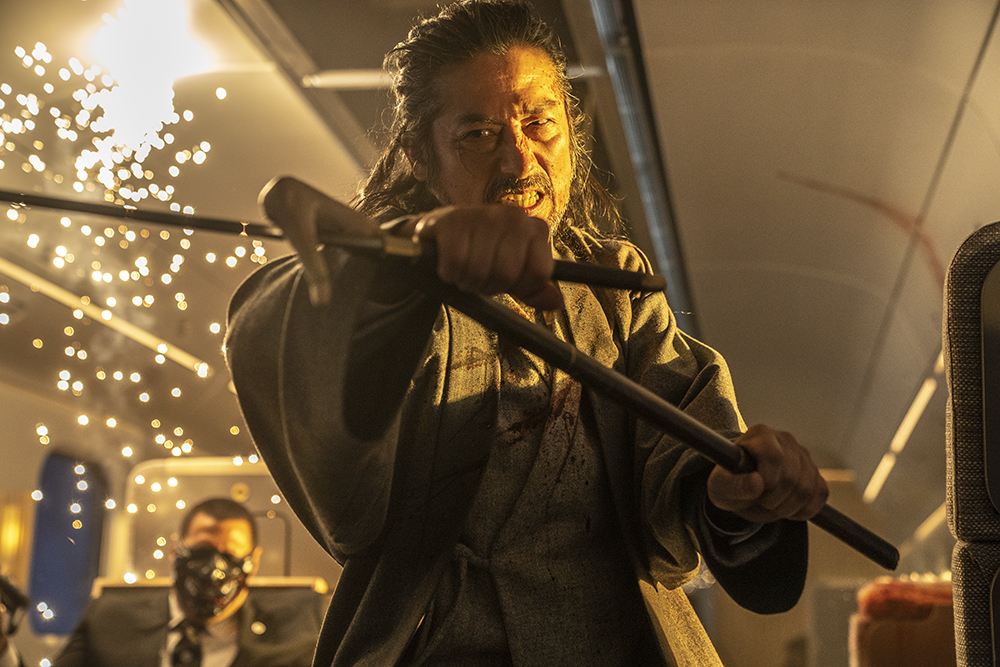
Nevertheless, it feels like thereâs an overload of stuff going on and arriving at each second. At a certain point it starts to get on oneâs nerves. However, thatâs not “Bullet Trainâs” most significant fault â that title belongs to its script and narrative structure. Since the film is constantly trying to juggle multiple characters and their respective plot-lines, it creates plenty of narrative complications; there are two primary ones. The first of these is that the audience doesnât care about any of these characters. They could be beaten to a pulp, sliced, or shot. It’s hard to root for any of the characters here, not even Brad Pittâs Ladybug. This then creates a sense of separation from its cinematic sensibilities and popcorn entertainment. Itâs just people fighting with each other without much explanation. And thatâs where the other primary fault comes into play. Thereâs no logic to whatâs happening on- screen almost during the filmâs entire run-time. This is both in its action and character development.
None of the characterâs connections with each other are appropriately set up or expanded upon. It leaves most of its explanation toward the end, at a point when the audience doesnât really care for such information since it’s already reaching closing time. The set-up to the action set pieces are accommodated around sheer âconveniencesâ rather than storytelling and directorial heft. Things happen for the sake of it, and the audience has to go along because they have no other choice. However, that doesnât mean they arenât entirely poor or diminished because of that. Some of the action happening is entertaining enough to withstand the poor design and layout. Although they are not close to being up-to-par with “Atomic Blonde,” I could see plenty of people being engaged with them. For example, a hand-to-hand fight between Pitt and Henry shows apt choreography. And thereâs also some tight-spaced combat with a snack bar that quickly nods to Jackie Chanâs earlier work.
A Film Too Self-Aware for its Own Good
In the end, “Bullet Train” flounders not because of David Leitchâs lack of talent, but because of the personas heâs trying to emulate. As the film continues, you see more of Tarantino, Ritchie, and even some of Robert Rodriguez’s stylistic panderings. Unfortunately, it is all for the worse, as its originality keeps flailing as it transgresses. With repetition of jokes that donât land (which is constant) and a shoddy script, you could only go so far. This is especially since it thinks it is way more clever than it actually is. And with the best bits and pieces of the movie already being in the trailer, whatâs left to enjoy? Instead of being a glossy late-summer popcorn movie, “Bullet Train” ends up as a cartoonish, too-self-aware, and exhausting feature that demonstrates that stars and style arenât enough to sustain a project. It needs personality, coherence, and panache.

“Bullet Train” is currently only available to watch in theaters.Â
Support the Site:Â Consider becoming a sponsor to unlock exclusive, member-only content and help support The Movie Buff!


1 Comment
Poorly written and barely coherent. The writer of this review clearly has an issue with the fact that, cinematically, this movie borrows from Tarantino movie techniques. But they fail to grasp that Tarantino has plagiarized from eastern cinema for years. At the end of the day, itâs a solid movie.