With the kinds of films that I enjoy, thereâs no in-between for a movie like âMonosâ for me: it will either be very boring, or Iâll love it. I think this is because of the short summary on IMDbâit reads, âon a remote mountaintop, eight kids with guns watch over a hostage and a conscripted milk cow.â I think itâs the conscripted milk cow that will elicit chuckles or make people not take it seriously, and I was one of those because that part does sound like it could just be strange.Â
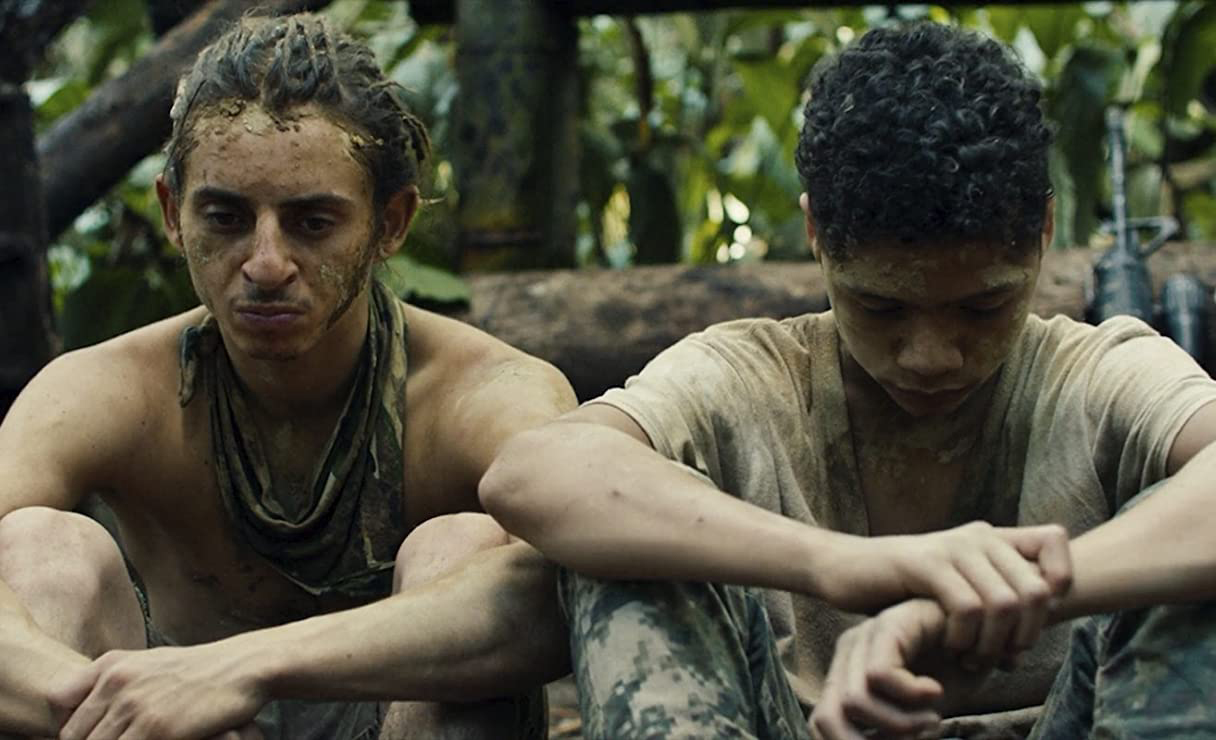
The cow is merely a setting piece as âMonos,â a Spanish-language film, is one I fell completely in love with and was never bored by. The writing is immediately interesting as the eight âkidsâ are blindfolded, playing a game with a bell with a bell inside it trying to get it into a net with more bells. We soon learn that these kidsâranging in age from as young as what could be 12 or 13 with Smurf (Deiby Rueda), to 19 or 20 with Wolf (Julián Giraldo)âare rebel child soldiers in Colombia who have kidnapped an American engineer, Doctora (Julianne Nicholson) and are holding her captive. They are also given a milk cow to protect.Â
It doesnât seem like these soldiers are affiliated with the Colombian military in any way, but thatâs never really clear to me, because I have no knowledge of how a military group like this works. We only know theyâre a group of kids brought together by something called The Organization. I think thatâs my only complaint of âMonosââthereâs no explanation for who they exactly work for or why they have Doctora as a hostage; and the only semblance of structure for the kids is reporting to the Mensajero/Messenger (Wilson Salazar), who gives them the cow and that catches up with them later.Â
Otherwise, there is no structure and thatâs the point as they are just a bunch of kids on a mountaintop trying to be soldiers. Theyâre free to do whatever on top of the mountaintop and they truly doâthereâs challenging adolescence as they learn about themselves as director/co-writer Alejandro Landes depicts adolescence similarly to war as they are both unpredictable. It makes this feel like a coming-of-age film as well as a war adventure; but itâs not coming-of-age in the traditional sense like a teen drama like âThe Perks of Being a Wallflower.â Their debauchery is funny, especially when some characters try shrooms. Since theyâre teenagers, everyone is horny and curious. The film touches on identity well with the gender ambiguity of Rambo (portrayed by Sofia Buenaventura), one of the characters here with the most compassion.Â
The relationships and dynamics depicted amongst them all are also intriguing in how they can lead to jealousy and more complications. This is especially because there are only two girls on the mountainâLady (Karen Quintero) and Swede (Laura Castrillón)âand everyone is horny and curious. This brings the film a hedonistic edge along with the characterâs sense of duty. Theyâre teenagers first and soldiers second, and itâs fascinating how this approaches that.Â

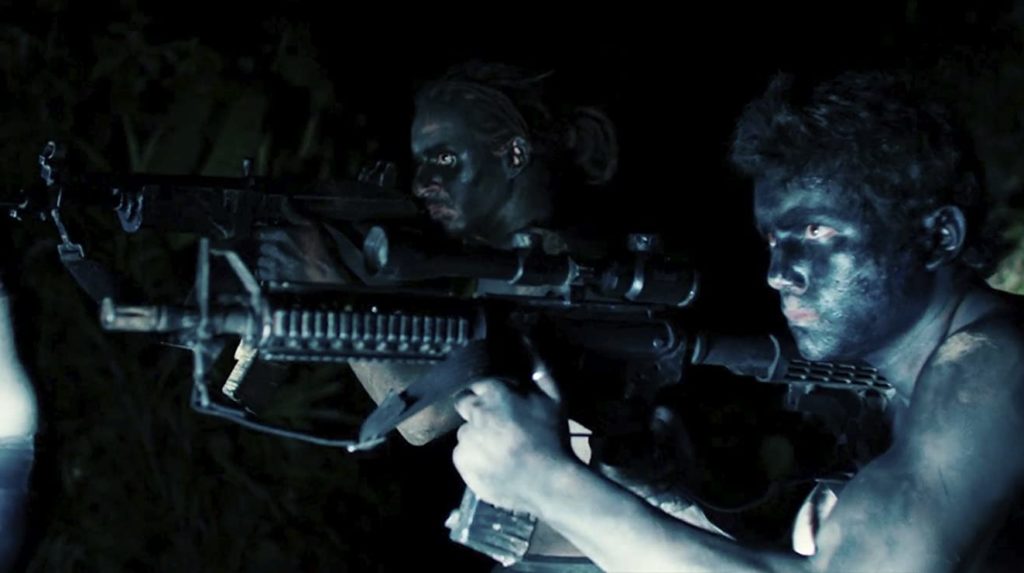
The drama and tension feels natural because of their character dynamics. A lie near the beginning of the filmâa lie which not everyone agrees on tellingâsets up the filmâs proceedings flawlessly and is a weight over their heads that threatens their bond. While the filmâs writing is great and the directions it goes in are very smart, the acting is also great. It feels natural, like weâre just watching a group on a mountainside, and thatâs largely because for most of the actors, this is their first feature film. The only actors with experience are Julianne Nicholson and Moises Arias (Rico on âHannah Montanaâ) as Bigfoot. His character is funny and his arc is the most fascinating, as his character is how the film expresses its themes of power and leadership within the group. Though, viewer be warned: We see him in his underwear and at no point in my life did I ever need to see the bulge of his Rico. In all seriousness, Arias is a highlight in this great role, and I love the roles he chooses. Julianne Nicholson is also good as Doctora, a hostage that also seems to be the glue of this group.Â
Besides the great drama, âMonosâ has a great score by Mica Levi. The film is also completely gorgeous. Some shots by cinematographer Jasper Wolf, especially when the film set on the mountaintop filmed at Chingaza National Park (13,000 feet), are breathtaking. Iâd also be so curious to know certain scenes are shot, as the results on camera make it seem like the shoot would have been demanding. This is especially the case for the second half of the film when the characters come off the mountain and the adventure genre kicks into gear for some of it. Gone is the comfort of the mountainside as they go into the unknown of the Colombian forests. Also gone is most of the amusing debauchery as the film dives deeper into its dark storytelling, themes and the characters and their situation. We learn some characters are doing this out of necessity of duty, and others want out. If there are any political themes here, those usually go over my head, but I donât think the film feels like itâs an in-your-face political message.
I think what Alejandro Landes (as well as co-writer Alexis Dos Santos) are going for with this film is when I saw a roasted pig and it clicked for me that this is so much like William Goldingâs âLord of the Fliesâ as the characters have a familial bond as they try to follow their own rules, establish order, and it all falls apart. There are times during this near the end where they feel as if theyâre going to their primal instincts, fitting as âMonosâ means monkeys in Spanish. I was fascinated to learn after the film that this is loosely based on âLord of the Flies.â Itâs never in a way where this feels like a âLord of the Fliesâ rip-off, only an homage, because thereâs passion and power in this filmmaking and writing.