





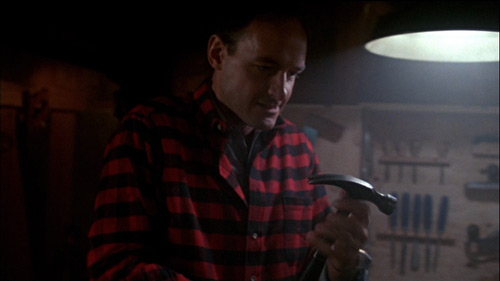
âWho am I here?â Jerry Blake asks, seconds before attacking a would-be victim. Blake is played by Terry OâQuinn (TVâs âLostâ) and the film is this, 1987âs âThe Stepfather.â As a horror film, it holds up to the test, including both setting and scares, a rare feat compared to much modern horror, which is fascinated with either hauntings or gore over story. The film takes place in the suburbs of Seattle (creep factor added due to the events that took place in and around Seattle during Ted Bundyâs killing spree), but rightly could take place anywhere. The filmâs antagonist and setting go hand-in-hand here with their anonymity.Â
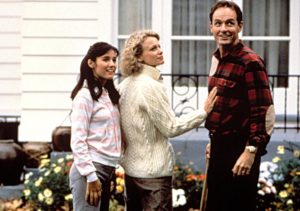
The plot of âThe Stepfatherâ is straightforward, setting up itsâ premise eerily and simply. OâQuinn plays a stepfather to a teenage girl named Stephanie (Jill Schoelen), and boyfriend to her mother, Susan (Shelley Hack). Weâve already seen what kind of man the stepfather is from the filmâs grisly opening sequence, where he walks nonchalantly out of a house whose inhabitants he has just killed. They failed to be his âperfect family,â and paid the price. Leaving his job and residence in that town, the filmâs events take place a year later as he attempts once again to craft the perfect family with Susan and Stephanie – no matter what cost.
Cinematically, what works about âThe Stepfatherâ is the creepy air it sets up, and the quaint autumn setting that serves as its backdrop. The stage setting is a little cheesy, particularly a leaf-raking fight between mother and daughter, but sets up a simple prospect: that Susan and Stephanie are happy. However, Stephanieâs mood changes as Jerry comes home, the film quick to introduce us to the mistrust and sense of danger he presents to her. She canât explain it to her mom, her friends, her therapist. Director Joseph Ruben shows us in a couple of quick scenes – from plastic smiles Jerry emits to a monologue of him losing it in his familyâs basement; we see Jerryâs not quite right, and the film puts us on edge as to just what might happen next.

The best films leave horror up to the imagination, rather than splaying it with high-def gore across a movies screen. In this way, Alfred Hitchcockâs âPsychoâsâ greatest achievement was in underscoring with oddity and horror the intentions under Norman Batesâ speech, showing us what evils he may be capable of, even without giving us the now-renowned shower scene.
Ruben clearly shows reverence of Hitchcockâs filmmaking with âThe Stepfather,â especially in its unsettling score, and the slow-to-build menace that the stepfather injects into the story. Itâs a testament to the filmâs story that this works, but a greater testament to the acting brought to the film, particularly by OâQuinn throughout. OâQuinn plays the part of the perfect dad – heâs a craftsman, handy with his hands, and a businessman, selling homes to the quiet townsfolk. We seldom see what horrors Blake is capable of during the filmâs first act; when we do, itâs because Quinn allows us to. A wayward glance, and angry stareâ¦these are the stage setting bits of acting (along with what we know Blake has done before) that make us follow the story along. Itâs not what he may do, but when he may do it, that become the most intriguing. But the film wisely offer little answers.
The rest of the cast performs aptly, most notably Schoelen and Stephanieâs therapist, played by Charles Layner. Often acting out, Stephanie is troubled, and Schoelen makes her a believable character, and a fun heroine to root for. Layner, acting as a confidant and friend, makes for some nice development with Stephanie, and, like OâQuinn, his silent stares and musings make us see that something more sinister than stepfather/daughter trouble may be lurking under the surface. For her part, Hack turns in a decent performance also; but her character is painted too thin to garner much sympathy or development.
What I liked about this movie is it keeps the build-up to a maximum and the gore to a minimum. The is a tension that the film keeps winding up, ever so slightly, with the viewer just waiting for it to break. When it does break, âThe Stepfatherâ transforms into more standard horror fare, and audiences probably wontâ be shocked by the events or their conclusion. But all-in-all, a decent horror offering, and a perfect film for our 6th annual â31 Days of Halloween.â
– by Mark Ziobro


