





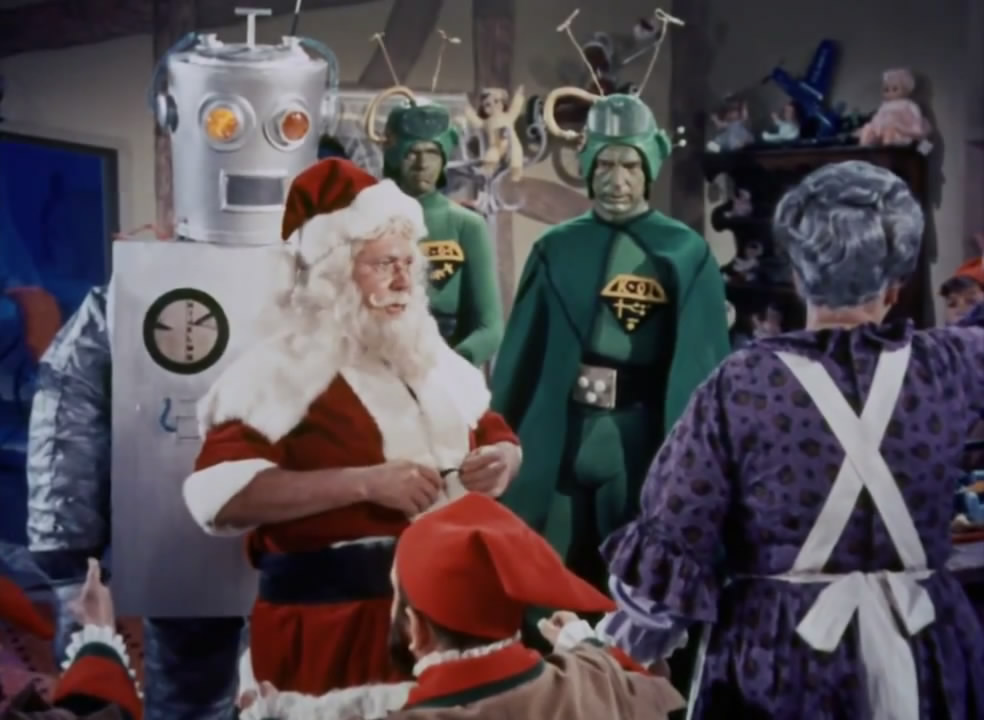
Many movies portray the leaps and bounds adults will often go to bring their children a magical Christmas: parentâs fighting each other for the perfect toy (âJingle all the Wayâ), others kidnapping the boss of your company when he refuses to give your family a Christmas bonus (âChristmas Vacationâ), and still others even taking on the role of St. Nick after the ‘Jolly One’ falls off your roof (âThe Santa Clauseâ). However, the 1964 epic “Santa Claus Conquers the Martians” by Director Nicholas Webster (T.V.âs âThe Waltonâsâ) takes a uniquely different approach â a group of Martian adults kidnap Chris Cringle himself, thinking itâs the only way to give their children the chance for a real childhood â inadvertently creating a cult classic in the process.
From a critical perspective, âSanta Claus Conquers the Martiansâ is an impossibility to review. It features marked overacting from all involved (the two kidnapped Earth children, Victor Stiles and Donna Conforti are the worst offenders), but the Martians and Santa Claus himself (John Call, âI Spyâ t.v. series) do themselves no favors. The set pieces, par for the course for 1960s sci-fi cinema, are also problematic, and downright laughable in their presentation. Green Martian outfits, robots that are clear human actors in a square cardboard suit, and reference to âanti-gravity chambersâ and âretro rocketsâ smack of a childâs view of alien life, or something you might see on the 1960s’ hit t.v. show âLost in Space.â Compared to the computer generated alien wonders of todayâs cinema, such as in âCloverfieldâ or even 1979’s “Alien,” the effects just donât hold up and fail to make any kind of real impression.
However, somehow the movie hits a humorous and warm note, if for no other reason than it manages to marry the genre of science fiction to the holiday season in a way so flawless, you have to wonder if some kind of movie trick was pulled over you during the filmâs 120 minute run-time. First, thereâs the issue of the Martians’ innocent naiveté in believing that kidnapping Santa Claus will be the end to the problems their children experience, among them insomnia and a general listlessness. âThey have the body of a child but the mind of an adult,â states soothsayer-Martian âCochem.â âThey donât have a childhood!â

The parallels to American society, and the trouble and strife that often forces youths to grow up far too quickly are stark compared to many modern problems, and seem mirrored by further Martian protestations that the Martian children spend too much time âwatching those silly Earth programs.â Additionally, in the portrayal of Cochem, the filmmakers make an interesting commentary on consulting others instead of trusting your own instincts. âWeâre adults,â states one Martian, Voldar, âwe donât need to consult some doodling old man.â
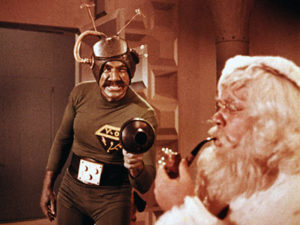
However, once the Martians make good on their plan to kidnap Santa, the movie takes on an oddly holiday tone, as Santa manages to make most everyone on board (save the perpetually-scowled Voldar who thinks the entire race of Martians weak for entertaining the notion of giving their children toys on Christmas) laugh, telling jokes, and amazing them with his ability to fit into the smallest places imaginable. Additional scenes, such as Santaâs desire to be compliant with the Martians and to give the children of Mars a good Christmas, also adds holiday cheer to a bizarrely, uh, bizarre situation and one that had the potential to fail miserably were it not for the tongue-in-cheek and downright satirical way the scenes are presented.
Thatâs not to say the movie is without fault. Some scenes toward the end, such as when Santa Claus escapes the Martians and hides, and the Martians engage in petty squabbles and fights over his ultimate fate, are time consuming and virtually pointless, as well as one fairly-morbid scene where Voldar attempts to murder Stanta Claus and the two children by sealing them in a pressurized chamber, that perhaps pushes the envelope on this cult classic a bit too much. In addition to these scenes, there is also the problem of the too convenient ending, as well as Ed Sullivan Variety Show type musical numbers that open and close the movie with perhaps a little too much cheese for movie goers looking for a more mature sci fi experience.

âSanta Claus Conquers the Martiansâ is one of those movies you watch by accident, are recommended on a whim, or watch every year simply because you have to. As far as Christmas required viewing, itâs hard to place the film on the same pedestal as movies like âA Christmas Storyâ or âItâs a Wonderful Life,â but at the end of the day some of the lessons contained within its relatively short timespan are just as iconic, just as important, and just as magical.
Will the Martian children be the better for Santaâs visit? Will Voldar learn his lesson and embrace the Christmas spirit? Will the all-business Martianâs â known for war but less for peace â finally realize whatâs been missing from their hectic lives? Youâll have to watch to find out. But, given the often cookie-cutter films that practically litter the Christmas season, you may just want a movie like this that not only breaks the mold, but absolutely shatters it in its attempt to bring laughs, cheer, and, in the most unlikely place, holiday spirit.
**We really struggled with a grade for this movie. One the one hand, it’s a cinematic nightmare, comprised of contrived scenes, see-through-costumes, and well, a paper-thin plot with thinly-veiled exposition. However, for the feeling the movie imparts, and the unintentional fun that one ultimately has while watching it, we’re inclined to give it a fair review and urge you to check it out this holiday season.**Â


1 Comment
Are you crazy Santa Claus Conquers The Martians is just as classic as A Christmas Story.