





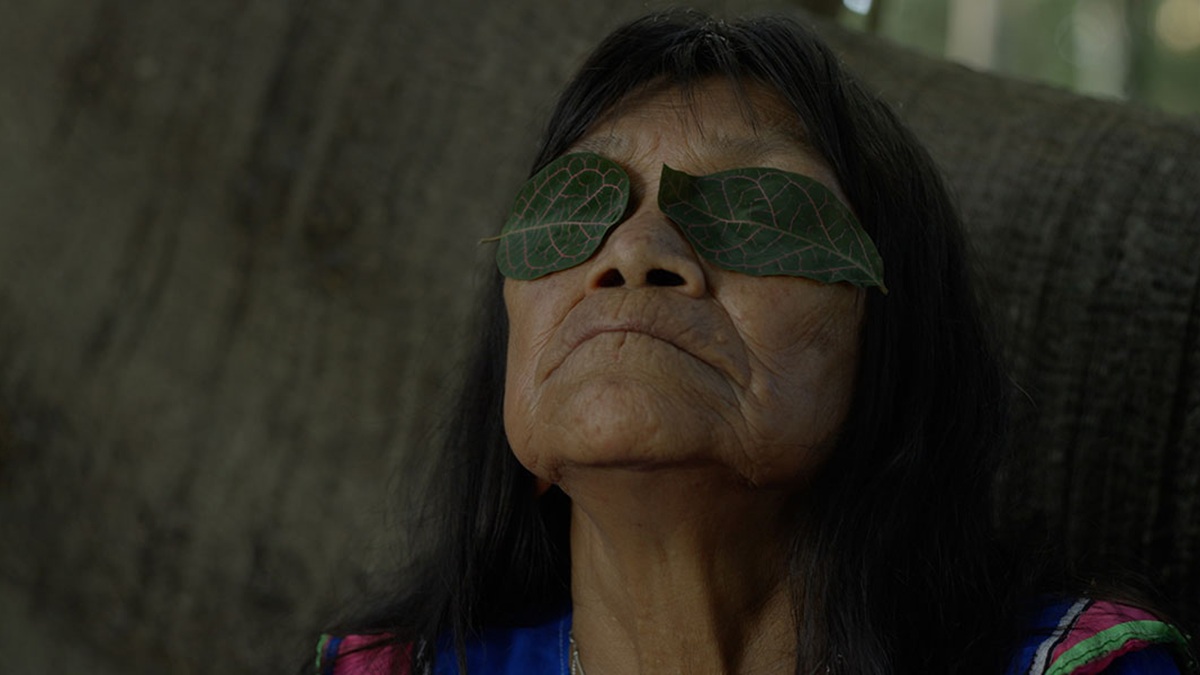
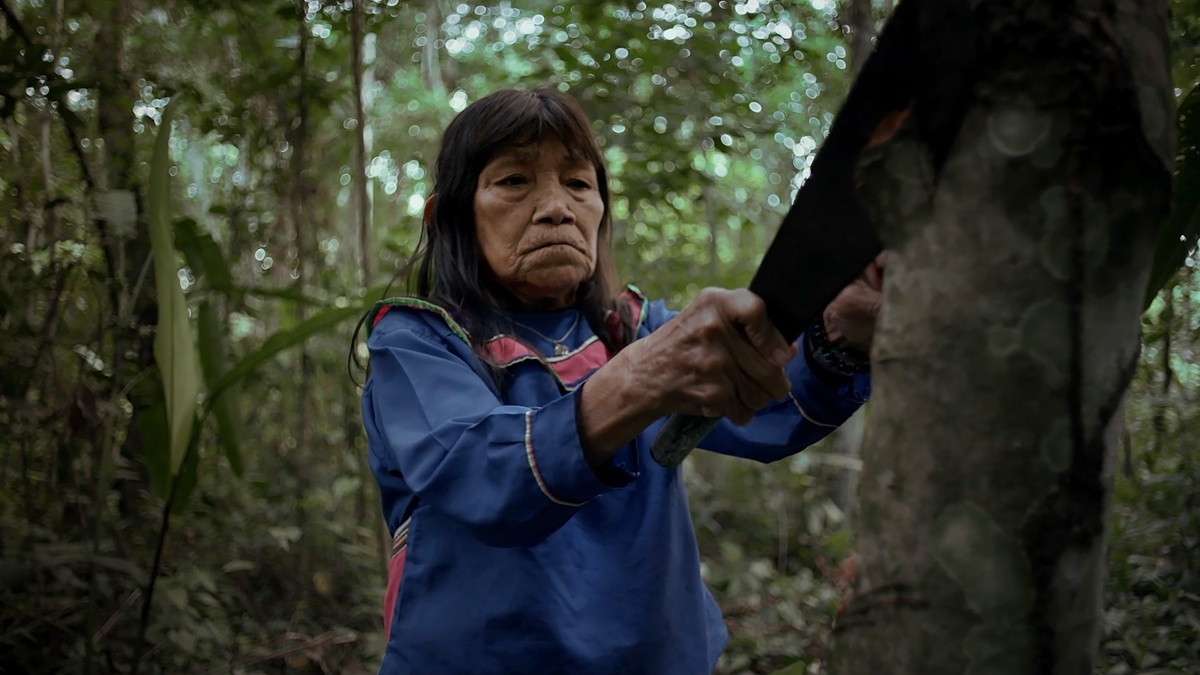
Maybe it has something to do with the long takes, or the stretches of silence that Ãlia Gasull Balada and Matteo Norzi allow to settle around Sara Flores. Whatever the reason, “The Hummingbird Paints Fragrant Songs” worked on me almost immediately. I ended up wanting to meet Sara. Not simply Sara Flores the celebrated Shipibo artist whose work now hangs in galleries from New York to Paris; but the woman behind those paintings: someone who walks into the forest looking for leaves, digs mud from the river, plays with her pet tamarin, complains when her body hurts, watches strangers with a sharp sense of humor, and keeps painting even as her hands become harder to stretch.
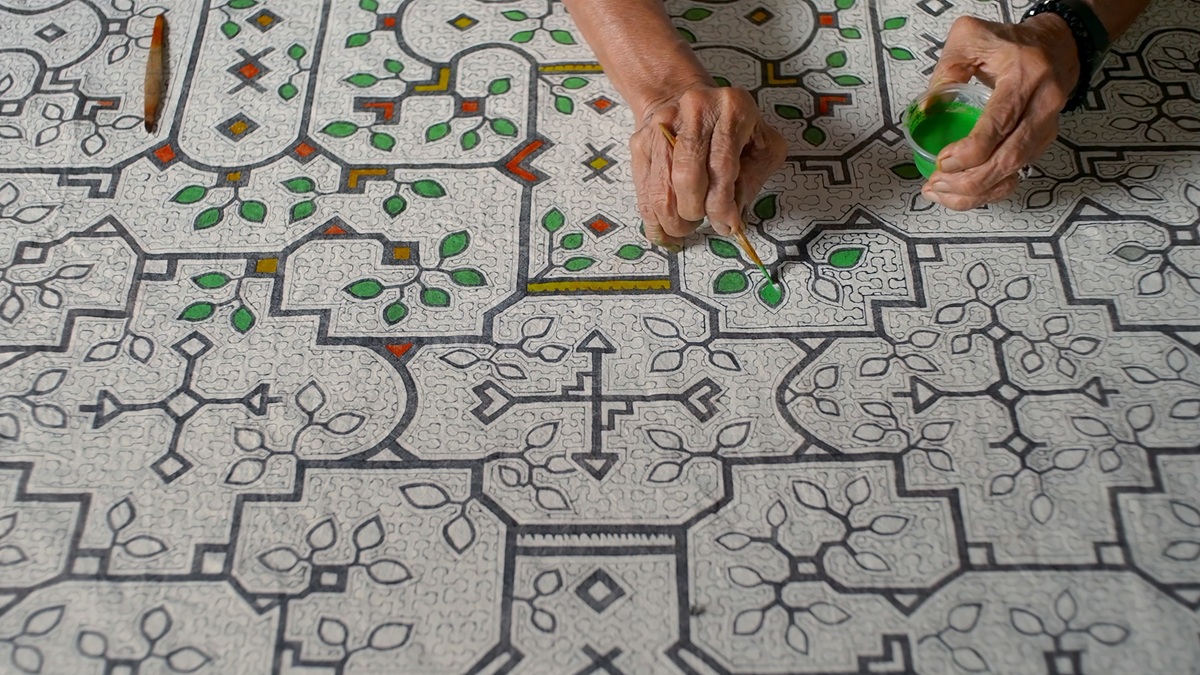
Flores practices kené, the geometric visual language of the Shipibo people, which she has been learning since childhood. The story she tells about first encountering those patterns is literally eye-opening: she remembers her grandmothers rubbing leaves over the childrenâs eyelids, after which she would wake up, look at the mosquito net, and begin seeing designs appear in front of her. Those shapes became something she wanted to draw. Her mother encouraged her to continue until the practice became second nature. âItâs all in the mind,â Sara says, with the casual certainty of someone who has spent a lifetime trusting what she sees.
Her description made me think of phosphenes, those strange shapes and flashes the eye can seem to manufacture from somewhere inside itself. But for Sara, the designs arenât visual noise. They become memory, knowledge, craft, and eventually a language. She still speaks about receiving visions that tell her how a pattern should move and where the lines should go. Gasull Balada and Norzi donât rush to translate that into something more digestible for outsiders. Johan Carrasco Monzónâs camera often stays still long enough for Saraâs own rhythm to take over, and a hand painting a line can matter as much as a gallery opening thousands of miles away.
That patience also gives room for Saraâs humor, which is one of the filmâs most endearing qualities. At one point, she compares Parisian art attendees to parrots squawking after the rain, and the comment instantly punctures the stiffness of the room around her. She seems to enjoy the opportunities that travel brings, and she certainly understands what international attention means for her work, but she doesnât appear overwhelmed by the ceremony surrounding it. âAs long as I live, I want to fly like a bird,â she says. The line could easily have been made sentimental in another documentary, yet here it comes from a woman who has spent most of her life working and intends to keep moving for as long as she can.
More TIFF 2026: Neo-Noir, Techno-Thriller âThe Remotesâ Takes the Slow Road Through Grief and Control
When Recognition Comes Late
By the time the international art world discovers Flores in her seventies, her paintings have begun circulating through spaces very far removed from where she makes them. There are exhibitions in New York and Paris, admirers surrounding her work, and even a collaboration with Dior. Recognition arrives late and, perhaps more painfully, seems to arrive abroad before it fully arrives in Peru. Sara notices the irony, but the film is too interested in her practicality to turn this into a simple story about the West consuming Indigenous culture.
These opportunities change her familyâs circumstances. They allow her to travel, present her work, and make use of an international platform she never had before. They also make one of her comments about aging hit much harder. Her body is already protesting the labor. Her hands are becoming more difficult to stretch. She is in pain, but the work continues. âIf I become incapable, weâd go hungry once again,â she tells her daughter in between body massages.
That sentence changes the gallery scenes for me. Her art can be spiritual practice, cultural inheritance, aesthetic achievement, and political statement all at once, but it is also labor. The paintings admired by collectors abroad are still made by a woman whose body has limits, whose family depends on her, and who understands how quickly material security can disappear. International recognition hasnât magically removed the conditions that made her work necessary in the first place.
This is where “The Hummingbird Paints Fragrant Songs” begins widening its gaze. Flooding and environmental degradation are changing the Amazon around Sara, while Indigenous land faces continued pressure from deforestation and encroachment. The film places her aging body alongside a landscape also being pushed beyond what it can sustain, but thankfully doesnât make the comparison too neat. Saraâs relationship with the environment has already been established through routine, materials, and memory. By the time the documentary becomes more overtly political, the land doesnât feel like a cause that has been attached to an artist profile. It has always been inside the work.
âI need my designs to grow leaves of resistance,â Sara says at one point, and the phrase gives kené another function. A pattern is no longer only something to be admired on cloth, canvas, or a luxury object. It can become a claim.
Related Review: âMother, You Have Not Died Yetâ: Grief Has Poor Boundaries
Art That Has Somewhere to Go
The documentary follows Shipibo activists pushing for the recognition of their people as an Indigenous Nation, including scenes connected to the United Nations. Sara joins younger land defenders, and the film gradually becomes less about an elderly artist receiving overdue recognition and more about what she chooses to do with that attention.
There is a contradiction here that I wish the documentary pushed against a little harder. Saraâs designs can be celebrated in prestigious galleries and adapted by a luxury fashion house while the people and territory those designs come from remain caught in a struggle over land, environmental damage, and political recognition. “The Hummingbird Paints Fragrant Songs” sees the gap, but it tends to observe rather than interrogate it. That fits the filmâs temperament, and Gasull Balada and Norzi clearly arenât making an exposé about the contemporary art market, but the tension is too rich not to want a little more friction from it.
One of the final images makes that contradiction especially potent. Saraâs visual language is transformed into a flag for the Shipibo Nation, and the thing looks almost uncannily like something Dior might have produced. I donât mean that dismissively; the resemblance actually makes the image stronger. The same patterns capable of becoming luxury branding are repurposed as a declaration of sovereignty. The design hasnât changed nearly as much as what it is now being asked to do. A handbag travels because somebody buys it. A flag travels because somebody carries it.
That transformation gets at what I like most about the documentary. It never reduces Sara to the inspirational figure that her biography could so easily produce. Her wit keeps the film from becoming reverential. Her concern about money keeps it from romanticizing the artist as someone floating above ordinary economics. Even its more spiritual passages remain grounded by the fact that Sara still has work to finish afterward.
The filmâs observational approach can sometimes become so hushed that its movement between intimate portraiture, spirituality, environmental crisis, and political advocacy feels softer than the material warrants. The quietness serves Sara beautifully; Iâm less convinced it always serves the institutional questions around her with the same force. Still, at around ninety minutes, the film rarely overstays its welcome, and its best passages understand that simply remaining with someone can reveal more than continually explaining her.
Sara knows she is growing older. Her body makes sure she knows it. Her imagination, apparently, has no intention of cooperating.
So much of “The Hummingbird Paints Fragrant Songs” concerns looking: the designs Sara once saw after leaves were rubbed across her eyelids, the collectors looking at her paintings, the institutions that took decades to recognize their value, and Sara herself quietly watching everyone back. By the end, I was less interested in decoding the patterns than in the woman still drawing them. The art world may have discovered Sara Flores late. The film is smart enough to understand that discovery and truly seeing someone are not the same thing.
So yes: watching the documentary, I found myself wanting to meet not the artist, but the person behind the art. And that, I think, is an even bigger compliment.


Ãlia Gasull Balada and Matteo Norzi’s “The Hummingbird Paints Fragrant Songs” had its world premiere at the 51st Toronto International Film Festival under the TIFF Docs program. The festival runs from September 10 to 20, 2026. Follow us for more coverage.




