






Death leaves behind a room nobody quite knows how to enter. People can sit with you, feed you, distract you, say the right thing or the wrong thing at the right time. None of that fills the space. Grief keeps working anyway, often in strange, private ways. It makes the mind reach for substitutes. A dress becomes more than a dress. A resemblance starts to feel like a summons. And sometimes, a gesture, repeated often enough, begins to look like possession.
LucÃa Aleñar Iglesias‘â’ “Forastera” lives in that uneasy place. It is about losing a grandmother, but not in the tidy, therapeutic way movies sometimes approach death. This is grief as confusion, as performance, as a child trying on an absence and finding that it fits a little too well.
Related Review: âHamnetâ is a Masterclass in Grief, Even When the Score Wonât Shut Up
A Summer That Stops Moving
Set in Mallorca, “Forastera” follows Cata (Zoe Stein), a teenager spending the summer with her younger sister and grandparents. At first, there is the looseness of a family holiday: sun, water, small irritations, idle afternoons that make vacation feel endless when you are young. The film takes its time with that calm. It lets the days breathe a little.
Then Cataâs grandmother, Catalina (Marta Angelat), dies suddenly, and the calm turns into something heavier. The film does not speed up, nor does it announce a major emotional rupture with big gestures. If anything, it grows quieter. The house feels stunned. The people inside it keep moving because bodies keep moving even when the spirit has fallen behind.
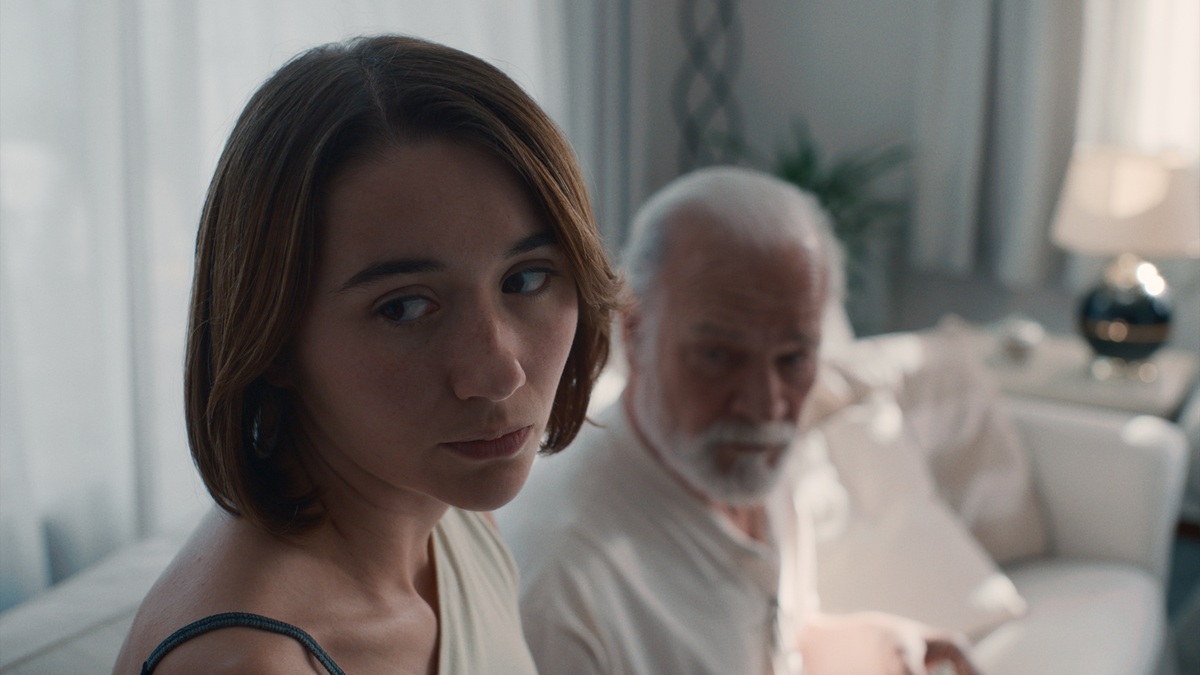
Soon, Cata finds one of Catalinaâs dresses and tries it on. It fits. Not just physically, though that already feels eerie enough. It seems to open a door for her. She begins to move through the house with a different awareness of herself, taking on little tasks her grandmother used to do, borrowing gestures, slipping into a role nobody has formally given her. At some point, what begins as curiosity starts to become a kind of service. She comforts her grieving grandfather Tomeu (LluÃs Homar), and the act feels tender until it begins to feel wrong.
That is where the film finds its most unsettling charge. It neither treats Cata like a case file, nor turns her into the vessel for a conventional ghost story. Instead, it shows that what she does feels more ordinary, and thus maybe more disturbing because of that. Cata is a teenager trying to understand death through imitation. She feels guilt, fascination. She also feels the panic of not grieving correctly. There is a particular terror in realizing you have not cried yet, especially when you are young. You start wondering whether the grief is delayed or whether there is something missing in you.
The Ghost in the Family Role
“Forastera” is not really a ghost story, though it understands ghosts better than many films that put one on screen. Here, the ghost is a place left open in the family. It is the chair someone no longer occupies, the kitchen routine that suddenly has no owner, or the old objects that keep insisting the dead were real. Cata does not simply miss Catalinaâshe starts learning her through what is left behind.
Zoe Stein plays this beautifully because she doesnât push for easy sympathy. Her Cata can look blank, watchful, awkward, or suddenly too composed. She still feels like a teenager, but there are moments when she seems to be carrying an adult knowledge she has no business carrying yet. Opposite Stein, Homar gives Tomeu a soft, wounded gravity. His scenes with Cata sit in a strange emotional pocket: loving, sad, uncomfortable. He knows she is not his wife. Of course he knows. But grief can make people accept a substitute for a few seconds longer than they should.
Núria Prims, as Cataâs mother Pepa, gives the film another way of looking at loss. Pepa seems less interested in entering the family trance. She keeps moving, perhaps because stopping would make the ghost too real. The film is smart enough not to scold her for that. Some people live with the dead by keeping them close. Others, meanwhile, survive by refusing to make eye contact with what has happened.
‘Forastera‘: A Landscape Caught Between Grief and Light
The film is lovely to look at, though not in a postcard way. Agnès Piquéâs images catch Mallorca in a double light: beautiful enough to tempt you, still enough to trap you. The sea, the white heat, the rooms, the old things, all of it feels suspended in a summer that cannot move forward. The music by Anna von Hausswolff and Filip Leyman does not shove feeling into the frame. It seeps in, then pulls back, leaving the silence to do some of the hurting.
Still, the filmâs delicacy has its limits. There were moments when I wanted Iglesias to press harder on the family tensions Cataâs transformation awakens. The resentment is there. So is the discomfort. But the film sometimes lets those feelings hover when it might have let them bruise. Its ambiguity is part of its pull, yes, but a few scenes are so carefully held that they nearly evaporate.
Even then, “Forastera” remains a quietly unnerving debut. It understands that losing a grandparent can become its own strange education. You learn things too late. You inherit stories after the person is gone. And you discover that the dead can become more vivid in absence, which feels unfair and almost cruel. Cata cannot fill the space Catalina leaves behind. No one can. But for one suspended summer, she touches that space, wears it, tests its shape. The void remains. The girl does not.


A Spanish-Swedish-Italian co-production, LucÃa Aleñar Iglesiasâ “Forastera” premiered in the Discovery section of the 50th Toronto International Film Festival on 8 September 2025. It will have its theatrical release on May 29, 2026, by Grasshopper Film. Follow us for more coverage.




