





There’s a moment in âHamnetâ where Jessie Buckley‘s Agnes Shakespeare screams. It isnât the kind of scream you hear in horror movies or melodramas; but rather something primal and guttural that comes from a place so deep you feel like you’re witnessing something you shouldn’t. It’s the sound of a mother losing her child, and Buckley doesn’t pull a single punch. She wails, she collapses, and then, maybe even more devastatingly, she goes quiet. The silence that follows is almost worse than the scream. That range, from raw vocal anguish to wordless suffering, is so pitch-perfect that it’s almost too obvious to say she’ll have award-giving bodies’ attention come awards season. But obvious doesn’t make it less true.
Chloé Zhao‘s latest film, adapted from Maggie O’Farrell‘s novel of the same name, is an exploration of griefâhow we carry it, how we express it, how it changes us or doesn’t. I’m a sucker for films that deal with this. Ryusuke Hamaguchi‘s âDrive My Carâ remains a deeply personal film for me, and I’m fascinated by movies that delicately examine how their characters circle around mourning, or whether they dive into it headfirst. âHamnetâ does both. It’s about a couple who lose their son and process that loss in fundamentally different ways: one wears her grief on her sleeve, the other buries it in work, in art, in distance. Neither way is wrong. Neither way is easy. And Zhao, working with O’Farrell’s source material (with the two co-writing the screenplay), understands that the space between those two approaches is where the real drama lives.
The Witch’s Daughter and the Playwright
The film opens with Agnes Hathaway walking through a forest, summoning a hawk to land on her falconry glove. She’s draped in red, and there’s something almost witchy about her presence. Indeed, gossip labels her a forest witch’s daughter, which she doesn’t discourage. William Shakespeare (Paul Mescal), an earringed Latin tutor, visits her barn. They talk, they kiss, she tells him to leave. It’s a courtship built on stolen moments and unspoken understanding.
The film establishes that Agnes has visions: she can see the future, or at least glimpses of it. She holds William’s hand and foretells something great in his future. She also sees herself with two children. Soon enough, they marry. They have Susanna, then twinsâHamnet and Judith. William, frustrated by his father’s abuse and his own stalled ambitions, leaves for London to seek his fortune in the theater. Meanwhile, Agnes stays in Stratford with the children. Even so, the family thrives in some ways. William becomes successful, they buy the largest house in Stratford, and the kids are seemingly alright. There’s joy here, captured in scenes of the children playing the witches from Macbeth, amusing their parents.
And then tragedy strikes. I won’t detail how or when because the film earns its emotional beats, but what follows is an examination of two people trying to navigate the wreckage of their lives. Agnes screams and mourns openly. William returns to London, channels his pain into his work, and struggles to write until he finds a way to transform his grief into something that will outlive him. The film’s title tells you what that something is.
Zhao’s Visual Language (and Translating Emotion from Page to Screen)
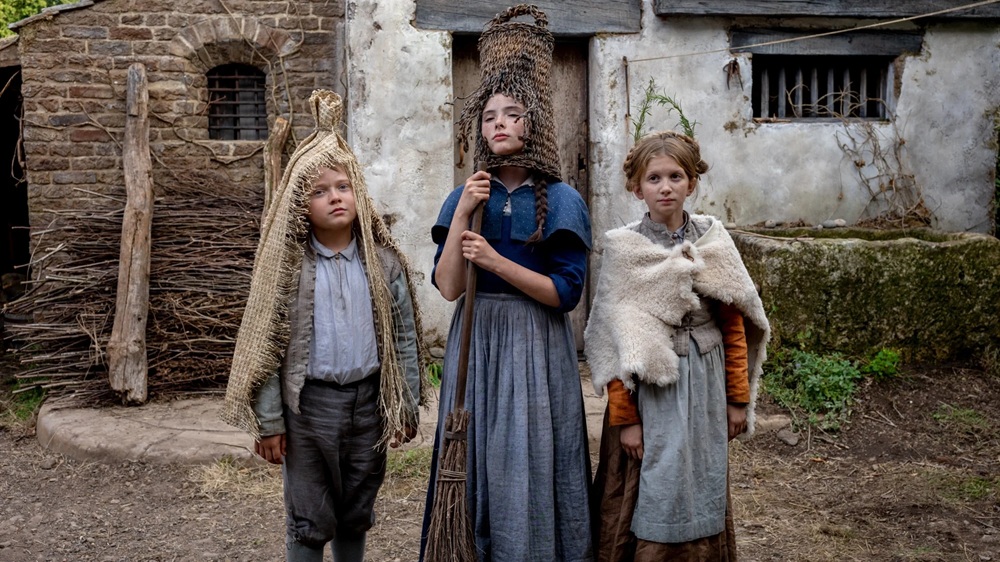
Zhao, known for her expansive landscapes in films like âNomadlandâ and âThe Rider,â brings that same eye for natural beauty to Renaissance England. The forest where Agnes spends time feels ancient and alive. There’s a mysterious cave that recurs throughout the film, and Zhao uses it as a visual metaphor for the threshold between life and death, between the known and the unknowable. It’s not subtle, but it doesn’t need to be. This is a film about big emotions and big ideasâgrief, art, legacy, loveâand Zhao isn’t afraid to lean into that.
Despite the differences between O’Farrell’s book and Zhao’s adaptation (purists will note changes in structure, in emphasis, in how certain scenes unfold), I feel like the director was able to translate the emotions from O’Farrell’s novel. That’s no small feat. The book is interior, concerned with Agnes’s visions and the texture of domestic life in Renaissance England. The film has to make all of that visual, has to find a cinematic language for grief and magic and the way people existed in a world before ours.
Zhao, working with cinematographer Åukasz Å»al, shoots the film like a dream that keeps threatening to turn into a nightmare. The forest scenes, with their muted greens and browns, feel alive. The barn where Agnes and William first connect has a tactile quality. You can almost smell the hay and wood. London, by contrast, is grey and crowded, a place where William can disappear into his work and his grief.
Two Performances, Two Ways of Mourning
Buckley’s performance is the engine that drives the film. She plays Agnes as someone who exists between worlds: part healer, part seer, part ordinary woman trying to raise her children and keep her marriage intact. When her son dies, something breaks in her, and Buckley doesn’t try to make it beautiful or noble. She makes it messy and raw. Her grief is just real, and Buckley commits to it fully.
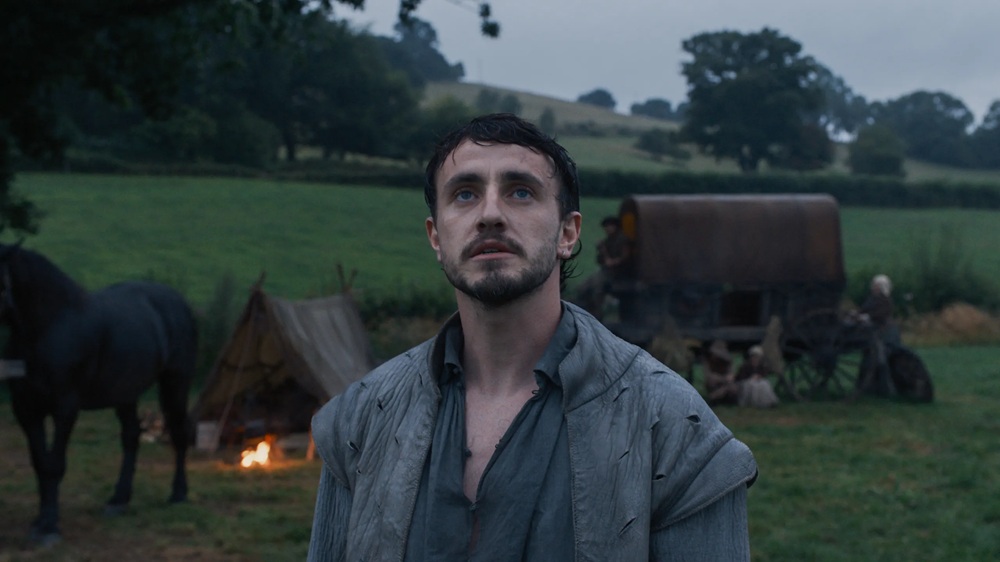
Mescal, on the other hand, balances this with a more subdued exploration of distracting oneself and attempting to channel pain and suffering into art. We see him try and fail, a few times in fact. He’s frustrated with his actors, yelling at them for not showing passion. He speaks the part himself to show them how to act. And when he finally plays Hamlet’s ghost to a jampacked theater, we see the beauty that came out of his grief; how he’s taken something unbearable and shaped it into something that will resonate for centuries. Mescal doesn’t make William a tortured genius. He makes him a man who’s barely holding it together, who’s found a way to cope that works for him even if it alienates his wife.
As for the rest of the cast, Jacobi Jupe as Hamnet and Olivia Lynes as Judith are both remarkable as the twins. They have a chemistry that underscores a bond that doesn’t need exposition. When tragedy befalls one of them, you understand why the other would be willing to trade places. Emily Watson as William’s mother Mary and David Wilmot as his abusive father John all do strong work, grounding the film in a specific time and place without making it feel like a museum piece.
The Problem with Sonorous Foreshadowing
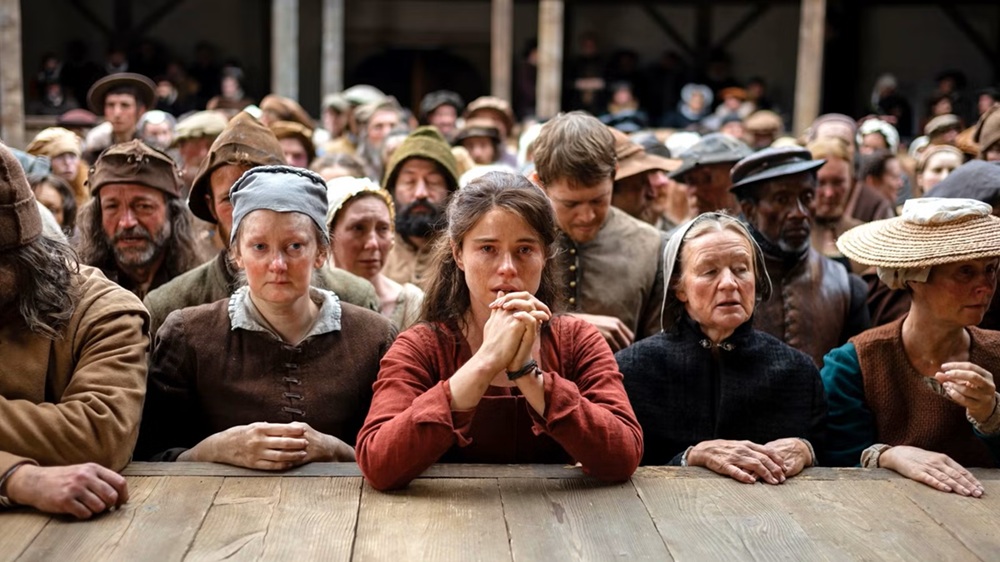
The film’s third act, where Agnes and her brother Bartholomew (Joe Alwyn, solid in a supporting role) attend the first performance of Hamlet, is where everything converges. Agnes is outraged at first, thinking her son’s name is being profaned. But as she watches the play unfold, she begins to see it differently. William plays Hamlet’s father’s ghost, and there’s a scene with him and the young actor playing Hamlet (Noah Jupe, terrific) that changes something in her. When Hamlet, dying, nears the edge of the stage, Agnes interacts with him in a quiet way, and the audience follows suit.
Here, we see a father pouring his grief into art, a period of compartmentalization betrayed by real emotions that just wouldn’t allow themselves to be bottled any longer, expressed onstage. Opposite, we see a mother wearing her grief on her sleeve, this time silently realizing that both of them, while different in how they embrace mourning, never veered away from sharing the same skies. It’s an extraordinary sequence, and it should be allowed to breathe on its own.Â
But here’s where I have to talk about Max Richter‘s score, which stands as one of the more ambivalent choices the filmmakers made. Maybe this is me talking as a frustrated musician, but several emotionally heartbreaking scenes in the movie needed no music whatsoever. That third act theater scene especially didn’t need Richter’s strings swelling underneath it. The images, the performances, the weight of what’s happeningâit’s all there. The music doesn’t enhance it; it just underlines it in bold, italic, and highlighter.Â
The issue I have with it is that Richter is too obvious a choice for this. His score has been overused to emotional death in films like âArrivalâ and TV shows like âThe Leftovers.â It’s effective, sure, but it’s also a crutch. I wish the film had employed a different composer. You know, someone like Dario Marianelli, or Patrick Doyle, who himself is no stranger to working on Shakespearean film adaptations. Doyle would’ve understood that sometimes silence is more devastating than any crescendo.
How âHamnetâ Captures Grief with a Look That Says Everything
On a lesser degree, some will more likely argue that the film is emotionally manipulative, even without pointing to Richter’s score as evidence. But here’s the thing: it’s actually the point. When you’re telling a story based on the life of, in my opinion, the greatest playwright who ever lived, a certain level of emotional grandeur feels appropriate. Shakespeare wrote Hamlet as a way to process his grief, to give his son’s death meaning and permanence. The play itself is manipulative, designed to make you feel, to wring tears and catharsis out of tragedy. So why shouldn’t the film adaptation embrace that? My issue isn’t with the intent but with the execution. The score doesn’t trust the audience to feel what’s already there in Buckley’s face, in Mescal’s silences, in the way Zhao frames a mother watching her dead son brought back to life through art.
Ultimately, these are forgivable quibbles. Because how âHamnetâ ends is something that made me realize this would rank among my top films of the year. We see the final act of the play as everyone in the theater is engrossed with Hamlet’s acting. Meanwhile, Agnes slowly locks eyes with William, himself backstage watching in awe as the audiences lock in as a collective, grieving the character’s death. The two, however, exchange a look that gives Agnes the realization about grief and mourning: William feels it, too.Â
Andâsay what you want about herâZhao makes damn well sure that we do, too.
“Hamnet” had its premiere at the 52nd Telluride Film Festival on 29 August 2025. It screened in this year’s QCinema International Film Festival, which ran from November 14 to 23, 2025. Follow us for more coverage.




