





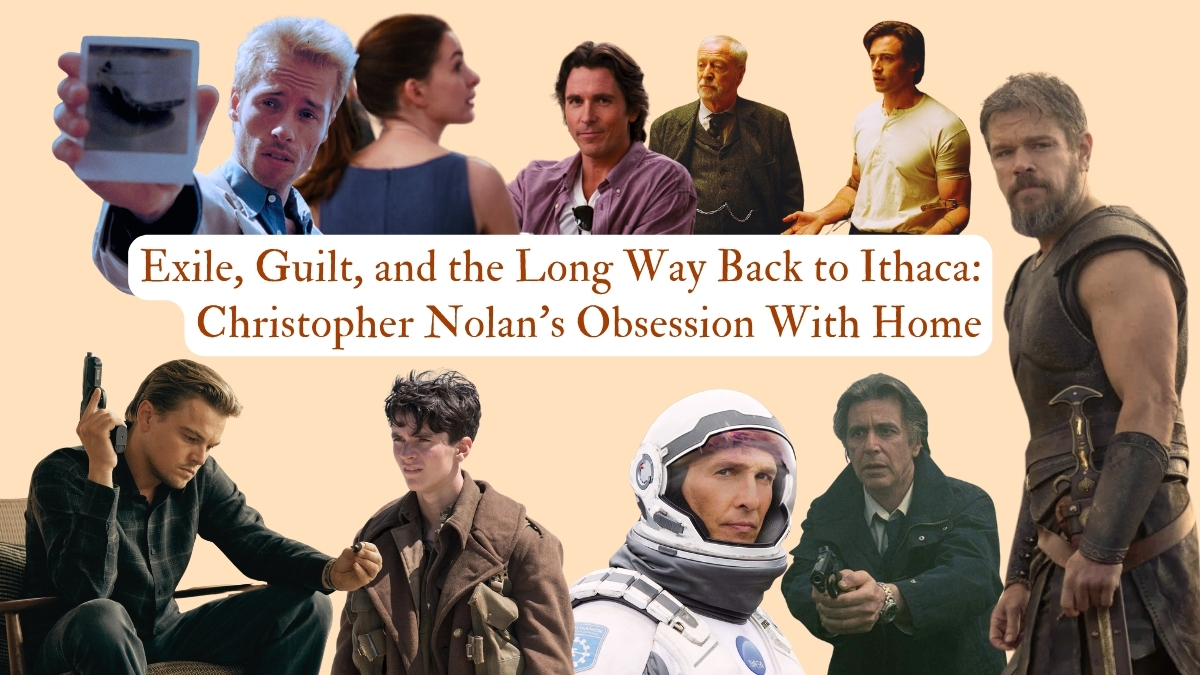
(Spoiler warning: The following analysis discusses major plot points from Christopher Nolanâs films. Proceed with caution.)
If you know the story of the Greek hero Odysseus, you know what the journey home looks like. You know the Cyclops, the single eye closing in the firelight before a sharpened stake finds it. Or the bag of winds, Aeolus’s gift, torn open by a greedy crew within sight of Ithaca, blowing them all the way back to the start. Or the pull of Scylla and Charybdis, the six-headed monster on one side and the swallowing whirlpool on the other, and the calculus of how many men you lose to get the rest through. You know that Odysseus survives all of it and that surviving is not the same as getting home, not for years and years and years. The story is not about whether he makes it. It’s about what the getting there costs.
And if you’ve spent any time with the films of Christopher Nolan, you recognize him, not exactly as Odysseus, but as something older and more persistent. A figure Nolan has been drawing and redrawing for over twenty-five years. He just never had a name for it before.
Before We Begin: Know Your Homer
When Nolan broke the news about “The Odyssey,” he said something in an Empire interview that felt less like a promotional quote and more like a confession: “When you start to break down the text and adapt it, you find that all of these other filmsâand all the films I’ve worked onâyou know, they’re all from the Odyssey.” Emma Thomas, his producing partner and wife, put it even more cleanly when they announced the project: the poem is foundational. You might expect a filmmaker to say that about the source material he’s adapting.
What’s striking is how obviously, almost embarrassingly, true it is. Because when you line up Nolan’s filmography and squint, what you find is not a series of different stories. It’s the same story, told in different ways. A man, a journey, and a home he cannot reach.
If you haven’t read the poem yet, you still have time. And if you’re not sure where to start, the answer is easier than it looks. Among the entry points out there, Emily Wilson‘s 2017 version, which is the one that reportedly shaped Nolan’s approach to the character of Odysseus, reads less like a classical monument and more like a character study. Wilson’s Odysseus is complicated, ambivalent, morally interesting.
Meanwhile, Robert Fagles gives you theatricality, Robert Fitzgerald gives you lyricism, and Richmond Lattimore is the one you reach for when you’re ready to go full Homeric archaeology. The point is this: there’s no wrong door into Ithaca. Whatâs important is to get there before the discourse does. And the discourse, as anyone who’s been online in the last several months already knows, is insanely loud.

The Noise Around the Film
Let’s address it, because it’s part of the story. The first-look image of Matt Damon in a red-plumed Corinthian helmet generated immediate and heated debate, with historians and classicists pointing out that Odysseus, as described in the Iliad, would not have worn that helmet, and that the armor wasn’t remotely consistent with the Mycenaean period in which the story is actually set.
Then came the teaser poster, which featured a golden backbone along the helmet crest. It felt like Nolan answering the critics in advance, which is very on-brand. And then the official trailer dropped, and a new controversy arrived: why on earth is everyone speaking in American accents? Why is it Damon and not someone British, or at minimum someone who sounds ancient? What does it mean for a mythological Greek epic to sound, well, like a prestige Hollywood film?
The filmmaker has spent almost his entire filmography making the same film about exile and return. His upcoming Homer adaptation might be the one where he finally names it.
These are fair questions, even if some of the people asking them seem less interested in answers than in the ritual of pre-release outrage. The short answer is that Nolan has always treated historical source material as a canvas rather than a script. This is a man who shot “Dunkirk” without a traditional narrative protagonist, who made a biopic of J. Robert Oppenheimer that told its climax in reverse. Nolan is not, at his core, a literalist. He is a filmmaker whose obsessions keep leading him back to the same emotional terrain, and that matters enormously for understanding why “The Odyssey” exists and why it excites and unnerves people in equal measure. The costumes might be anachronistic, the accents too. But the yearning at the center of the story is not.
And through all of it, the majority holds. “In Nolan we trust” trends every time a new piece of footage drops. After all, this is an auteur who has walked out of studio pitches with nine-figure budgets, who turned a three-hour film about a theoretical physicist into a nearly $960 million global phenomenon that won multiple Academy Awards, who kept the theatrical experience alive through sheer force of will during a pandemic that nearly killed cinema as a communal act.
And you know what? The film still isn’t out. We’re still two months away from knowing whether it delivers. And yet audiences have already sold out its opening weekend. That tells you something, not just about the film, but about what Nolan has built over the course of his career. To put it simply: a relationshipâone that feels, fittingly, a little like waiting for someone to come home.
The Exile Who Cannot Return
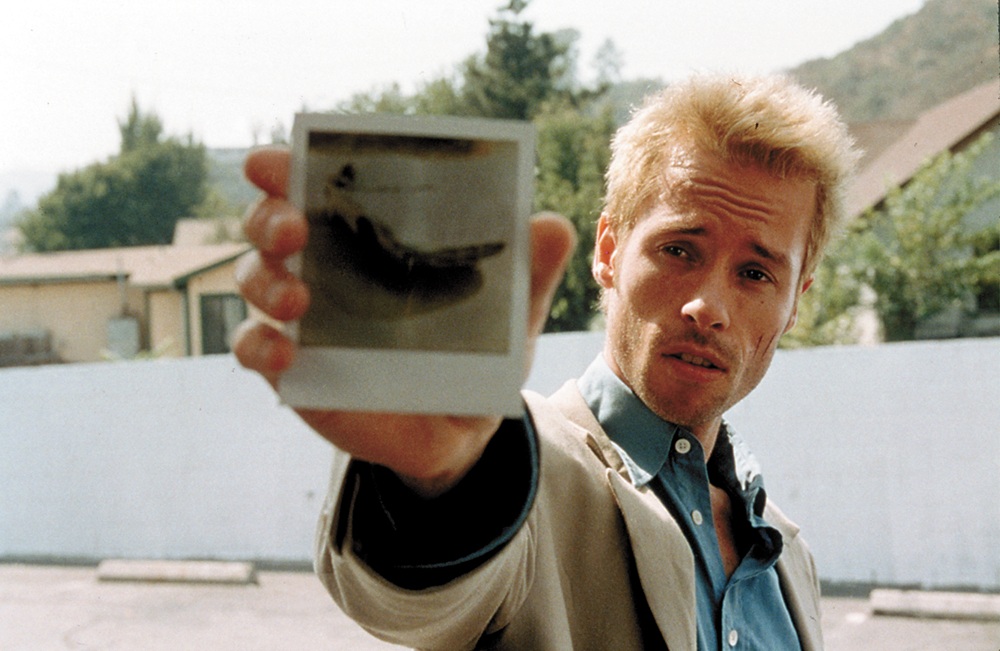
Letâs start with “Memento,” because that’s where Nolan started, more or less. Guy Pearceâs Leonard Shelby is a man without a home in the most radical sense imaginable: he cannot build one, because he cannot accumulate the memory required to do so. Every fifteen minutes or so, the world resets. Every fifteen minutes or so, he finds himself a stranger in a life he can no longer access.
The tragedy of “Memento” is that Leonard’s quest, to avenge his wife’s murder and give his loss some shape and purpose, is itself a kind of homecoming attempt. He wants to return to the person he was before that night in the bathroom. And he can’t, not because anyone is stopping him, but because the part of his brain that would allow him to recognize home when he got there is simply gone. His tattoos, his Polaroids, his handwritten notes are the maps of a man who knows he is lost and cannot stop trying to find his way back. He never will. That’s not a spoiler. That’s the wound the film refuses to close.
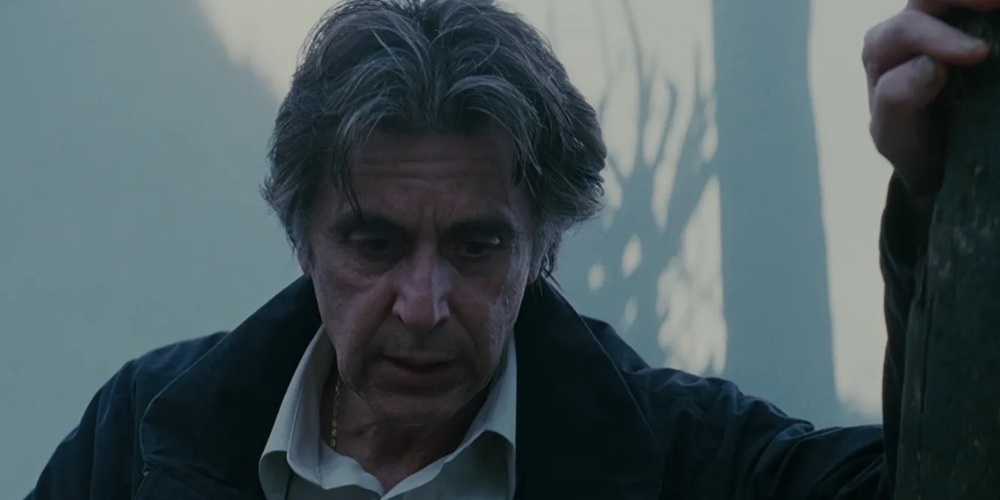
“Insomnia” takes a different approach to the same idea. Will Dormer (Al Pacino doing some of the most quietly devastating work of his late career) is a detective exiled not by external circumstance but by guilt. While working on a case in Nightmute, Alaska, he accidentally shoots his partner, and covers it up out of panic. In that quaint village, Dormer discovers that the sun never sets, and finds out soon enough that the light refusing to let him sleep is doing something more insidious: it’s refusing to let him forget. Home for Dormer is a state of moral clarity he no longer deserves and can no longer reach. The insomnia is literal and also a metaphor so on-the-nose that it would collapse under lesser direction. Nolan holds it steady.
These early films establish the template thoroughly. The Nolan protagonist is almost always guilty of something. And guilt, in this filmography, functions less like a feeling and more like a force of gravity. It pulls these men away from wherever they might otherwise belong and keeps them in orbit, circling home without ever landing.
Cobb and the Children He Left Behind
“Inception” is the most naked version of this. Dom Cobb (Leonardo DiCaprio) is a thief who extracts secrets from dreams for a living, exiled from America and from his children because his wife is dead and the authorities think he killed her. Everything about the film’s spectacular architecture, all those folding Parisian streets and zero-gravity hotel corridors and snow fortress assaults, is scaffolding built around a single unbearable fact: a man cannot go home to his kids.
The mission, the inception, the planting of an idea in Robert Fischer’s subconscious, is not really the point. The point is that Cobbâs last memory of his children were them facing away from him. That he has most likely memorized the extradition laws of every country he passes through, calculating which ones will hand him to the Americans and which ones will not, because there is nothing he wants more than to go home to his kids and nothing that would guarantee he never gets the chance to properly clear his name.
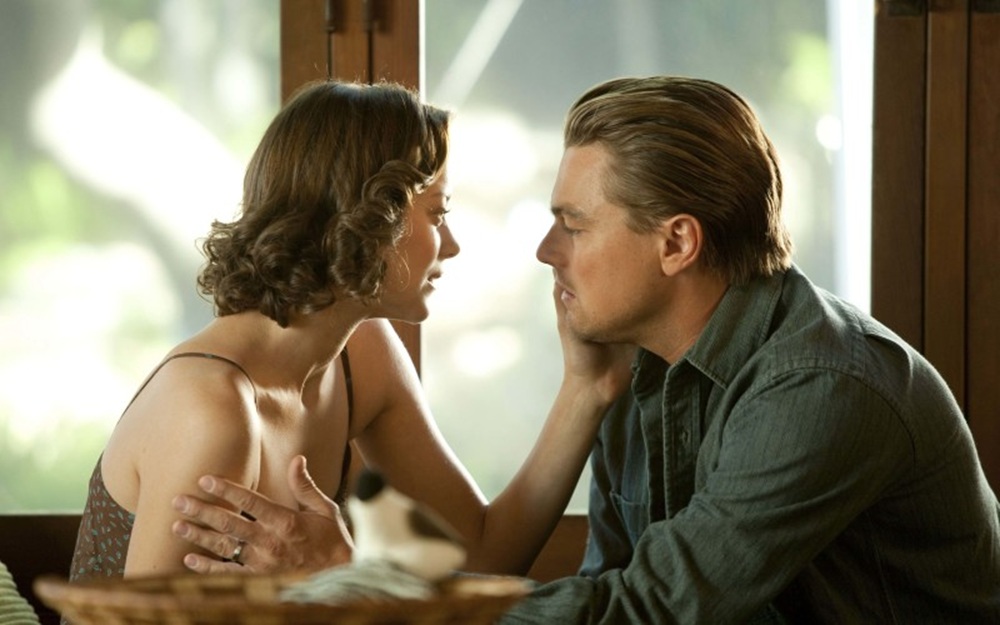
Here, Ariadne (Elliot Page) functions partly as our guide and partly as a therapist. She’s the only character who goes looking for what’s wrong with Cobb, who descends into Limbo not because the mission requires it, but because she can see that he’s haunted and she wants to understand by what. What she finds, and what we find, is Mal. Marion Cotillard, ghostly and devastating, embodies not a person but the shape of a grief that has calcified into something weaponizable. I’ve written before that Mal registers more as a device than a person, and I stand by that; the brevity of her scenes with Cobb makes their history feel more conceptual than lived-in.
But that’s also, perhaps, the point. Cobb’s relationship to Mal has already been processed into myth by the time we meet him. She’s not a woman anymore. She’s a projection, a wound. And the only way home is to let her go. He does. And in the film’s final shot, the spinning top and the cut to black before we see whether it falls, Nolan grants us homecoming as hypothesis. We don’t know if it’s real. For Cobb, he doesn’t care anymore. And that, somehow, is the most hopeful ending he’d offered up to that point: a man so desperate to be home that he decides to stop asking whether he is and just live there.
The Soldier Who Can See England
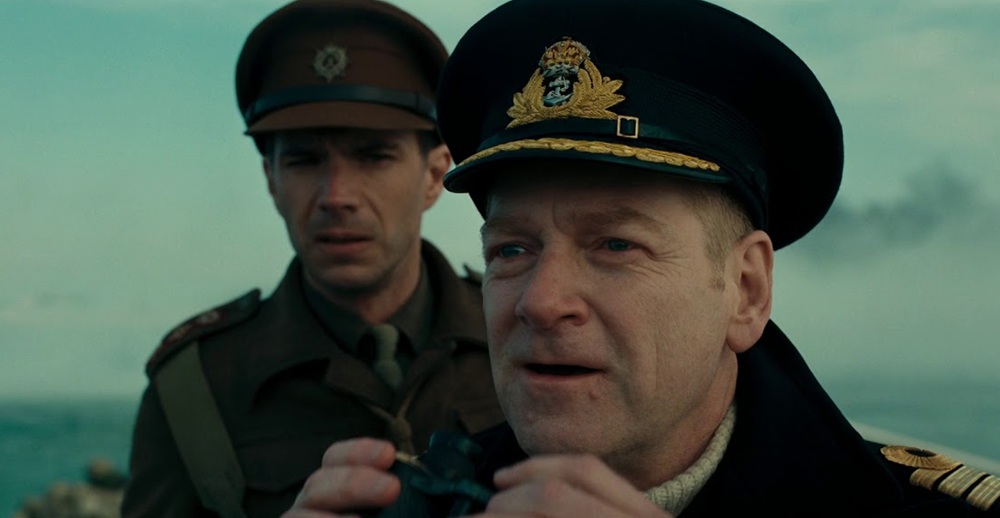
“Dunkirk” is the most literal home film Nolan has ever made, prior to “The Odyssey” itself. The English coast is visible from the beach. Literally visible. You can see it. Even the characters explicitly say so. Three hundred thousand men are stranded on that sand with their home in plain sight, and the entire film is about the gap between those two things, the knowing and the getting there.
Nolan strips the film of almost everything we associate with war movies: heroic speeches, individual character arcs, moral complexity rendered in dialogue. What he leaves is sensation. The physics of being trapped. The arithmetic of survival, how many men, how many ships, how many hours before the enemy arrives. Tom Hardy flying a Spitfire on empty fuel. Mark Rylance navigating a small civilian boat across the Channel because someone had to. The casual line, “Well done, lads,” spoken by a local man to the returning soldiers, who cannot understand why they are being thanked for surviving something they feel they failed to endure with sufficient dignity. They made it home. It doesn’t feel the way they thought it would.
What does the movie do? Home came for them.
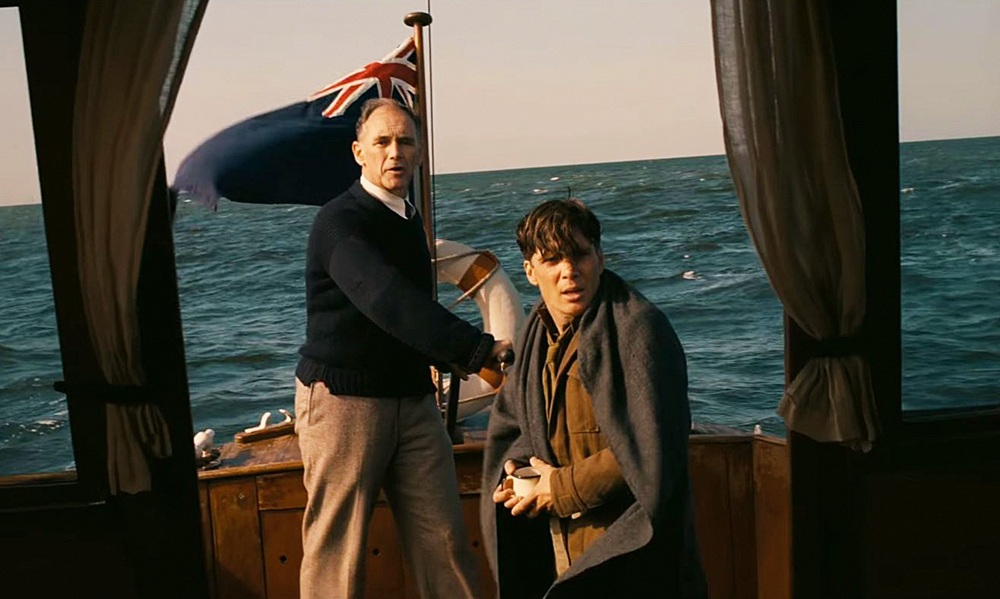
But the film’s most devastating moment happens on the rescue boat. A soldier, played by Cillian Murphy, has been pulled from the wreck of a torpedoed ship. He’s broken, shivering, terrified. He causes an accident that kills George (Barry Keoghan), one of the civilian boat’s crew, a young man barely more than a boy. And Peter (Tom Glynn-Carney), the other boy on board, chooses to lie to the shivering soldier about what happened. He tells him George will live. Mr. Dawson, Peter’s father, hears this lie and says nothing. He approves of it. They all go home carrying that together.
It’s a small moment in a film full of enormous ones. But it’s very Nolan. The lie that protects. The guilt that travels home with the survivor. The permission slipped quietly between a father and a son.
The Cinematic Grammar of the Nolan Lie
This motif, the necessary deception and the truth weaponized by withholding it, runs through the entire Nolan filmography in ways that become almost impossible to ignore once you start looking.
Leonard in “Memento” lies to himself, systematically, in order to function. His entire narrative is that of structured self-deception, and the film’s ending reveals that the lie has been serving a purpose he couldn’t consciously allow himself to admit. In “Insomnia,” Will Dormer covers up his partner’s accidental death, and that lie hollows him out from the inside. Alfred, in “The Dark Knight Rises,” burns Rachel’s letter, the one where she tells Bruce she’s chosen Harvey Dent, and lives with that deception for years before it finally surfaces at the worst possible moment.
Another one: Cooper and TARS, near the end of “Interstellar,” lie to Brand about their real plan. They’re not going to Edmund’s planet together; they’re going into the black hole, and they can’t tell her because she would stop them. They need her to survive. So they let her believe something false, and the deception is necessary and even loving. Cooper is sacrificing his chance at home in order to save humanity, and he can’t explain that to the person he’s leaving behind.
And then there is Dr. Mann. Played by Damon in his first collaboration with the director, Dr. Mann is someone who lied about the habitability of his planet in order to be rescued. He manufactured hope he knew was false, sacrificed other people’s lives to preserve his own, and when confronted, breaks in the most recognizable way: he tries to justify the unjustifiable.
Mann is, in some sense, the dark mirror of every Nolan protagonist. Where Cobb’s deceptions are born of grief, where Dormer’s is born of accident, where Alfred’s is born of love, Mann’s lie is born of cowardice. It is the Nolan pathology taken to its worst conclusion, a man so unable to face the truth of his situation that he invents a better one at everyone else’s expense. In a film full of characters trying desperately to get home, Mann is the one who would let the whole enterprise burn to ensure his own survival. As we know, he doesn’t make it.
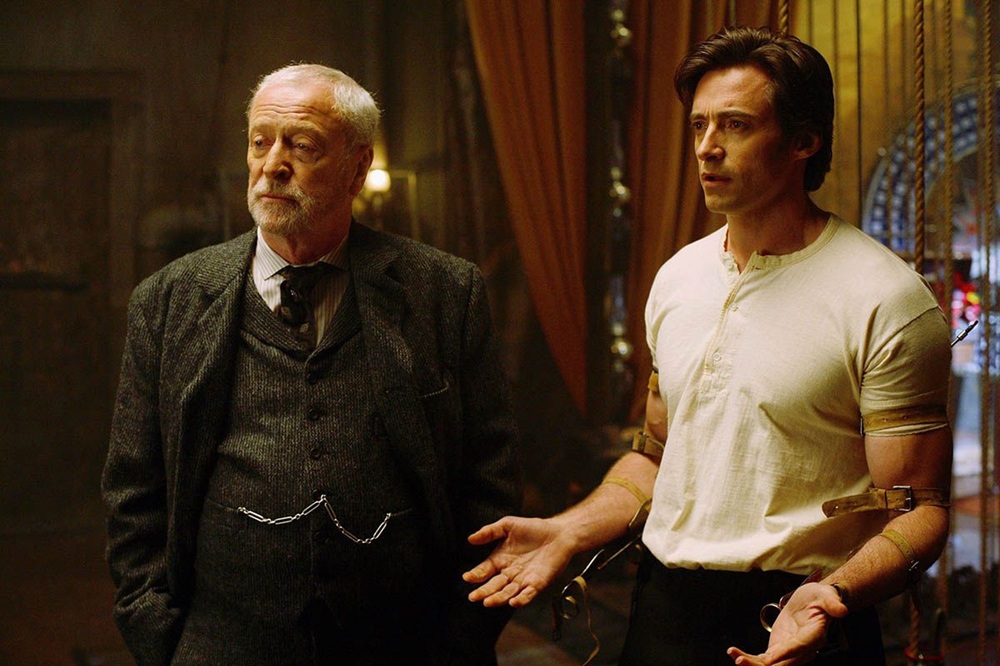
“The Prestige” offers perhaps the most unsettling variation on all of this. Cutter, played by Michael Caine, tells Angier (Hugh Jackman) the story of a sailor who drowned and was resuscitated, describing the experience as “like going home.” It’s a beautiful lie and a functional one: it keeps Angier willing to risk the act, night after night, in a tank of water. When Cutter later admits the sailor described it as agony, the word “home” curdles. Every other lie in this filmography conceals what happened or what’s planned. Cutter’s lie is different. He makes home sound like a mercy, knowing full well it isn’t.
These lies almost never work cleanly. They protect, but they also hurt. They enable action, but they also isolate. The characters who lie in Nolan’s films are always lying in service of something, whether love, survival, justice, or mission, and the films are honest enough to show the cost of that. The guilt travels. It accumulates. It keeps these men from home even after they’ve technically arrived. In Nolan’s hands, even the destination can be fabricated.
Cooper and Murph: The Longest Way Home
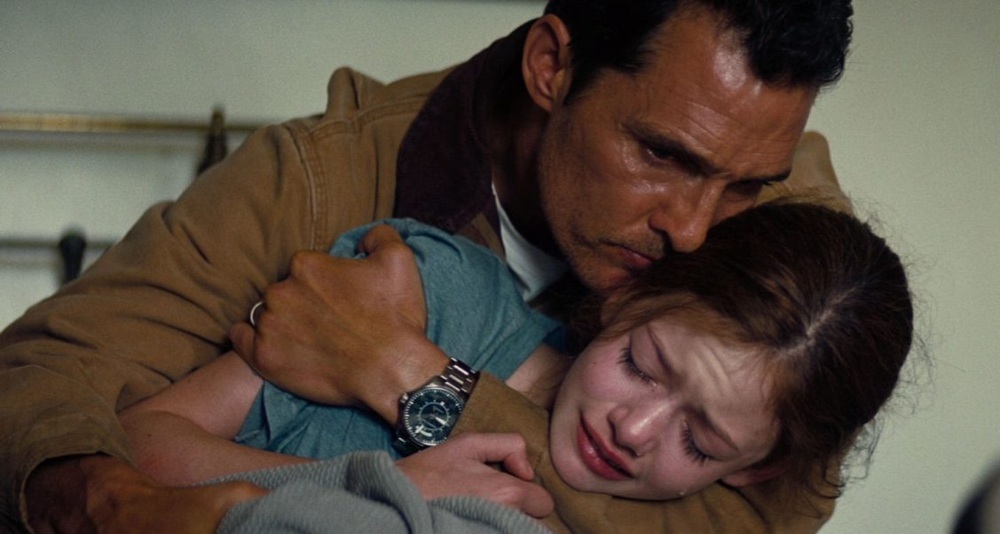
While “Dunkirk” is Nolanâs most literal home film, “Interstellar” is the most direct predecessor to “The Odyssey.” And here, we see the filmmaker at his most operatic and his most vulnerable. It’s the film where the intellectual scaffolding is most obviously built in service of a feeling: a father who leaves, a daughter who waits, and the unbearable arithmetic of time dilation and what it costs the people you love.
Cooper is, in the most literal sense, Odysseus in a flight suit. A man of strategy and skill, pulled away from his family by an ecological catastrophe, journeying through impossible terrain, trying to get back to the people who need him. The video messages scene, Cooper watching decades of his children’s lives arrive in a burst, watching his son become a man and his daughter become a stranger, is Nolan at his most unguarded. There’s almost nothing in the way: just Matthew McConaughey‘s face and what’s happening on that screen and Hans Zimmer‘s organ climbing toward something the film can’t quite contain.
When his daughter, adult Murph (Jessica Chastain), finally speaks to him across time and space, it is through the bookshelf. The ghost she thought was haunting her bedroom as a child. That ghost was him. It was always him. And the message he sends across a dimension is not data, exactly. It is love formatted into physics.
That this ends in reunion, Cooper waking up on a space station and going to see Murph one last time, only to be told to leave because âno parent should have to watch their own child die,â is almost too much. The film knows it and lets it be too much anyway. Nolan didn’t apologize for being earnest here. He made you feel the full weight of the longest road home in his filmography and then charged you for the privilege.
Most of us paid it twice.
Bruce Wayne: Exile as Identity
When you think about it, The Dark Knight trilogy is essentially a story about a man who loses his home, his parents and his city and eventually his faith in the city he tried to save, and who has to find his way back not just to Gotham but to himself.
By the time “The Dark Knight Rises” begins, Bruce Wayne (Christian Bale) is a recluse. He has retreated from the world. He goes through the motions of existing in Wayne Manor, and when Gotham needs him again, it nearly breaks him, literally. The pit. Bane’s back-breaking. The months of recovery. The climb back out, which Nolan frames as one of the most purely archetypal sequences in his career: a man descending into the earth, ascending through sheer will, emerging into light. He does it, famously, without the rope. After all, you cannot half-commit to going home.
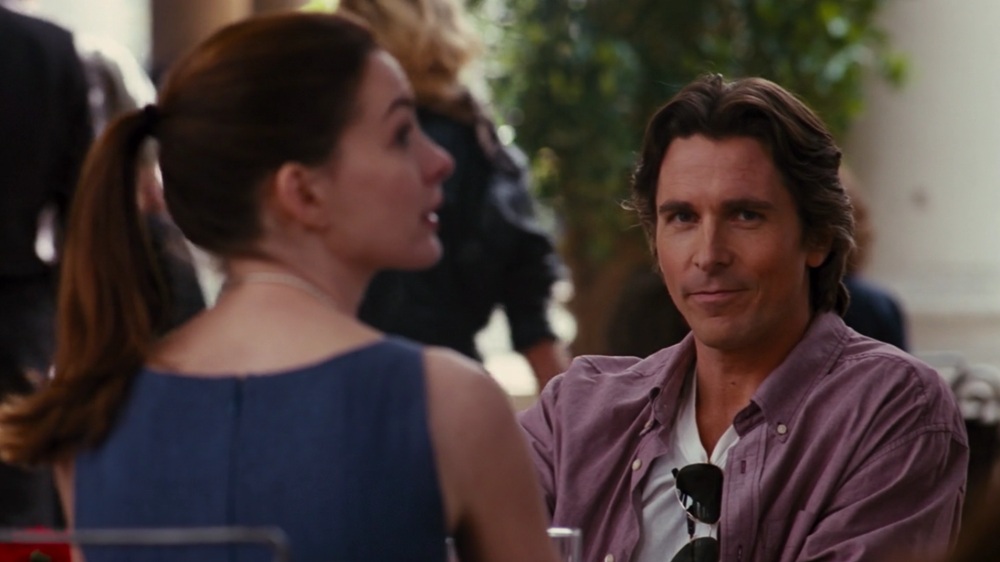
The film ends with Bruce’s apparent death and then, in the film’s final beat, with Alfred spotting him at a café in Florence, alive and with Anne Hathawayâs Selina Kyle, having given up the cowl and with it the exile that defined him. It is Nolan’s most unambiguously happy ending, and it works because it has been so thoroughly earned. Batman was never really the destination. Himself was. And it took three films and approximately everything he had to get there.
Oppenheimer: The Man Who Burned the Map
And then there’s “Oppenheimer,” the one where there is no homecoming, where the exile is permanent and entirely self-administered.
J. Robert Oppenheimer builds the bomb, watches it detonate, and understands in that instant that the world before July 16, 1945 is gone. He can never go back to being the man who did not know what he was capable of. The film is structured around this impossibility, told in two timelines, in color and in black-and-white, in full orchestral Göransson and terrible silence. The security hearing where his loyalty is stripped from him, the humiliation that followed, and the knowledge that the thing he built is now loose in the world, multiplying and spreading, with nothing to be done about it.
What home means for Oppenheimer is debatable. Whatever the case, what’s left is a man orbiting a place he destroyed in order to protect another place, and neither of those places exists anymore in quite the form it did before. He is the exception in Nolan’s filmography: the exile whose journey home reveals that home has been incinerated.
It is the most tragic film Nolan has ever made, and also, I’d argue, the one that comes closest to Greek tragedy in the classical sense. Which maybe explains why he began writing “The Odyssey” immediately after winning Best Director for it. He’d been circling Homer for years. After “Oppenheimer,” he was ready to name the source text directly.
The Matt Damon Starter Pack: Or, Why He’s the Only Choice for Odysseus
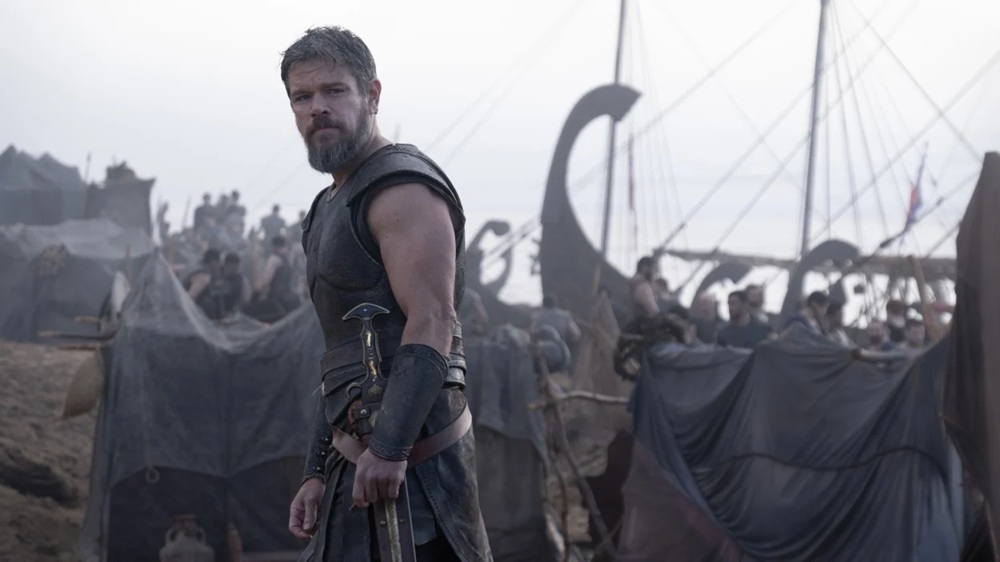
Matt Damon’s entire career has been preparation for this role.
“Saving Private Ryan“: rescue Matt Damon and bring him home.
“The Martian“: rescue Matt Damon from Mars and bring him home.
“Interstellar”: send a rescue team to Matt Damon on a freezing planet so he can get home, a premise he then destroys with his own cowardice because his character turns out to be the villain who faked the planet’s habitability and lets men die to preserve himself.
And now “The Odyssey”: Matt Damon is the one who needs to get home, and he’s going to handle that himself this time if no oneâs willing to help, thank you very much.
The joke lands because there’s something genuinely true inside it. Damon projects a particular kind of weathered competence. He looks like someone who has been through something and came out still functional, which is different from looking invincible and different from looking broken. Odysseus, especially as Emily Wilson renders him, is a man who is morally complicated, practically brilliant, and emotionally constrained by a warrior culture that doesn’t really have a language for what he’s feeling. He’s wily, he survives, and he makes choices that are not always admirable. And he gets home. Damon can do all of that. He’s been doing versions of it for thirty years.
And that Mann detour in “Interstellar” matters more than it might seem. Damon has already played the version of this archetype who fails at it, who chooses cowardice over honesty and pays the price. Now he plays the version who earns it. There’s a symmetry to that, and it doesn’t feel like an accident that Nolan keeps returning to him. Even in “The Odyssey,” where Odysseus will rely on divine intervention, most notably from Zendaya‘s Athena, the story is ultimately about a man whose cleverness and will carry him further than any deity could on their own.
That’s Damon. That has always been Damon. I mean, if only Jimmy Kimmel agrees.
âThe Odysseyâ: Is This the Culmination of Nolanâs Fascination?
Nolan specifically cited Wilson’s 2017 translation as an influence on his characterization of the hero. Wilson’s Odysseus is described, in her much-discussed opening line, as “the man of twists and turns,” where previous translations had favored “the man of many devices” or simply “resourceful.” The shift is subtle but significant. Wilson’s Odysseus is not just clever; he’s a man whose nature is to change shape, to adapt, to be many things to many people. That’s a more interesting human being to follow for two-plus hours. It’s also, in a very real sense, the description of half of Nolan’s protagonists.
I think this is what Nolan has been doing this whole time.
Every film has been a rehearsal for this one. Not in the trivial sense that artists develop their skills over time; but in the deeper sense that the themes he has returned to, almost compulsively, across his entire careerâthe exile, the journey, the guilt that complicates the homecoming, the lie that enables or destroys it, the time that has passed in your absence, the people you left behind who are no longer the people you leftâall of these are the architecture of the Odyssey. Homer had it first. Nolan has been living in it.
What makes this adaptation feel like a culmination rather than just another project is precisely that self-awareness. Nolan’s not coming to this material as an outsider; he’s naming something he’s always been doing. There’s a particular thrill to watching an artist arrive at the text that explains him, to watching Nolan, who has almost thirty years telling stories about men who cannot get home, finally sit down and adapt the story that invented the idea. It’s like learning that a musician who spent their career writing sad songs about love had been reading The Divine Comedy all along without mentioning it.
There’s a footnote to all of this that feels almost too neat. In 2003, before “Batman Begins” existed, Warner Bros. hired Nolan to direct “Troy.” He was fresh off “Insomnia,” they wanted to keep him in the fold, and the swords-and-sandals epic seemed like the right vehicle. Then the studio cancelled Wolfgang Petersen‘s “Batman vs. Superman,” Petersen wanted “Troy” back, and Nolan was handed the Dark Knight as what screenwriter David S. Goyer would later call a “consolation prize.”
Petersen’s “Troy” came out in 2004 to mixed reviews. By contrast, Nolan’s consolation prize became one of the most acclaimed superhero trilogies ever made. Even so, the ancient world never left him. He told Empire that certain images stayed lodged in his imagination for the better part of two decades: how he’d stage the Trojan Horse, what that world could look like through his lens.
“The Odyssey,” then, is not just a culmination of his thematic obsessions. It’s the completion of a detour that began over twenty years ago, a homecoming of its own kind.

Waiting for Ithaca
The film is not out yet, and yet debates have begun. The accents came under heavy scrutiny, the costumes contextualized and re-litigated. Someone else will post a TikTok defending Nolan and rack up millions of views. Someone will write a very long thread about Corinthian helmet iconographyâheck, even Iâm writing this though not in defense of the director, but in the service of spelling out his patterns aloud, however unnecessary it feels for others. The discourse will do what the discourse does, which is fill the space where the art has not yet arrived.
Underneath all of that noise is something more interesting: the faith. Not blind faith, because Nolan has earned the right to be criticized, and “Tenet” exists as evidence that even he can disappear up his own architecture when he stops trusting his audience with the emotional core of the story. The faith is something more specific. It’s the faith of people who know what this filmmaker does with exile and longing and the impossible distance between a person and the place they call home. The appreciators of good cinema who know that when Nolan builds a labyrinth, there is always, somewhere inside it, a father trying to get back to his children, or a soldier trying to see England again, or a dreamer spinning a top to check whether any of this is real.
Homer wrote the Odyssey sometime in the eighth century BCE, give or take, though scholars have been arguing about exactly when since before any of us were born. The poem survived because it told a story that people could not stop needing to hear: a man goes away to war, and then he tries to come back, and the world is strange and hostile and full of monsters, and still he keeps going, because there is someone waiting for him and he promised. That’s it. That’s the whole thing. Everything else, the Cyclops, the Sirens, Circe, Calypso, Scylla and Charybdis, is obstacle. The story is the promise. The story is the going home.
Christopher Nolan has been telling this story since “Following,” since “Memento,” since a sleepless detective looked at the Alaskan sun and felt it looking back. He has told it as a heist film, as a superhero trilogy, as a war movie, as a science fiction epic, as a historical drama. Now he tells it as itself, with the name on the tin and the Mediterranean light andâif weâre luckyâMatt Damon strapped to a mast while something beautiful and terrible sings at him from the rocks. Yes, the story, as has always been in Nolanâs case, is the going home.
“The Odyssey” is scheduled to be theatrically released in the United States by Universal Pictures on July 17, 2026. Follow us for more coverage.Â




