Yorgos Lanthimos is a professional trickster and manipulator, often making audiences uncomfortable and uneasy in each of his feature films, beginning with âDogtoothâ (âÎÏ Î½ÏδονÏαÏâ), which left the 2009 Cannes Film Festival audience in shock and awe, admiring and yet weirded out by the Greek filmmakerâs vision. Heâs inclined to use provocation as a gateway for his odd, often macabre, ideas. In the beginning of his career, it helped create some fascinating notions about human behavior in tightly controlled social settings, where heâd critiqued the norms and power dynamics via absurd, exaggerated scenarios, like a collective that is hired to assist them in their grieving processes by standing in for their recently passed loved ones (âAlpsâ) or a world where people are obliged to find a romantic partner by a certain age or they are transformed into animals (âThe Lobster,” my favorite film of his).Â
Lanthimos had a particular gift that many filmmakers envied. He has the ability to create unusual concepts that capture the attention of both arthouseâthose that help elevate his voice to a broader audienceâand mainstream audiences. I would never have thought that the director behind âDogtoothâ would be considered one of the most acclaimed and recognized filmmakers of our time. Throughout the years, he has evolved his style, opting for a more crisp look and ditching the stripped-down, grimy texture of his early work. However, his knack for prodding and providing shock remains. Regardless of the millions of dollars invested in each project, Lanthimos will not compromise his vision.
Yorgos Lanthimos and Will Tracy Adapt with Their Absurd Vision
This decade, he has been working tirelessly in the directorâs chair, three feature films (and an experimental short), all with his muse Emma Stone. This new collaborative relationship has greatly inspired Lanthimos, resulting in one unique feature after another. But if he has adopted a trait in the past couple of years, it is being more pretentious. With pseudo-intellectuality plastered onto each frame, Lanthimos has drifted into self-parody, mistaking obscurity for depth and implementing faux irony. His provocation is now hollow, and the aesthetic is all for vanityâs sake. He traps himself in his own artifice. This is particularly evident in his 2023 feature, âKinds of Kindness,” a project that showcases his worst unfiltered tendencies through a triptych about human connection riddled with unnecessary, goading baggage.Â
Although his follow-up, âBugonia,” is not as antagonizing and navel-gazing as the aforementioned, he continues the trajectory of overloading in pretensions rather than creating insight and intrigue. It plays like an adaptation of the film by South Korean filmmaker Jang Joon-hwan, âSave the Green Planet!â Lanthimos and writer Will Tracy (âThe Menuâ) utilize some of the ideas and concepts that Joon-hwan explored, but make changes to the story to give âBugoniaâ Lanthimosâ distinctive touch and style. The title refers to an ancient Greek belief that bees could spontaneously emerge from the carcass of an ox, creating a state of prolonged suffering. This concept serves as a metaphor for how life can arise from the dead or the malignant.Â

By knowing this beforehand, the title provides too much context for the ideas Lanthimos and Tracy want to plant in the picture. What serves âBugonia,” for better or worse, is the increasing absurdity that makes you second-guess every single narrative swing. The film follows Michelle Fuller (Emma Stone), the CEO of a fictitious major pharmaceutical company, who bathes in riches while pleading for the working classâ appeal. Sheâs a walking contradiction, an arrogant and ignorant company woman who lives to elevate her ego and position in the companyâan easy target for the filmâs themes of inequality and human cruelty. Michelle has rubbed many the wrong way, including Teddy (Jesse Plemons) and Don (Aidan Delbis), two broken men looking for a way to make ends meet and help their loved ones.Â
A Psychological Chess Game Beautifully Framed by Robbie Ryan
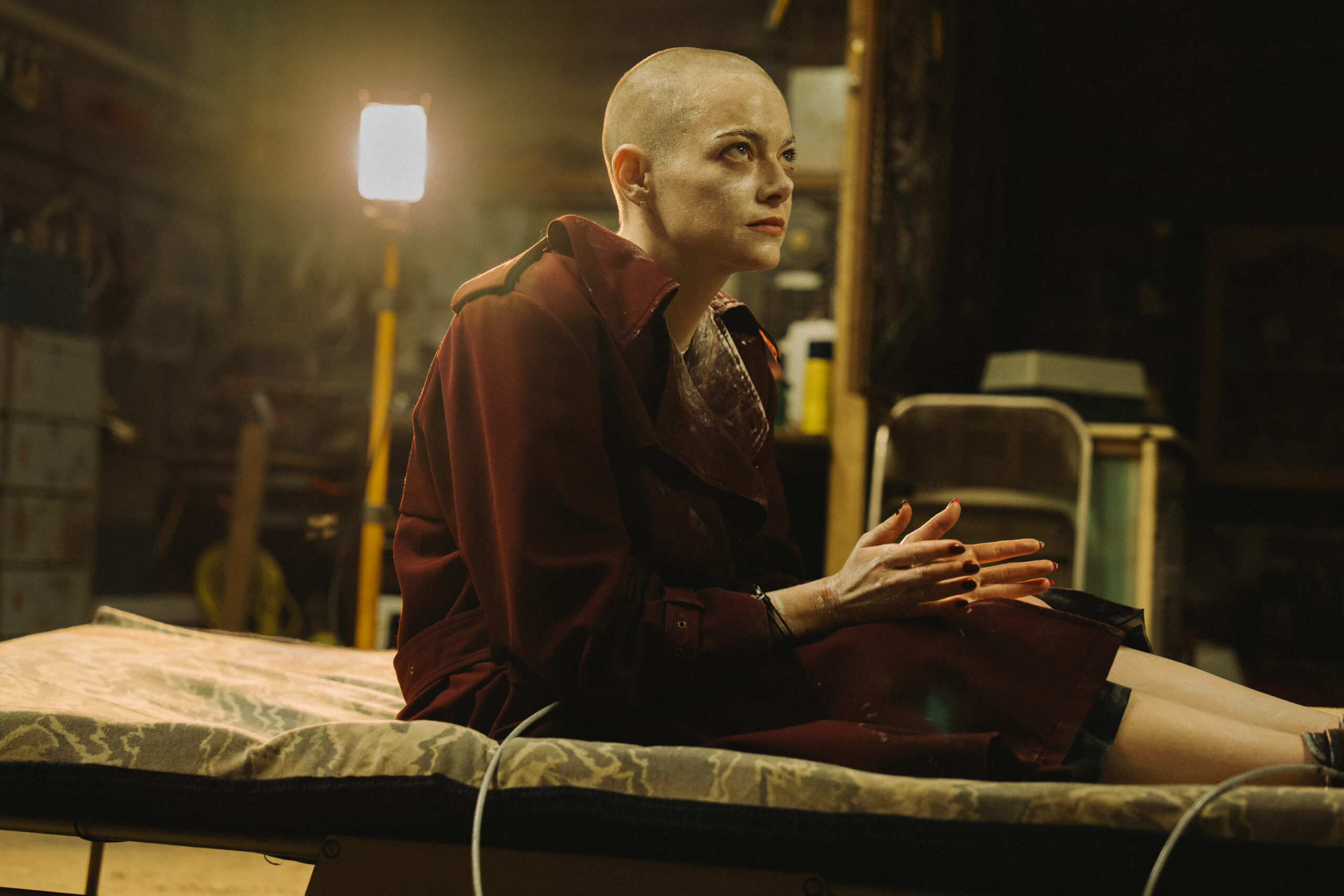
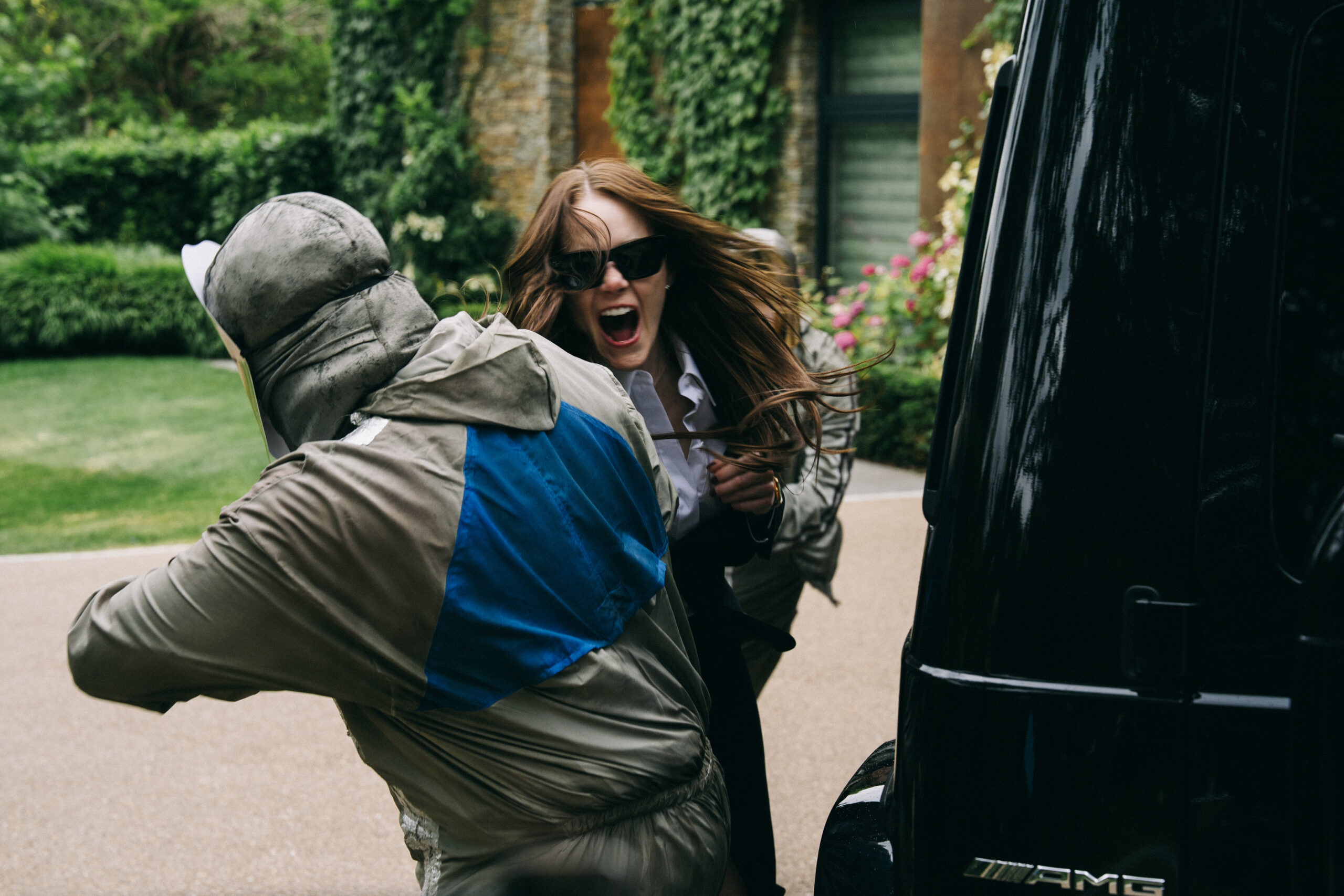
The two have reached their breaking point; they cannot hold on to another day being exploited by these million-dollar companies that preach about saving the world and its inhabitants, all the while cursing everything into further damnation. So, one day, Teddy and Don sneakily break into Michelleâs home and kidnap her. But Teddyâs motives are more than their respective injustices. He has a conspiracy theory that Michelle is an alien seeking to destroy the planet, which is why all of her actions are detrimental to human well-being, and he drags his cousin Don along with him. Teddy and Don torture Michelle and shave her head. It sets up a psychological chess game between the uber-rich CEO and the conspiracy theorists.
Cinematographer Robbie Ryan captures the claustrophobic and suffocating nature of the dilemma between these three players. One of the best elements of âBugoniaâ is its aesthetic. While I prefer Lanthimos when he utilizes griminess, the textures of the images bring these settings to life, slowly becoming characters of their own. Each house, Teddyâs and Michelleâs, helps broaden the inequality between them. The obvious factors are the dust-piled former and the lavish latter, but in the way that Ryan frames the film, you get more of the sense of entrapment than simple contrast. The visual language begins to warp as the film escalates. Lanthimosâ stylistic tendencies mirror the psychological decay of the characters.
Lanthimos and Tracy set up an array of ridiculous scenarios and prompts for the characters to act upon, each becoming increasingly hasty and ridiculous as the run-time continues. Some of these scenarios are risible, while others are pretty funny. Yet none of them has enough thematic weight for the director and writer to have their cake and eat it too. The two pile absurdity on top of satire until both end up collapsing under the strain of Lanthimosâ balancing act between the cruel nature of reality and empathy towards Teddy, unable to condemn or acquit him for his actions, which are both violent and âconciliatory.” They want us to laugh at Teddy while feeling his plight for justice.Â
Prioritizing Concept Over Characters
This is a tricky and challenging narrative move that few filmmakers could manage. And Lanthimos, because he is difficult to tame when under the pressure of his urge to provoke and a âlaughing at the painâ quip, is not the right man for the job. This is why the so-called âemotionalâ factor of âBugoniaâ is flawed from the very beginning and lacks merit, outside of Jesse Plemons’ attempts to save his character from weak personification. Jesse Plemons excels at making cold, broken characters feel human through his gentle tone and slow mannerisms. Plemons reaches further into Teddy than Tracy does with his lines. Another actor who tries her best to elevate the material is Emma Stone. She also delivers yet another solid, dedicated performance under Lanthimosâ vision.
Within the weight of it all, the pieces are in place for Stoneâs Michelle to be a morally complex character with numerous contradictions woven into her essence; in terms of the titular metaphor, she is the queen in the beehive. Michelle nurtures a false indictment just to rid them of the right to live. Stone delivers a nail-and-hammer performance with this passive-aggressiveness, making her interactions with Plemons engaging. The actors help mitigate some of the script’s weaknesses, making them less apparent to the audience. Yet, thereâs always a joke or an intent to arouse that one canât be bothered by being intrigued by the characters because they are always second-fiddle. In the end, Lanthimos and Tracy prioritize concept over character to the detriment of âBugonia.”