





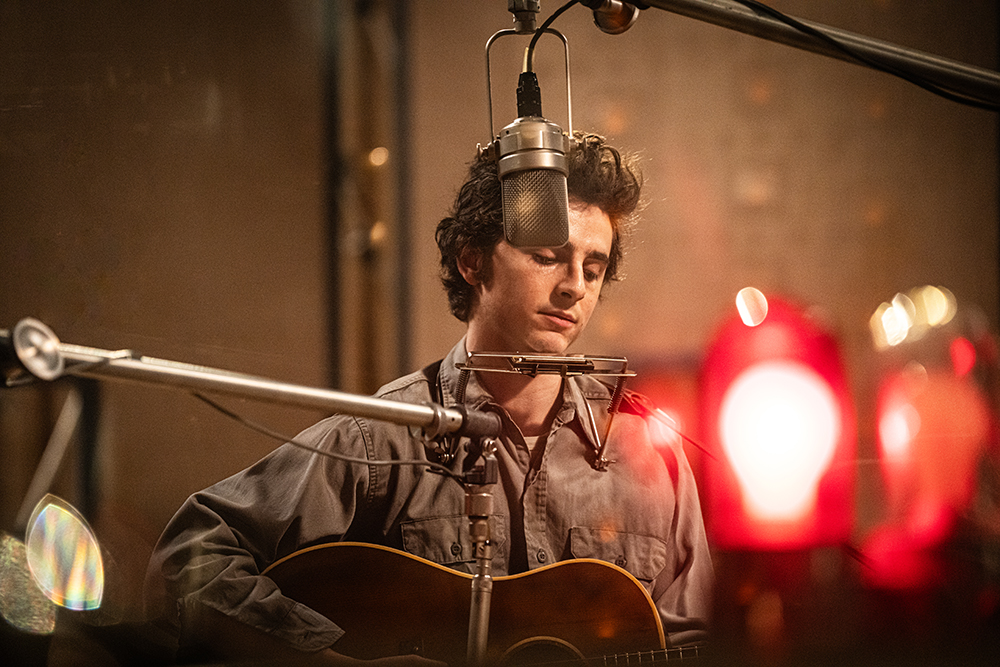
A biographical film often runs the risk of self-sabotage. The success of its actors in becoming their subjects could hijack a delicately-crafted film and transform it into an imitation game in which the famous people playing other famous people take turns one-upping each other while viewers keep score. James Mangoldâs âA Complete Unknownâ stands on (and occasionally stalls due to) the quality and precision of its acting, particularly the trio performing (songs, too) as legendary musicians Joan Baez (Monica Barbaro), Bob Dylan (Timothée Chalamet) and Pete Seeger (Edward Norton). While nostalgia for the generationâs rebel spirit might unwittingly simplify its complex subjects, a contagious, near religious reverence for the music redeems and elevates this serviceable period piece. Hewing to a reliable, linear arc, Mangold counterintuitively raises the difficulty level, constructing a Dylan we may have seen many times before, but, thanks to Chalamet, we might not soon forget.Â
Opening on Christmas Day, âUnknownâ dares to test the worldâs collective box office stamina while âWickedâ and âMoana 2â are still scorching hot. No doubt, the film will generate Oscars buzz in several major categories, although my hunch is that itâs destined to be this yearâs âMaestro” (2023) which earned seven nominations and no wins. Mangold (âWalk the Lineâ) is operating in familiar territory and âUnknownâ is a more concentrated, straightforward narrative than Bradley Cooperâs Berstein biopic. Itâs also more gunshy, lacking the auteurist flair and energetic outburst of the monochrome, often manic âMaestro.â And, similar to âMaestro,â the dialogue concerning âUnknownâ could get bogged down in aesthetics: Chalametâs accent this year might be Cooperâs prosthetic nose.
Live Singing Sets ‘A Complete Unknown’ Apart
Chalamet excels as a young Dylan (born Zimmerman), nailing the Minnesotan drawl and singular gravely voice while summoning the enfant terrible persona which defined the budding superstarâs ascension. Similar to Joaquin Phoenix (Oscar-nominated for ‘Best Actor’) and Reese Witherspoon (Won ‘Best Actress’) in âWalk the Line,â all of the actors here sang their own music, and played instruments, too. And Chalament even upped the ante, singing live. On-screen Dylans abound, both in fiction features (âIâm Not Thereâ for 2007 had seven actors play Dylan, including Cate Blanchette) and documentaries (DA Pennebakerâs âDonât Look Backâ and Martin Scorseseâs âNo Direction Homeâ and âRolling Thunder Revueâ), so Chalamet is already fighting an uphill battle for shelf space among the sunglass-wearing, moppy-hair folks who dare to portray the bard. He succeeds on merit and certainly likeness.Â
Barbaroâwhat a voice!âand Nortonâwhat a banjo!âarenât slouches either, and Boyd Holbrook is having the most fun as the man in black, Johnny Cash (Mangoldâs cinema collides!). Although the film takes place in the early 1960s, the worldâs political turmoil is background music, and Mangold prefers to zero in on Dylanâs private and then very public lives. He comes to New York with a guitar and a goal to meet Woody Guthrie (Scoot McNairy) and that relationship is the anchor for his evolution from a modest, self-styled folk singer to a petulant diva. (And while he was young at the time, I canât help but think of what Roger Ebert would have made of this film, having eviscerated Dylan of that era, labeling him petty, vindictive, and ânot very bright.â)
Dylan’s Singing Began as a Tribute… and Maybe Mangold’s
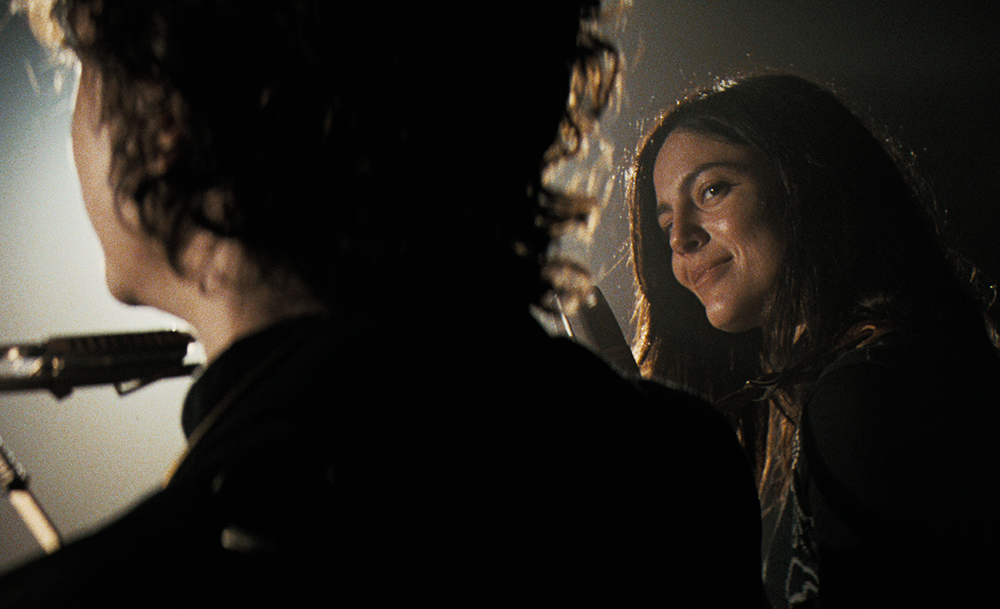
The filmâs dramatic crescendo is when Dylan went electric at the Newport Folk Festival, much to the dismay of his closest allies and boosters. Itâs a charged, raucous moment (âIâll sing louderâ), dimmed only somewhat by Mangoldâs earlier over-investment in Dylanâs transactional relationships. The on-again, off-again romance with Sylvie Russo (Elle Fanning) was clearly fundamental to Dylan, but the script (co-written by Mangold and Jay Cocks) is far more infatuated with the brighter stars Baez and Seeger. Sylvie then becomes a cipher, representing the ideals that appealed to Dylan (equality, activism), but only after he grew up a little bit. The gesture towards what could have been comes off as half-hearted or perfunctory, deserving either total omission or more substantive airtime to explain Dylanâs art and relationship to the world.Â
Mangold has spoken from the heart about this project, having started it before Covid-19, long before Chalametâs upgrade to the rarefied, upper A-list air. The director has mentioned the influence of his mentor Milos Forman, whose âAmadeusâ (1984) is the consummate musician anti-biopic, a masterpiece of style, sound and mercurial misbehaving. Forty years later, Mangoldâs film is more Leopold than Wolfgang, yet itâs full of imagination and an eagerness to eavesdrop on the psyche of stars whose moment met them. Dylanâs singing began as a tribute (to Guthrie), then rebellion and ends the film somewhere between an act of revenge and a duty. Mangold follows, rather than leads, from one phase to the next, emphasizing Dylanâs influences and distractions, and all the cultural trends and global unrest which couldnât nudge him off course. If some of the story is familiar, it’s entertaining all the same. So throw this film a dime.

“A Complete Unknown” opens nationwide on Christmas Day.Â




1 Comment
Fantastic review