





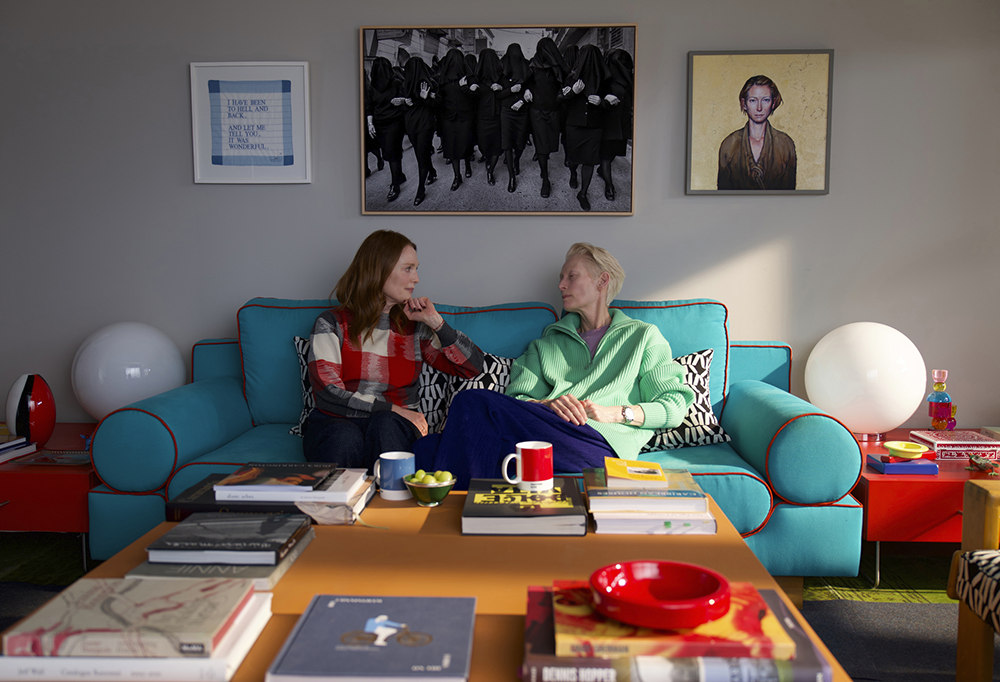
Pedro Almodóvarâs elegant and animated artistic vision colors death in bright reds and jagged purples, turning âThe Room Next Doorâ from a meditation to a celebration, propelled by the asymmetric brilliance of Julianne Moore and Tilda Swinton. Adapting Sigrid Nunezâs potent and poignant âWhat Are You Going Through,â Almodóvarâs film was the Centerpiece selection at the New York Film Festival, marking the directorâs fifteenth NYFF selection, of which a record nine have been gala presentations. And while the stellar production design oozes Almodóvarâs grace and flair, Moore and Swinton are indelible, depicting two friends linked by an extraordinary commitment to each other, developing and nursing a bond that flourishes as mortality looms in the foreground.
Ingrid (Moore) is a successful, New York-based writer of autofiction, who finds out through a mutual friend that her old pal Martha (Swinton), a war journalist, is losing a fight with late-stage cancer. While no longer as close as they once were, the two friends catch up quickly when Ingrid visits Martha at the hospital, flowing back into conversation about life, family, and career. So close were these two, that they even shared a man: Damian Cunningham (John Turturro), who Ingrid still confides inâa secret she doesnât disclose until later. In that initial meeting, Ingrid and Martha move past the reasons why they hadnât spoken, and cut to the chase of Marthaâs agonizing routine: experimental cancer treatments, chemo brain, silence from her only daughter Michelle. Smiling, fitfully optimistic Ingrid bats away what she sees as Marthaâs defeatism, reasoning that these days, thereâs always hope, giving up is unacceptable.Â
Leaving No Ambiguity on Almodóvar’s Themes
But what Martha will eventually relay, in a pulsating monologue plucked directly from Nunezâs novel, is that she intends to show bravery and fight back in her own way. Martha found a pill on the âdark web,â and decided that sheâd take it; the treatments werenât working, her body wilting and she refuses to suffer out her dying days while, some vigor remained. So, in the cafe of Alice Tully Hall at Lincoln Center (Almodóvarâs tribute to the festival that has been so supportive of his career), Martha asks Ingrid to be in the room next door when she takes the pill. It lightens the mood a bit when Martha says Ingrid wasnât her first choiceâthree friends already said noâand soon, they are in a car on the road to a glorious Airbnb (actually located in Madrid), where Martha will spend an unspecified number of remaining days.
Almodóvar leaves no ambiguity about whose sideâfriendship and the freedom to chooseâheâs on here. And the vibrant production design emphasizes both how the rooms look on the inside (farmhouse-chic, stunning floor-to-ceiling wall candy) and what their world looks like to us. Several sequences are filmed, at first, from the outside through windows, a voyeuristic effect that permits us only to bear witness. The audience becomes a transient third wheel, peering at the two friends at first from a distance, then waiting patiently for an invitation to move closer. When Ingrid visits Marthaâs stunning New York rental (âItâs a friendâs place, so I barely pay rentâ), the camera rolls from top down, situating the two friends perfectly in the middle, face to face on a couch, silently earning and rewarding each otherâs attention. It almost felt invasive to peek, but itâs impossible not to eavesdrop on Moore and Swinton.Â
Natural, Nuanced Performances from Moore and Swinton
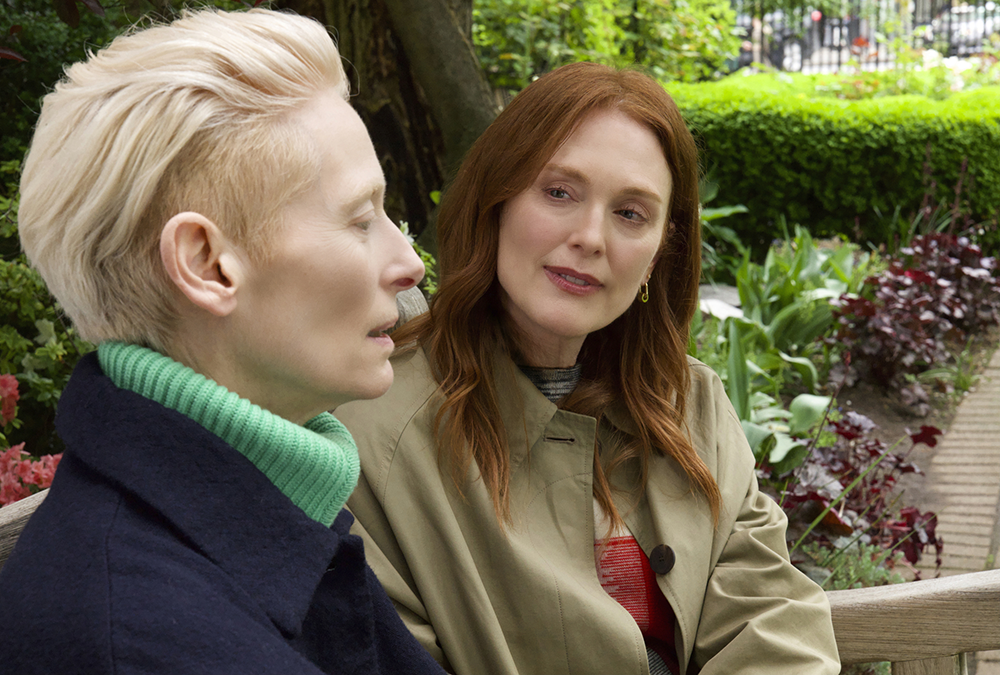
Shot by cinematographer Eduard Grau (âPassingâ), the visual beauty never overpowers the human element on screen. And with Moore and Swinton (and Turturro, splendid as the truth-telling academic and former cad Damian), how could it? Long-time Almodóvar collaborator Alberto Iglesias composed a score which delicately builds tension, and unwinds with grace and dignity, mirroring Marthaâs meticulous and clear-eyed planning for her own finale. The music is a complement, never a conceit to manipulate the mood or elicit sympathy, and it serves as a eulogy for the friendship and Marthaâs memory while the credits roll. In a reverse of âThe Hoursâ (2002), Mooreâs character hosts a mourning family member, and itâs only a moderate jolt to see Swintonâplaying mother and daughter, yet againâa final time.Â
Moore and Swinton are both so natural, itâs tempting to call their performances effortless. But, the opposite is true. The caring, tender world these friends share seems like it had to be grounded in reality, love and trust accumulating after years of life, loss and resolution. The way their partnership develops, inevitable distance from estrangement collapses and contracts, until itâs unclear where Martha ends and Ingrid begins. When Ingrid refuses to accept Marthaâs wishes, sheâs telling us more about her own fears than what she wantsâor who she can beâfor Martha. Late Almodóvar is softer in tone aside his earlier melodramas (besides some heightened Martha mannerisms and a slightly jarring, Sirkian flashback), but the subject matter and delivery are arguably more provocative. Itâs a searching, searing film, anchored by living legends who have met their equals on screen, an enchanting match made in Almodóvarian heaven.
“The Room Next Door” screened at the New York Film Festival, which runs from September 27th – October 14th. Follow us for more coverage.Â




