





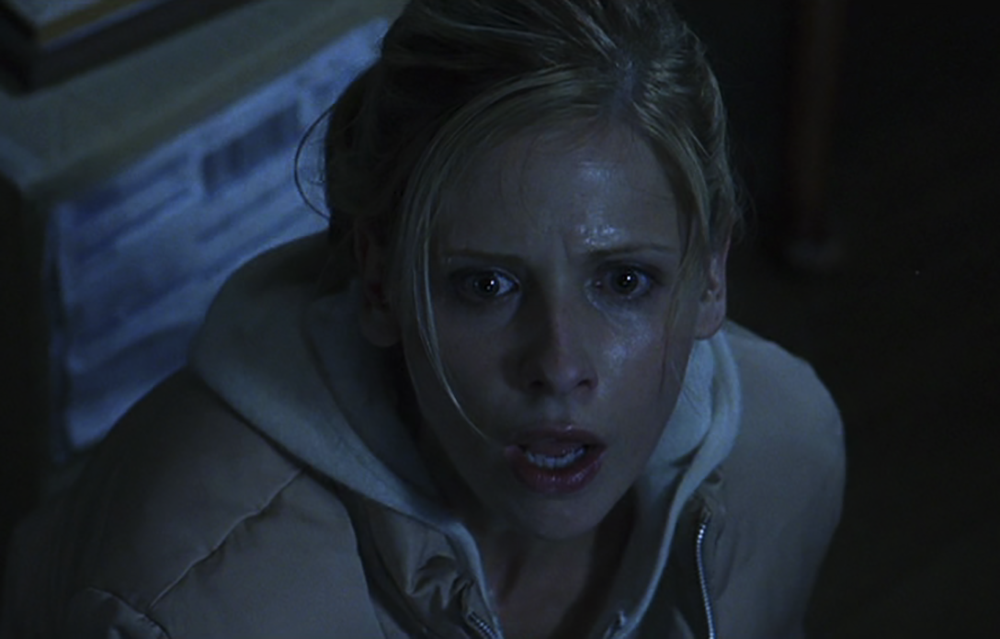
Sarah Michelle Gellar was still in the spotlight when âThe Grudgeâ was released, only five years past âCruel Intentions.â The charmâif that word appliesâwith Director Takashi Shimizuâs 2004 horror film is her restraint. In fact, though it stars popular actors of the time, itâs a slow-burn supernatural thriller that is creepy and procedural. Itâs atmospheric and tempered. And though it starts with a popular American actor (Bill Pullman) jumping to his death, the film is uniquely Japanese. Shimizu wrote the original screenplay for his 2002 Japanese film, and this remake is more of a higher budget reimagining than a redux. Of the other Japanese horror films produced by Hollywood (âThe Ring,â âDark Water,â and âOne Missed Callâ), this was the only one to remain filmed in Japan. Â
For some reason, that fact makes this film creepier. Shimizu (along with co-writer Stephen Susco) set the stage well. Karen (Michelle Gellar) has just moved to Tokyo to be with her boyfriend, Doug (Jason Behr), who is studying to be an architect. She volunteers in a welfare office aiding elderly or ailing persons (her supervisor is Ted Raimi, Producer Sam Raimiâs brother). She ventures into the eerie house that acts as this filmâs epicenter to take care of a coupleâs ailing mother. The shots are still and quiet, and everything here has a greenish-grey tint to it. Even the Columbia Pictures logo at the filmâs opening looks old and dated. And while Michelle Gellar and Behr could have distracted from the idyllic Japanese surroundings, Shimizu and Cinematographer Hideo Yamamoto use it to make usâlikes the filmâs protagonistsâfeel isolate and alone.Â
A Mystery to Unwrap
âThe Grudgeâ presents a mystery in the shape of a house, using present and past to tell its story. The thing that works about Shimizuâs film is that you never get the whole story. And maybe that’s the point. In fact, even the filmâs plot description is a red herring. âThe Grudgeâ isnât about a rage-filled entity or curses that follow, like in David Robert Mitchellâs âIt Follows.â Rather, itâs about exponential trauma, a trauma so horrific it has nowhere to go but stand still and repeat itself. The story behind that trauma takes Shimizu and Gellar most of the filmâs run-time to expose. The film’s winning argument is it doesnât happen in grave climax, but creepy proceedings drawn from its lingering atmosphere.Â
That atmosphere follows us during flashbacks leading to âthisâ storyâs beginning, with an American family moving into the cursed house, of course not knowing itâs cursed. They consist of Jennifer (Clea DuVall), Matthew (Michael Mapother), and Matthewâs ailing mother, Emma (Grace Zabriskie). When we first meet Emma (prior to this scene), sheâs in much worse shape. However, flashing back in time doesnât do much to fill us in. She âsleeps all the time,â per Matthew, but Jennifer often has a different view. That is, of course, until Jennifer begins to discover horrible things in the house while Matthew is at work. These involve a hissing cat, moving shapes, and other, worse things which shouldnât be given away. Itâs clear something inhabits the house, and the scenes are creepy yet often obvious in their presentation.Â
Drawing from Japanese Source Material
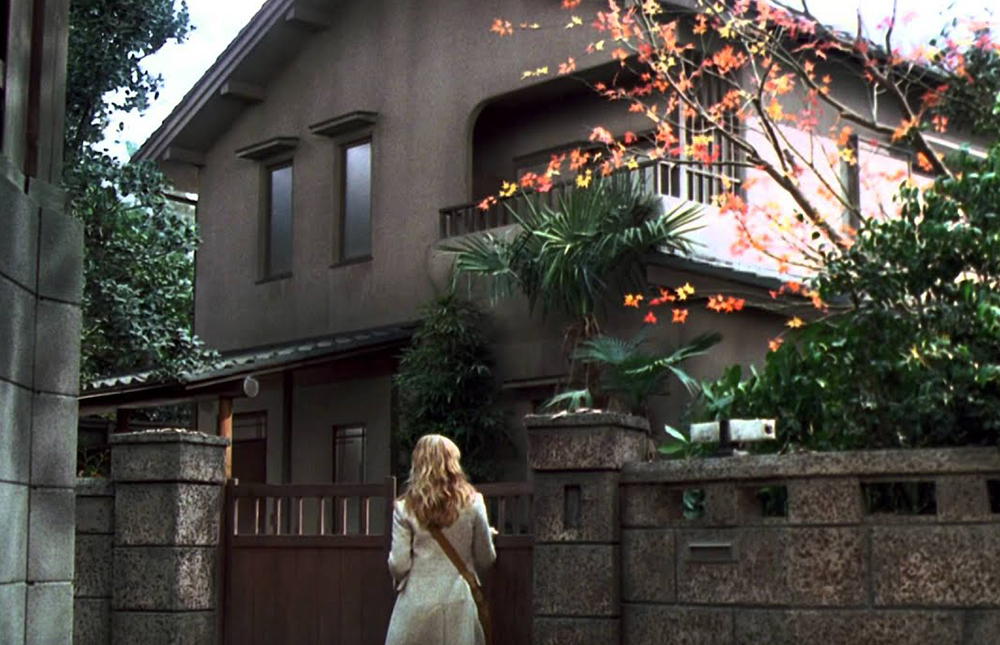
I havenât seen âJu-on: The Grudgeââthis filmâs source materialâbut that filmâs $3.5M budget has been upgraded to $10M for this film, and Iâm sure most of that went to landing Michelle Gellar and the filmâs special effects. The film is odd in that its photography of Tokyo, the movements of its cast, and the dull greyish-green it layers over everything gives it a slow, purposeful feeling. Yet the filmâs CGI often flies in the face of this, often showing when it should be telling. But therein lies the filmâs strength: itâs not really showing or telling something we can understand. We know that some kind of curse is stalking Karen and others associated with the house. But weâre not sure if itâs only contained to the house, or if it moves, and why. Amidst this, Karenâs supervisor has a run-in with an entity and Doug does a good job being a supportive partner as Karenâs mental health suffers.Â
âThe Grudgeâ is based on the aforementioned âJu-on,â and what makes âThe Grudgeâ feel jumpy and almost malaise-filled lies in the fact that Shimizuâs original film was actually the middle of a three-parter. Weâre only privy to a small part of the storyâin this case Karenâsâand weâre the better off for it. Michelle Gellar is tasked with most of the lifting in this film, and she handles it well. She doesnât steal the scenes, but becomes part of them. Her ‘other’ status as an American trying to learn Tokyo lets her blend into the filmâs proceedings. Aside her, a police detective (Ryo Ishibashi) carries most of the rest of the film. He seems not to blink at his discoveriesâno matter how ghastlyâand with just a look lets us know he knows more than he lets on. His acceptance sets the film’s tone, well before he tells Karen what is really at stake. But by then it feels too late.Â
Michelle Gellar and Ryo Ishibashi are Pleasing
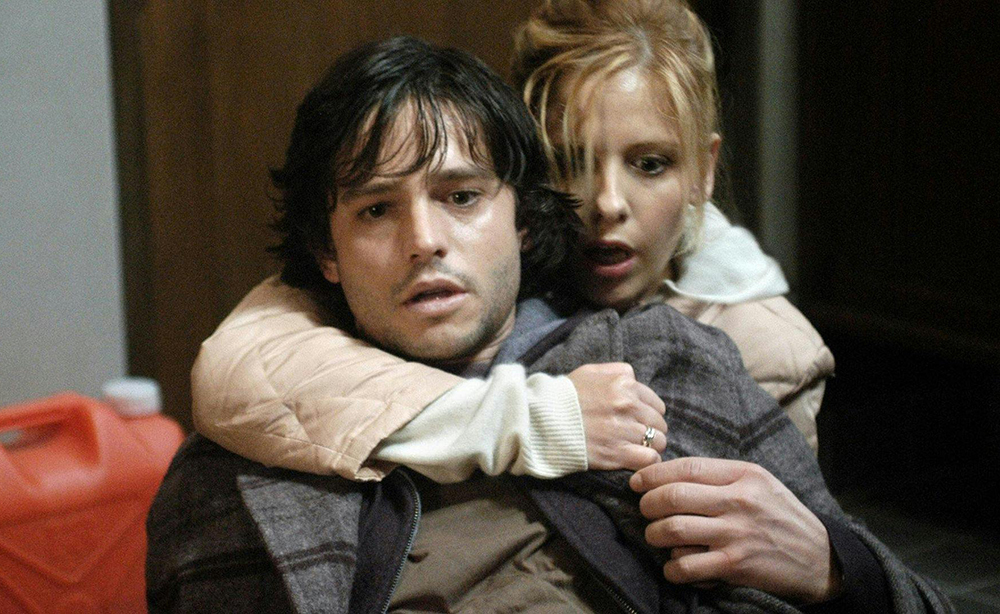
âThe Grudgeâ is a good movie. Itâs not greatâbut maybe itâs not supposed to be. It’s not horrific but unnerving, and perhaps along the way we lost sight that thatâs what horror films ought to be. There are plenty of creepy parts in Shimizuâs films, but it always seems to pull back when it speeds up. Thatâs a good thing. Like Matt Reeveâs âThe Batman,â âThe Grudgeâ feels like a portrait of its proceedings rather than becoming overstuffed with Hollywood trappings. While it features a generous use of CGI, the movie feels as atmospheric as âIt Followsâ with the feeling of un-safety offered in âFinal Destination,â but without that filmâs Hollywood flash.Â
âThe Grudgeâ feels like an indie. Its events begin and end, yet features a malaise that lingers, letting you know maybe it never will end. Its acting is apt and its cinematography is patient and pensive. Thereâs a horror to discover here. That Shimizu and company offer that to us in part, and want us to use our imagination to fill in the rest, is what ultimately makes the film succeed.Â

“The Grudge” is available to watch on most streaming networks.Â




