





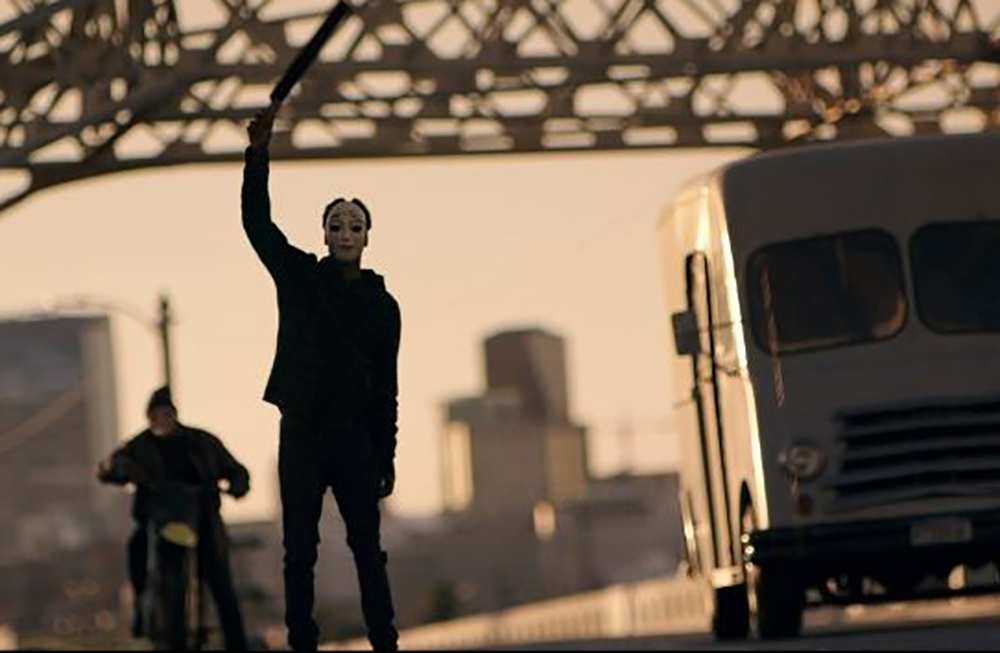
Thereâs no mistaking the fact that the âPurgeâ franchise centers on social commentary. However, at its base, it’s a horror franchise. And for some reason the series opener didnât do it for me. Maybe it was the big names (Ethan Hawke and Lena Headey, who seemed wasted), or the fact it was held hostage in a single home on Purge night. But for whatever reason, James DeMonaco, in his second outing, directs a superior horror picture with âThe Purge: Anarchy.â The film is equal parts horror and commentary. It depicts an altered U.S. landscape thatâat timesâisnât that hard to believe isn’t reality.Â
âAnarchyâ works because it is, for all intents and purposes, our first look at a Purge landscape. The film takes place in Los Angeles, but not that sun-burnt, hazy atmosphere as in excellent films like âDriveâ and âTraining Day.â Here, sunset is approaching as a couple, Shane and Lizâs (Zach Gilford, Kiele Sanchez) car breaks down on the freeway. Wiser people have long abandoned the streets as the night of legal murder and mayhem inches closer. It only occurs to Shane at the last minute that a group that has been stalking them has cut the transmission. They set off on foot before the blaring horn that announces the start of open hunting.Â
Stranded on Purge Night
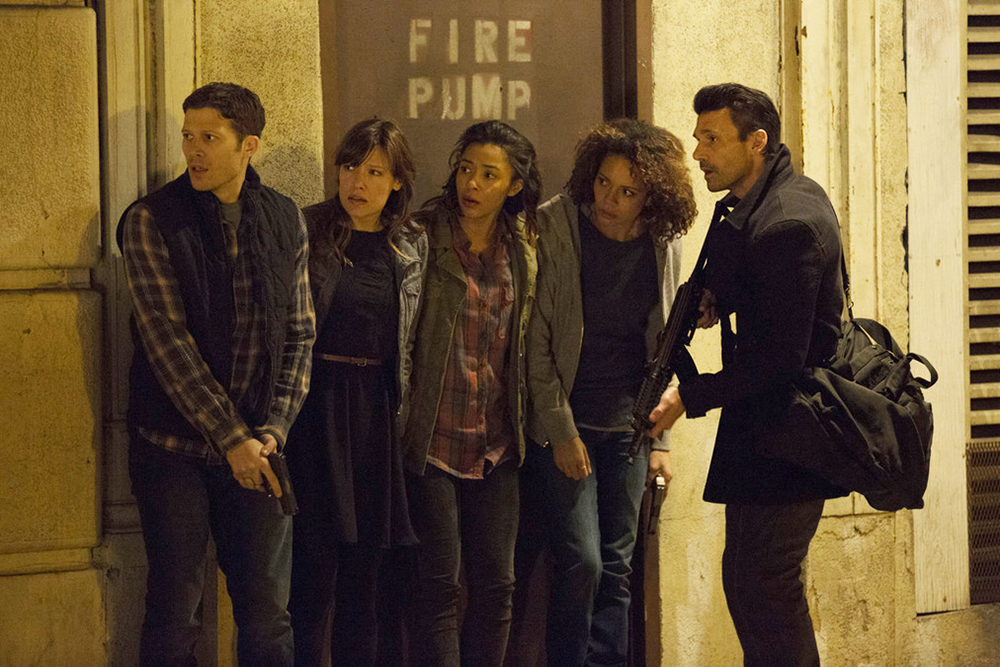
âAnarchyâ then sets us up to follow Liz and Shane as it introduces two other pieces to the triangle. We have a mother and daughter Eva and Cali (Zoë Soul, Carmen Ejogo), trying to survive the night. They soon meet Shane and Liz and the loner âSergeant,â played with gruff and zeal by Frank Grillo. Sergeant isnât a purger; heâs not out tonight in an armored car, armed to the teeth to kill innocent people. âAnarchyâ is slow to piece together why heâs Purging, although it offers glimpses. His son has died, and his wife left him after the event. Heâs out for recompense. But he stumbles, fatefully, across Liz and Shane and Eva and Cali and becomes intertwined in their struggle.Â
What works about âAnarchyâ is it turns the night streets of L.A. into the murder circus the night should be. The film sets up every corner and alleyway as potential death zones. Sergeant is clearly some kind of ex-military, and the opening sequence where he tells himself to avoid involvement as a group of kidnappers try to take Eva and Caliâbefore tactically taking them all down with easeâsets up his character. âWhy did you help us?â Eva asks. âYou reminded me of someone,â Sergeant retorts. In many ways, Sergeant is the heart of this movie. DeMonaco realistically sets up his inner struggle, as well as a U.S. that is ambivalent about the Purge. Not everyone is out cajoling and murdering. Decent people and low-income folks huddle behind closed doors just waiting for the night to be over.Â
A Host of Lunatic Villains Makes ‘Anarchy’s’ Horror Stick
âAnarchyâsâ violence is explosive and filled with the kind of carnage you would expect. But the filmâs real horror comes not from jump scares nor torture cinema, but from the host of villains it sets up. The homicidal maniacs that take part in the Purge dress in lavish costume (the most egregious political icons that formed the U.S. and references to âGodâ), and parade around in taunting ways. While the Purge’s America is meant to believe âreleasing the beastâ one night a year curtails crime, itâs clear normal folk arenât out killing. These are pure sociopaths, who for one night let their real selves out, torturing, maiming, and relishing in killing. Itâs clear DeMonaco is making savage takedowns on right wing politics with both the emblem that represents the âNew Founding Fathersâ (the current political winners) and the vitriol let fly by the purgers. But the reason the film is so horrific is that the hate and boastful statements hurled by the Purgers arenât that far from the hate seen on social media message forums in lieu of some of our own current events. DeMonaco makes us believe his villains believe these things, which makes it all the more horrifying.Â
A Solid Evening of Terror
That said, Grillo is the best part of this picture. Thereâs something vindicating about seeing would-be murders laid to waste. And later, as a character warns him âsaving livesâ is against the rules, we canât help but side with him more. The movie intensifies with some surprise shocks (cheaters be damned!) and we learn more about the unseen forces that support the Purge. The ending sequence, featuring a live-action homage to âThe Most Dangerous Gameâ is horrific and sad. It also works to bring out these peopleâs will to survive, making us like them even more. And the filmâs closeânot to be spoiled hereâoffers a tragic look at a damaged manâs soul and the forces of good heâs met that try and save him.Â
All-in-all, âThe Purge: Anarchyâ is a solid horror film. Itâs a cut above the first one, basking us in macabre and social commentary. At the same time it tactfully sidesteps the torture cinema craze that started 10 years prior. It offers looks at the human psyche we wish we could unsee, a cat-and-mouse type night of survival, and a look into the dark abyss of human nature. DeMonaco did a good thing here, and along with the anxious cinematography by Jacques Jouffret, âAnarchyâ leaves in its wake a solid evening of terror.Â
“The Purge: Anarchy” is available to watch on most streaming networks.Â




