





Riley Stearnsâ follow-up to “The Art of Self-Defense,” “Dual,” has some interesting “Black Mirror”-esque concepts, and the casting of Karen Gillan is perfect since she fits the bill with her excellent deadpan line delivery. Sad to say that it feels less than the sum of its parts.
Few directors perfectly encapsulate the art-form that is deadpan comedy. Of course, the names that pop in your head when thinking of deadpan are Wes Anderson and Yorgos Lanthimos. You can also argue that Roy Andersson is also a part of that small group, in its own right. However, itâs Yorgos who has caused significant shifts in filmmaking thanks to his style.
Riley Stearns Makes a Name for Himself in the World of Deadpan
Deadpan wasnât the same after “Dogtooth” released back in 2009. Lots of directors wanted to use Yorgos’ techniques, but many failed. One of the few that survived and made a name for himself is Riley Stearns. 2014âs “Faults” was my introduction to Stearnsâ work, and ever since, I have thought about his directorial approach. Then came “The Art of Self Defense” in 2019, and thatâs where people started to notice him a lot more. It was a film about hypermasculinity in the most straight-faced way, and it didnât work for me as a whole.
Regardless, I anticipated his next  move; Stearns was still doing interesting work, even though I didnât connect with it. His latest, “Dual,” has some of the issues I had with his previous feature, but itâs still intriguing. It centers around Sarah (Karen Gillan), who has a terminal disease with a 98% of killing her. Subsequently, she decides to clone herself so that the people who care for her can grieve more calmly.
Deadpan wasnât the same after ‘Dogtooth’ released back in 2009.”
The clone is almost exactly like Sarah, except that she has blue eyes instead of brown. She spends time with the clone so that it can learn her maneuvers, tastes, way of speaking, quirks, and everything in between. As everything is going well, at least for the clone, Sarah’s told that she isnât going to die after all. However, when she begins to reclaim her life, the clone doesnât want to go, as she has a life of her own.
Dual and ‘Duel’ as Plays on the Movie’s Title and Themes
The only way to settle this is a court-mandated duel to the death in a year hence. The filmâs name comes in two ways: a wordplay on duel (as per the duel to the death) and dual (as in having two of yourself and the duality of living within the repercussions that your clone will replace you at the time you die). The aspects that make up the name are interesting, though this isnât the first or best film to do them.
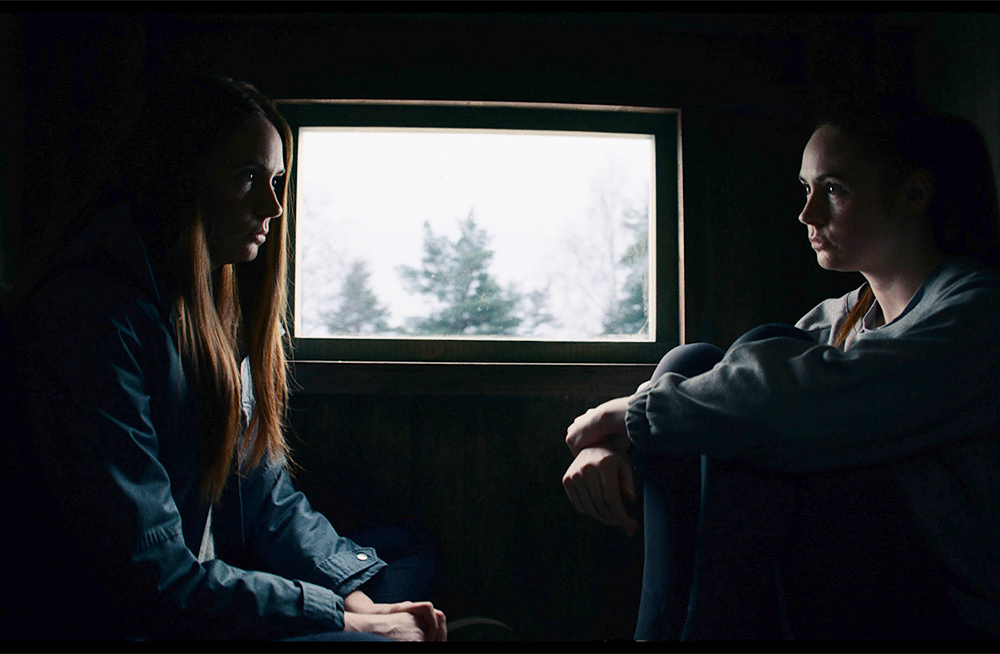
The way it is set up is quite engaging and funny. The script takes itself seriously enough to deliver some heft to the material and is funny enough to get us attached to the lead character. Thatâs why “Dual” excels for at least one and a half acts. Minimalistic âsci-fiâ mixed with bleak comedy is a formula that can work well until it starts to drag and drag, and then the credits roll. The movie goes downhill once Sarah begins to train with a combat expert (Aaron Paul) for her duel because she doesnât want to die (nor now or in the hands of her clone).
The reason why the film suffers is because it feels less than the sum of its parts; ideas that were settled for greatness remain undercooked, given the dedicated cast almost nothing to chew on. The whole concept of cloning seems like a “Black Mirror” episode (it might be one already, but I havenât seen the entire show), and youâd think that the movie will focus on the inner-angst and melancholy both the clone and Sarah are passing through in that year of preparation.
The reason why the film suffers is because it feels less than the sum of its parts…”
Loss of Character Development Causes the Film to Suffer in Parts
Instead, it goes from one combat training scene to the other; this is fine, but we never get to see the real Sarah as her character is very underdeveloped. For the weeks that the clone spent learning about her, the audience knows a small fragment. And it is a bit unfair since Gillan ate this performance whole with excellent deadpan delivery and stone-wall demeanor, with a few moments of showing emotions (which the film needed more of so that it wasnât so distant).
The other actors (Aaron Paul, Beulah Koale, Katariina Havukainen) are given little to do and are even less explored than our lead characters. Beulah Koale played a vital role in the film, as Sarah’s ex and the cloneâs boyfriend, that could have caused a growth into a broader territory in terms of the expansiveness of reality or given us questions that would stick inside of our minds (again, a la “Black Mirror”), yet nothing happens. He is in the film for the first act, and then he says his grace and leaves. Itâs a bit frustrating since you can see the potential by just reading the tiny fragment of the synopsis. Ideas about reality, morality, judgment, self-worth, and empathy are bubbling in your mind, then you watch the movie, and you are left with a somewhat empty experience.
This review was written from day 5 of Sundance Film Festivalâs 2022 programming.Â
Support the Site: Consider becoming a sponsor to unlock exclusive, member-only content and help support The Movie Buff!


