





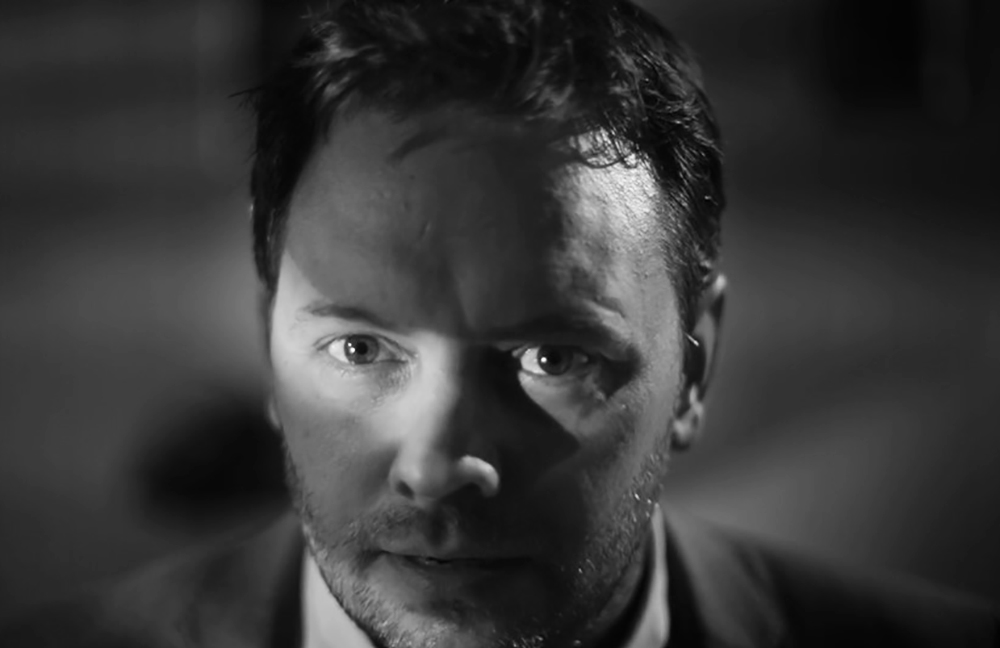
Actor Dan Franko and director/writer Ben Sledge come together to produce the independent short âThe Recursion Theorem,â a psychological/noir thriller that Franko himself describes as inspired by âThe Twilight Zone,â Hitchcock, and âThe Shining.â The short, filmed in black and white (with strategic intersperses of color), is gritty, yet accessible, and gives a glimpse into the maddening mind of its protagonist Dan Everett (Franko), who wakes up to realize he is trapped in a solitary room with no hope of escape.Â
What is most striking about Sledgeâs film is that he and Dan Franko were able to pull such a professional looking production out of a budget of only $8,000. The cinematography by Omar Juarez is engaging and sufficient, and the sound department produces random thematic music that fits the bill. The opening, which shows Everett sauntering around the solemn room, observing his surroundings, is especially apt. We see not a single light on, the only luminescence of some spilled sunlight from drawn blinds. We see, also, Victorian-looking chairs, some creepy paintings, and a carafe of whisky and two glasses (though sometimes the two glasses becomes one; illusion and questioning reality are frequent themes of âThe Recursion Theoremâ).Â
Everett approaches his new âprisonâ with the nonchalance of walking through an antiquities shop. His pace is slow and steady, panic not present but only occasional laughter at its idiosyncrasy. However, as Everett realizes escape is impossible (every door leads to a path back into the same room), madness begins to take over and insanity reigns.Â
Of course, for a production like this to work, it has to have a stellar lead, and Franko does nothing to disappoint. He observes and comes to grips with his predicament in a way that mixes reality and fantasy. Observe his realistic reaction to the creepy paintings he finds abundant; itâs a sense of perversion and disbelief. But observe also his maniacal laughter at his discovery that walking through a door from one side of the room only leads one to enter from the other (itâs like one of those old Super Mario mini-games, where you can walk in a straight line in perpetuity, in an unbroken loop). Franko, with 39 acting credits to his name (including the TV series âVeepâ and âThe Wireâ) is able to imbue his worsening madness well. A look, a laugh, or learned helplessness line his defense. Cinematographer Juarez adds to this with protracted close-ups of Frankoâs face. Itâs uncomfortableness the filmmakers are trying to impart, and they do it well. Â

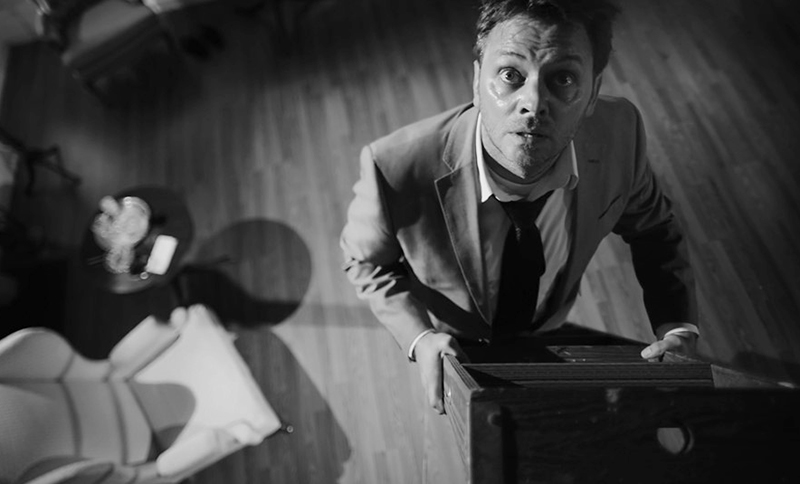
âThe Recursion Theoremâ is bizarre in that it has no ancillary charactersâ¦well except another man named Dan, played also by Franko. He has that caretaker/man-in-the-know type that is an obvious homage to the bartender/caretaker relationship in âThe Shining,â but done in a way that is creepy in its own right and effective. And, whereas in âThe Shiningâ the audience is well aware the protagonist is hallucinating, and not conversing with an actual barkeep, here we are not so sure. Sledge keeps the audience guessing, alluding to Everettâs slipping sanity with subtle gestures such as two glasses appearing on the table one moment, only to have one appear the next. Thereâs also the way the pairsâ conversation oozes subtext, much in the way Hitchcockâs âPsychoâ did between Norman Bates and Marion Crane. What seems a physical imprisonment of one man, soon hints at more illusory things. Is the predicament a dream, a fantasy, a glimpse? Or is Everett stuck in the throes of depression and suicidality? The ending, truncated and terse, only hits at this, but ever reveals.Â
Additionally, the limited special effects that Sledge and company were able to foster are engaging and effective. The infinite loop of the room is well portrayed, the best occurrence as Everett reaches his hand out of an open window and looks horrifyingly behind him as he sees his hand sticking out from the other side. His reactions are more akin to the protagonists in the many stories of H.P Lovecraftâdisbelief in concert with insanity, which make his responses both believable and maddening at the same time.Â
If a criticism must be made, it could be said that the ending is a little too abrupt, and a little too ambiguous, to make the wrap-up as easily digestible as Franko may have been going for. But itâs a minor criticism. What âThe Recursion Theoremâ does is to propel you headfirst into insanity and a land of disbelief. With good production value, good acting, and eerily effective set pieces, the filmmakers are able to do just that.Â
âThe Recursion Theoremâ won awards at both the Columbia Film Festival and the Garden State Film Festival. You can watch the film currently on Amazon Prime.Â



2 Comments
Sounds intriguing. Added to my watchlist.
If you like indie Vidal, I’m sure you’ll love it.