“Big and Tall” is a short-length independent film with child protagonists. It revolves around Molly, a girl determined to win a ten thousand dollar bounty by photographing a Bigfoot. She doesnât have much support from neither her friends: Devon, Carl, Tyler, nor her mom. Despite being surrounded by doubting Thomases, Mollyâs eagerness to find the mythological creature doesnât fade and her faith in its existence doesnât shake. After wandering throughout the woods for quite a time, she does experience a sense of disillusionment: it is, however, suggested that she eventually manages to see the creatures and get an empirical evidence of their encounter.
The film vibes are cheerful and idyllic, as a result of nature passages, Mollyâs positive spirit, and upbeat music. A latent insinuation of a Bigfoot being a benevolent creature is omnipresent: an allegory of a noble savage. Its similarity to humans is implied in Mollyâs words:Â
âTheyâre more advanced on the evolutionary scale than your typical mammal. They probably bury their dead⦠Theyâre just more sophisticated than people give them credit for. They havenât gotten this far as a species without being careful. They probably have a huge cave system, where they bury their dead. And the entrances to the caves could be high up on the sides of cliffs, where theyâre not easy to reach.â
She depicts an idealized being: just enough intelligence to be deserving of empathy, but not too intelligent to be malevolent and corrupt. Its anthropomorphic nature symbolizes an innate goodness of humans, a life in harmony with wilderness and its intrinsic goodwill. Untouched by the evils of the civilized world, it represents a door to an eurythmic, brighter, and purer one. Mollyâs adventure indeed has an objective of creating a better world:Â
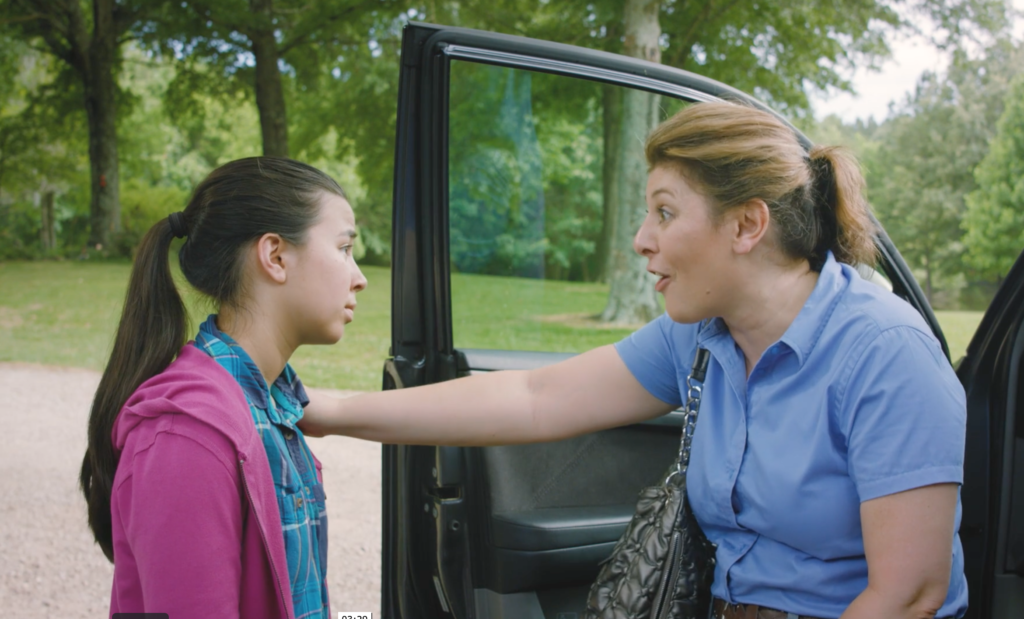
âIâd give it (the 10,000 dollars) to my mom. Then maybe she wouldnât have to work those two jobs and we could justâ¦â

A return, or a glace at a primitive life, uncovers the universe before Pandora opened the jar. When Hesiod wrote down the Myth of Five Ages in his poem “Works and Days,” he made sure to ascribe the disruption in humanityâs paradisiacal existence to Pandora opening the jar that contained all the evil and misery. What was left inside, however, was Elpis, or a spirit of hope. In literary interpretation to this day, itâs unclear why was Elpis the only thing that remained in the jar. One of many speculations could be that Hesiod thought that hope is the only thing that could keep the humankind in existence. Through the utopia-dystopia paradigm, “Big and Tall” can be better understood.
The anthropological and folkloric element is another thing that can be appreciated in the film. Contrary to the traditional tendency to associate folktale motifs with superstition, magic, and the occultâwhich is good material for the horror genreâ”Big and Tall” doesnât exploit their uncanny potential. It rather aims to be informative, so that a viewer can get the impression of watching a mixture of a fictional and documentary film. Molly, her friends, and her mom do engage in dialogues, but her explanations have a mere narrative role of a documentary film:Â
âDid you know that the counts of the creatureâs existence in this area date back to the 1920s? Some of the best visual evidence didnât surface until the 1960, with the release of the Patterson-Gimlin film.â
As a modern fairy-tale, it fuses the unknown, the adventure, the legendary creature, the reward, with a heroine that deals with stereotypes connected to her being a female: for example, her friends advise her not to be alone in the woods given that âsheâs a girl.”
You can watch âBig and Tallâ on Amazon Prime.