



Seven years after the original âAlienâ was produced, its sequel, âAliensâ was released. This time, however, the film packs more of a punch, is markedly scarier, and has an increased production value. Ridley Scott, who directed the first film has here been replaced by James Cameron, and the plot has been expanded, both of which help the film in different ways. And without the ultra dim lighting of the first film, we are able to see the alien creatures in their full splendor, a feat that won the film two Oscars for âBest Sound Effects Editingâ and âBest Visual Effectsâ respectively.Â
The basic plot of the film is that Ripley (Sigourney Weaver) is found by a rescue team and awakened from cryogenic hibernation after sleeping for 57 years. The news of how much time has passed is given to her by Paul Riser (of âMad About Youâ) fame, as she is quickly brought before her administration to tell her story of what happened. She explains the aliens. Of course the plot requires that she is disbelieved, being the sole survivor of the original catastrophe. However, her story ultimately gathers some weight as a moon, where colonists have been creating a habitation to live on, suddenly loses contact with Earth. A team of highly armed Marines – with Ripley convinced to go along as a consultant – are sent to the moon to investigate.
What works about âAliensâ is the lunar setting that serves as itsâ backdrop and the way it invokes fear through subtlety and camerawork rather than through gruesome deaths and special effects (though both are present throughout). For instance thereâs a survivor that the group finds, a young girl named Newt (Carrie Henn), who states matter of factly that the Marinesâ firepower wont be enough. Or thereâs the way the aliens’ presence is hinted through their wounds (bleeding acid splashing on the ground), or the repeated use of an infrared tracking device the Marines have that shows the aliens descending creeping closer and closer to them throughout the film. And when they do appear, fear is invoked with through their ability to sustain much of the Marinesâ hardest firepower and the aliensâ sheer numbers. Thereâs not just one run-amok alien this time, but a whole colony.


In films like this, its characters (even heavily armed Marines) are usually presented as little more than cannon fodder. However, like the excellent 1987 film âPredator,â here the Marines are developed and given depth, which makes us care about them, unlike the first film where the shipsâ inhabitants were thinly brushed. Thereâs a young Bill Paxton playing a Marine named Hudson, and others such as Gorman (William Hope), Vasquez (Jenette Goldstein), and Corporal Hicks, played by Michael Biehn. In a way that differs from his later career, Paxtonâs Hudson appears afraid and manic once they encounter the aliens, while others, like Vasquez, appear oddly stoic. But thereâs a camaraderie between them that is clear and present, especially as they watch out for both Ripley and Newt throughout.
We also see an interesting character named simply âBishopâ – an android played by Lance Henriksen. After Ian Holmâs android character from the first film had betrayed Ripley and the other human members, Ripley instantly distrusts him. However, Bishop makes the movie in several scenes, including its high octane middle and fright-crafted ending, which hosts one of the scariest scenes in the entire movie.


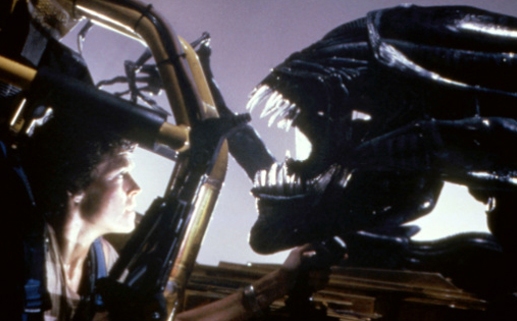
The special effects given the aliens is superb, with menacing close up detail, hideous mouths dripping with saliva and jagged teeth. The aliensâ embryos, or the âface huggersâ are improved this time around, and move quicker, and, though faceless, create as much if not more fear than the aliens themselves. Of course, the creepiest scene in the entire movie is towards its ending, as Ripley inadvertently finds herself deep within an alien nesting ground. The presentation of the âQueenâ is a thing to behold, done to perfection by effects creator Stan Winston (among others), who would later go on to create the dinosaurs for âJurassic Park.â
All in all, âAliensâ is a solid film. With better character development, better lighting, and a non-stop finale, it improves upon its predecessor in remarkable ways.