Football is the national pastime. Sure, baseball holds the name, but only football has the publicity, the ads, and the notoriety that captivates America year after year. In many ways, autumn is no longer fall, but football season.
While people have been familiar with boxingâs âpunch drunkâ syndrome for years, CTE, or âChronic Traumatic Encephalopathyâ didnât get much attention at first, even amidst the chagrin of its founder, Bennet Omalu. However, a multitude of NFL player deaths, along with the eventual publication of books and articles on the topic, would bring to light the condition, which rendered men in once great health to elderly Alzheimerâs patients. Now this Christmas we have âConcussion,â a film based on Omaluâs discovery and the backlash it proffered. And lined with powerful material and performances, the film is decidedly worth the effort.
Omalu is a Nigerian immigrant, brought to life here by Will Smith. We see from the start what kind of man he is: a driven professional who gives his all to his endeavors. Heâs called to testify in court, convincing, with scientific proof, that a suspect could not have killed the victim because with his condition, hemophilia, he would have surely bled to death if he had been scratched in self-defense. Heâs also a pathologist, his job to determine not how a person lived, but how they died. Heâs good at what he does, delving into a personâs life to determine their death, even taking to talking to the corpse aloud during autopsies, which angers a fellow pathologist. However, itâs not strictly his work ethic that brings Omaluâs work into question: a foreigner believing in the American Dream, we see how Omaluâs immigrant status comes into play.
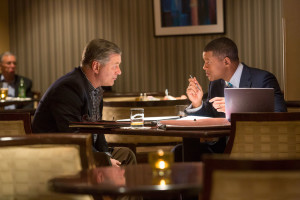

âConcussionâsâ tone is grim, and is presented wonderfully by Director/Writer Peter Landesman. The film is led by Smith and his mentor, Cyril Wecht (Albert Brooks), as we get a crash course on pathology, medicine, and traumatic brain injuries. âRepetitive head trauma chokes the brain,â Omalu asserts, adding without thought, âGod did not intend men to play football.â The whole thing is presented from Omaluâs outsiderâs view, from his distaste for even having a television in his home, to ignorance of football as he asks, before performing an autopsy on a NFL player, âwho is Mike Webster?â – though the entire city of Pittsburgh, from its CEOs down to its blue collar workers, worshipped the footballer dubbed âIron Mike.â
The performances here are mostly top of the line. Smith absolutely dissolves into Bennet Omalu, showcasing a performance we havenât really seen since his nominations for the films âThe Pursuit of Happynessâ and âAliâ respectfully. His accent feels authentic, his slow, purposefulness of speech adding to his character in unique ways to make us believe this man came from Nigeria in pursuit of the American Dream. But, like the thoughtful âLincoln,â âConcussionâ is not about Smithâs performance, not built around him as Oscar fodder. The film presents the topic seriously, morosely, and carefully, with Omalu a voice for footballâs unsung victims. Losing much during âConcussionâsâ run-time, Smith brings the right amout of naïve good intentions and despair to Omaluâs character to make the portrayal nothing if not powerful.
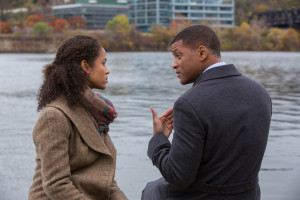

âConcussionâ is not a football movie, but a human one. It paints its victims as just that, victims, words not often used to describe footballâs greats. It echoes the horrors of footballâs âpatch âem upâ mentality, seen in movies like âVarsity Blues,â or documentaries such as âSchooled: The Price of College Sports,â while also showing the glory and hope footballâs heroes brought to cities like Pittsburgh during tough times.
Thereâs a great shot in this film, of Omalu walking up the locker room steps to the stadium, his shadow cast down the stairs like so many a football hero movie has done before. Is he a hero? Maybe/maybe not. Unchecked progress is often an anthem of our money-driven world. With great performances and a focused lens, âConcussionâ asks us to maybe slow down every so often and ask about the consequences.