





Why do people stay at jobs they loathe? To show up every day, doing something that makes your skin crawl or makes you feel that you are wasting your life? Money? Success? Or is it a more sinister element: comfortableness. Predictability causes people to do many unpleasant things, as its opposite, change, even if it would bring good things (or even things not so bad) is a scary prospect broached by only the bravest men. It is in this vein that the 1992 drama “Glengarry Glen Ross,â based off a play by David Mamet, presents the lives of four real estate salesmen working in a dingy and decrepit office.
âGlengarry Glen Rossâ portrays the kinds of men who may work this kind of profession, and expertly examines why each man stays with little-to-no reward. Thereâs mild Shelley Levene (Jack Lemmon), whose wife is in the hospital; thereâs George Aaronow (Alan Arkin) and Dave Moss (Ed Harris), working-class guys, struggling at their jobs who canât catch a break. And then thereâs sharpshooting Ricky Roma (Al Pacino), whose sarcastic, f-bomb dropping persona is courtesy of his being the best salesman in the office. With the exception of Roma, everyone in the office complains that their sales are tanking because the âleadsâ â contact information for potential clients â are crap.
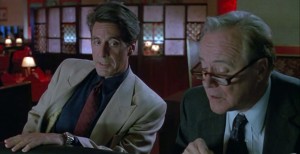

Roma is absent from the office at the filmâs opening, a decidedly concise and brutal scene where the owners of the firm, an ever elusive âMitch and Murrayâ send in Blake (Alec Baldwin), a hotshot salesman from their downtown office to straighten out the failing salesman of this dismal office. âPut the coffee down,â he spits at Levene. âCoffee is for closers.â The berating that follows is scathing, pointed, and unforgiving. Baldwin is in complete command of his character, bringing an acting performance to the table that garnered him, in this one, small, seven-minute scene, an award for âBest Actorâ at the Valladolid International Film Festival. His point is clear: start selling or get out. The crew has a week to save their jobs.
Thus the three employees (save Roma, busy âclosingâ a potential client in a bar) depart the office, each dealing with the situation in their own way. Levene cold calls potential clients from payphones in-between calls to his sick wife and begging the firmâs stolid boss, John Williamson (Kevin Spacey), for the âGlengarry leads,â a new batch of money-makers reserved for only the best salesmen. Moss and Aaronow have other plans. They discuss good customer service, and the unfairness of the lot theyâve been dealt, spiting Williamson, Mitch, Murray, and Roma for his easy sales. They fantasize about a past colleague who went off on his own and broke the chains of servitude. They also discuss breaking into the office and stealing the Glengarry leads, in hushed tones, both hypothetically and practically.


Itâs almost impossible to single out a best actor among this lot. As Levene, Lemmon pulls off his character with both charm and hopelessness, making us believe his effort to excel, perhaps out of nothing but habit. Likewise, Harris puts forth a powerhouse performance unlike any Iâve seen. It struck me this is the most dialogue I have ever seen Harris deliver and decided he is very good at it. He absolutely owns his scenes as the angry yet conniving Moss. As Aaronow, Arkin is effective, yet shadowed by Harris similarly to how Romaâs potential client is shadowed by Roma. Theyâre sponges, and absorb the world-as-seen as painted by these two powerhouses.
Rounding this out, Pacino delivers a hard hitting, fluid, and mesmerizing performance, part angry commandeer we know and love yet part smooth talker weâve never seen. Itâs no surprise Pacino won an Oscar for ‘Best Actor in a Supporting Roleâ for this portrayal. And finally, as manager/company-man Williamson, Spacey delivers a pleasing and solid performance; at first as a man burdened with motivating unmotivated troops, but later, a man we see may be more complicit in low office morale than originally suspected.
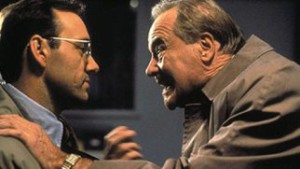

âGlengarry Glen Rossâ is a excellent movie, both a detailed study of the inner workings of the minds of those working in a struggling office, as well as the workings of the real estate tradeâs low, low end. The filmâs character development is top of the line, as is its portrayal of its heroesâ¦and its villains. This is a serious movie, an office movie without humor, and as such, is probably the truthful portrayal of overworked and underpaid office staff that “Office Space” wanted to be. It features a stellar cast, a intricately detailed script, and ambiance and mood that help set it as a stark, dismal account of these menâs colorless lives.
During one scene, Aaronow mutters to himself, âI hate this job,â then listlessly picks up his receiver off his desk and launches robotically into his sales pitch once again. Why donât these men quit? Sometimes itâs what doesnât happen in a movie that says more about a situation than anything else.
– by Mark Ziobro



1 Comment
Pingback: » About Last Night (R)