



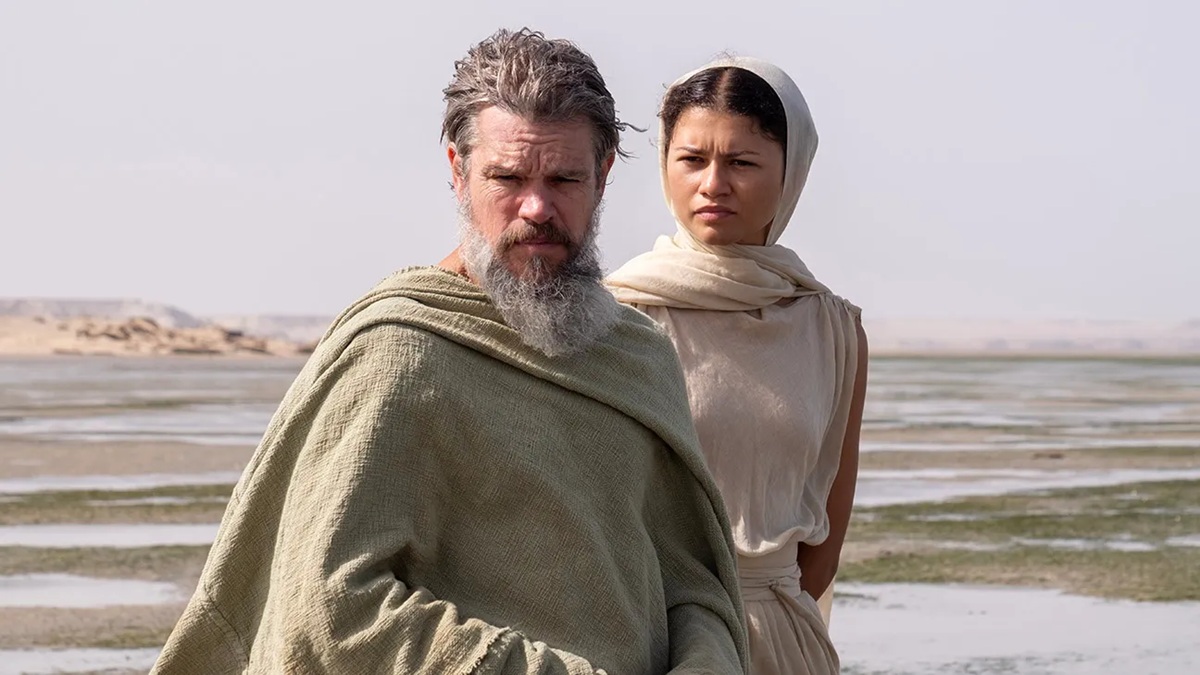
Minutes after watching Christopher Nolan’s “The Odyssey,” I described it as an assault to the senses in the best possible way. My ears were ringing. My body felt depleted. Images of men swallowed by darkness, water, fire, and their own arrogance kept colliding in my head. I’d spent nearly three hours watching Nolan fling people across the ancient world, and by the closing credits, I felt as though I’d been dragged behind one of their ships.
That’s praise, but not unconditional praise. “The Odyssey” is cinema as both art and physical ordeal, mounted by a filmmaker with the resources, control, and sheer brass neck to make Homer seem insufficiently ambitious. It’s also clunky and overpacked, especially in an opening act that occasionally behaves as though Nolan is trying to be everywhere in Homer at once. His usual attraction to fractured chronology sometimes disperses the emotional attention instead of concentrating it.
Then the movie finds its destination.
Once its scattered threads begin converging, Nolan the storyteller catches up with Nolan the engineer. The final movement doesn’t rescue “The Odyssey.” It completes it, giving shape to the exhaustion, guilt, anger, and longing that the earlier passages have carried across the sea.
I came to this adaptation with my own history. Andrei Konchalovsky‘s 1997 television miniseries, starring Armand Assante, was the version that first made me fall in love with Odysseus and his voyage. Its effects have aged, but its patience hasn’t. A two-part production naturally had more room for encounters and relationships that Nolan compresses, merges, or leaves behind. There are moments when I still prefer how that miniseries handled the material, even though Nolan’s movie exists several technological lifetimes beyond it.
The comparison doesn’t diminish his achievement. It clarifies what this version values. Nolan treats Homer less as a leisurely episodic tale than a forced march through memory, war trauma, legend, and the stubborn need to believe there’s still a home waiting somewhere beyond the horizon.
Too Much Story for One Ship
Adapting the 24 books of Homer into one feature requires compression. Nolan doesn’t merely shorten the poem; he rearranges its memory. Stories exist inside other stories. The past interrupts the present. Ithaca, Troy, and the voyage coexist as experience, history, rumor, and song.
As he often does, Nolan assigns certain characters the audience’s need for orientation. Much as Arthur once explained the architecture of dreams to Ariadne in “Inception,” Menelaus (Jon Bernthal) recounts the war’s cost to a son trying to understand the father who never came home. Elsewhere, Odysseus attempts to assemble fragments of his own past from memories that no longer arrive intact, while Tiresias gives language to a fate the men can’t yet comprehend. The exposition remains exposition, but Nolan usually attaches it to an emotional need: Telemachus wants a father, Odysseus wants himself back, and the crew wants to know whether there is still a future waiting for them.
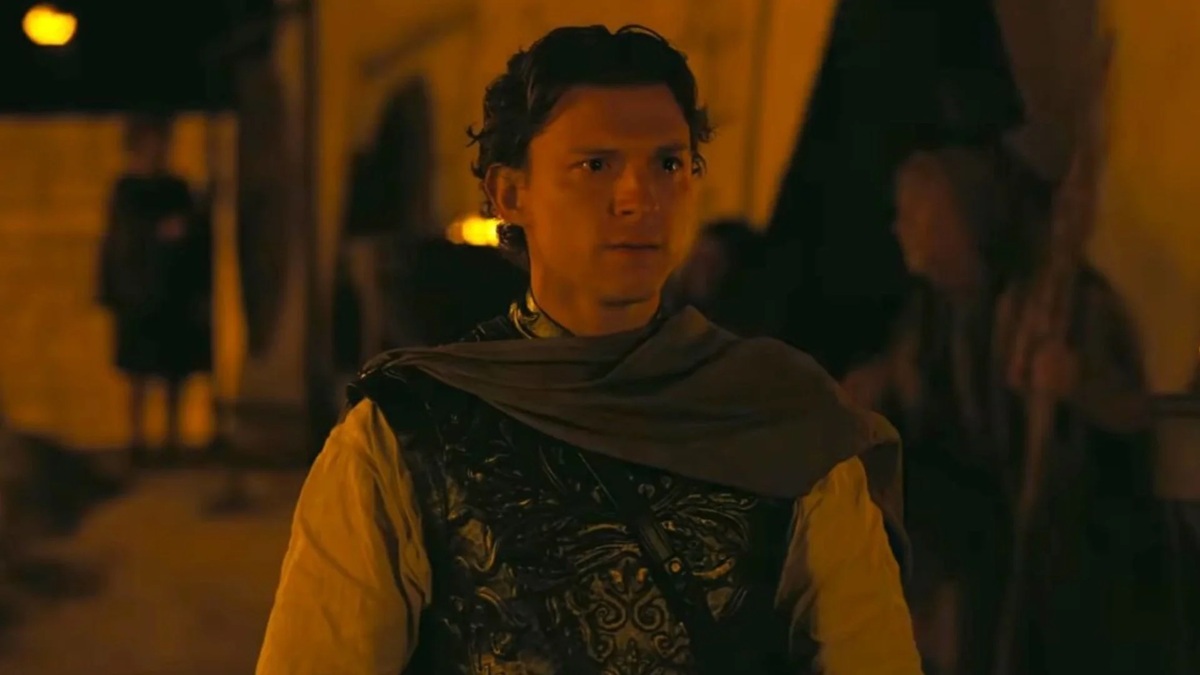
It’s an intelligent approach for material that has survived because people keep retelling it. Odysseus (Matt Damon) exists as a man, but also as a legend that reaches his family before he does. Telemachus (Tom Holland) grows up beneath the absence of a father and the enormous presence of his reputation. He wants the man, but songs and secondhand accounts are the closest substitutes available.
The first act struggles to contain all of this. Jennifer Lame’s editing moves among perspectives and timelines with purpose, but not always grace. There’s a difference between productive disorientation and a movie elbowing through its own exposition, and “The Odyssey” crosses that line more than once. Nolan is usually at his sharpest when he uses time to tighten a dramatic vise. Here, he initially uses it to prevent an enormous amount of story from escaping the building.
The movie remains legible nonetheless. Confusion isn’t the problem so much as divided concentration. Before one relationship or idea settles, another demands the screen. Odysseus’s guilt, Telemachus’s search, Penelope’s resistance, the war, and the voyage all matter, but the movie doesn’t initially know which one should be breathing at any given moment.
This is where the longer 1997 miniseries retains an advantage, because it had the luxury of stopping. Nolan’s velocity generates urgency, but it can also turn myth into inventory. Some episodes arrive with greater force than others, and not every omission is painless simply because the horizon now fills an IMAX screen.
His modernized language, however, proves liberating. The American accents and contemporary vocabulary never pulled me out of the movie because Nolan doesn’t treat them as cheeky updates. They simply allow the characters to speak as people instead of marble statues. Sword-and-sandal cinema has spent decades teaching audiences that antiquity sounds most authentic when delivered in formal vocabulary by British actors. Sod that. Rage, grief, lust, rivalry, and children’s disappointment in their fathers haven’t grown less recognizable over three thousand years. Hearing “daddy” in this world only confirms how little the emotional mess of families has changed.
The same principle applies to the casting. Some pre-release noise fixated on Lupita Nyong’o and Elliot Page, as though Homer had left behind specifications that Hollywood was morally bound to obey. Nolan doesn’t pause to justify either performer, and the movie is better for it. They enter this world, do the work, and belong there. If their race or gender identity is still what occupies your mind after three hours of gods, monsters, war, grief, and bloodshed, that isn’t a problem with the adaptation. It’s yours.
IMAX Makes the Myth Hurt
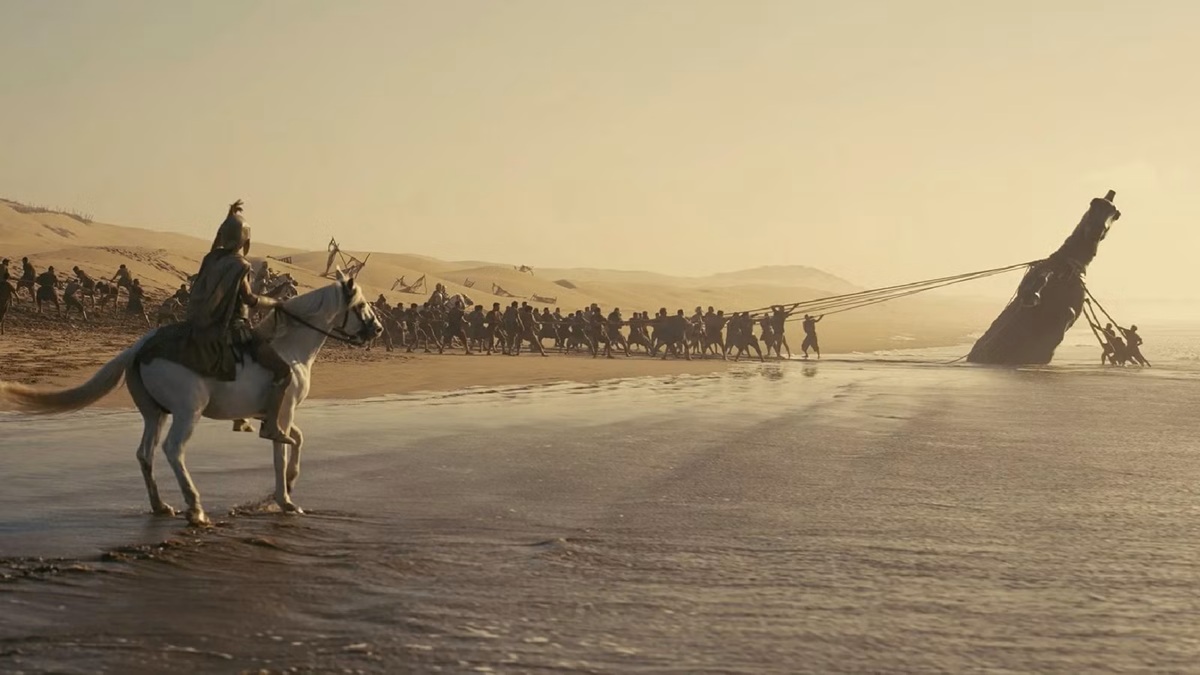
For all the discussion surrounding its technical milestones (being the first film shot entirely using IMAX cameras), “The Odyssey” earns the scale Nolan has given it. Hoyte van Hoytema’s cinematography doesn’t merely make the ancient world large. It gives that world weight, temperature, darkness, and texture.
The sacking of Troy establishes the approach. Fire, smoke, mud, shadows, and bodies fill a military victory that looks indistinguishable from the end of the world. The images remain astonishingly clear without sacrificing chaos. Nolan doesn’t place us above the battle to admire its choreography. He drops us inside it, where every flash of light reveals another reason to run.
The action is frenetic and kinetic without becoming spatially incoherent. Nolan may throw bodies, ships, fire, creatures, and weather across the screen, but he rarely loses track of where the danger is coming from or where Odysseus and his men must move to escape it. Lame’s editing is far more assured here than in some of the first act’s temporal shuffling, working with Göransson’s score and the punishing sound mix to accelerate panic without reducing the images to noise.
That control gives each stop along the voyage its own pulse. The Laestrygonian attack has a different rhythm and physical threat from the descent into Hades, just as the encounters with Polyphemus and Circe seem to obey their own nightmares. Nolan’s compression may deny some episodes the dramatic room they had in Homer or the 1997 miniseries, but the set pieces seldom blur together. Each new shore appears to have invented a fresh way to make returning home seem unreasonable.
Nonetheless, van Hoytema preserves intimacy within the immensity. Faces remain expressive. Ships don’t float prettily across postcard seas; they strain against water that appears determined to erase them. Landscapes dwarf the people without reducing them to decoration. The scale isn’t competing with Odysseus’s ordeal. It is the ordeal.
On the other hand, Ludwig Göransson’s score is primal, metallic, and archaic. Wind instruments breathe and shriek. Percussion strikes with the force of tools being forged or weapons being raised. The music doesn’t present ancient Greece as a stately civilization viewed through museum glass. It clangs, trembles, gasps, and howls. The sound design is even more punishing. Waves crash with enough force to alter the atmosphere inside the theater. Wood cracks, metal collides, and silence sometimes arrives less as relief than as warning. The movie produces a panic response I didn’t know I needed and wasn’t entirely grateful to receive.
To which I say: this may also be Nolan’s best horror film.
I say that partly in jest, though only partly. He has smuggled horror into his work for years. “Inception” turns the subconscious against its trespassers. “The Dark Knight” treats the Joker like a contagion. “Dunkirk” is a survival nightmare of unseen attackers, sinking vessels, confined spaces, and clocks that won’t stop.
“The Odyssey” allows those instincts to roam openly. War becomes a haunted landscape. Caves become mouths. Bodies are transformed, consumed, and carried toward realms where the living have no business wandering. Polyphemus isn’t a mythological attraction waiting for his close-up. He is terror at an inhuman scale.
Nolan has spent years discussing his interest in making a horror movie. After Troy, the sea, the dead, Polyphemus, and Circe, one begins to wonder what he thinks this is.
A Sacred Law, Broken Everywhere
The movie repeatedly returns to Zeus’ Law (or xenia), the sacred law of hospitality protected by Zeus. Hosts must feed, shelter, and protect strangers; guests must respect the household that receives them. Beneath that arrangement lies the belief that any traveler, beggar, or unwanted visitor might be a god in disguise.
Nolan makes this more than a classical-studies footnote. Xenia becomes the moral architecture of the journey. It explains why Odysseus and his men approach unfamiliar shores expecting food and refuge. They assume the world shares a common code, even when they have no idea what waits beyond the next threshold. Each arrival becomes a test. An offered meal may mean sanctuary. It may conceal captivity. The host may honor the gods, mock them, or decide the guests themselves look appetizing.
The irony is that Odysseus wins the war by turning a gift into a weapon, then spends his journey home depending on strangers to believe hospitality still means something. The law he manipulates at Troy becomes the law on which his survival depends. Nolan lets that contradiction accumulate until the voyage starts to look like a moral recoil from the victory that set it in motion.
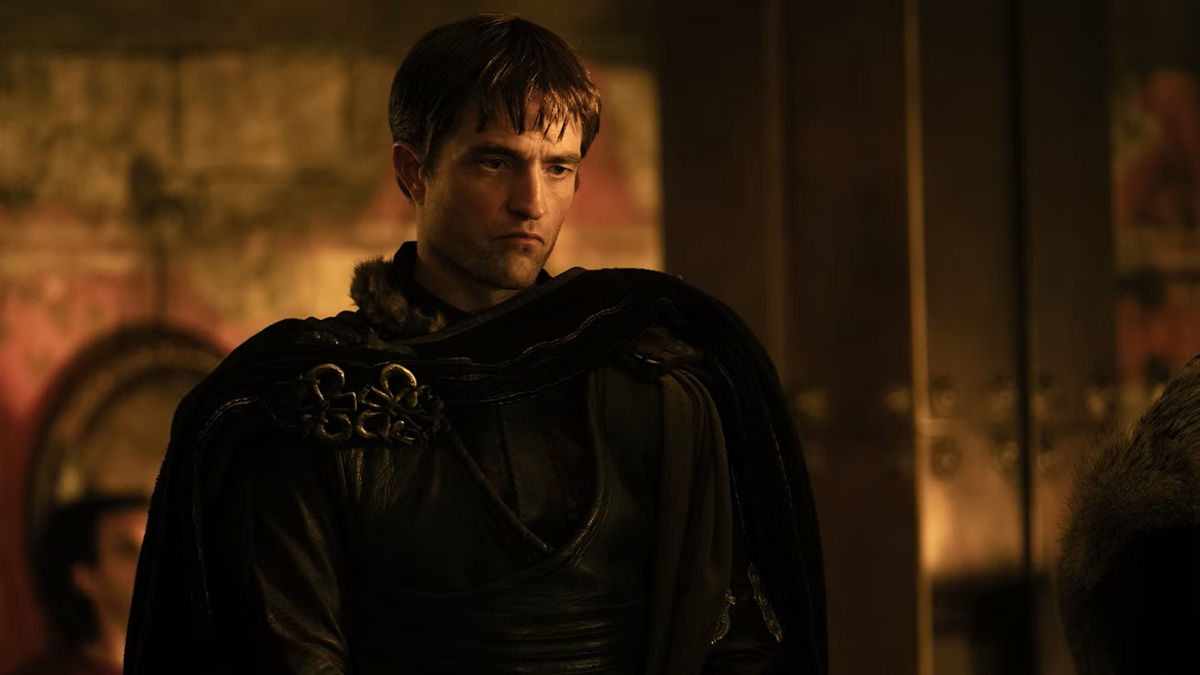
The same law clarifies what has been happening to Ithaca in Odysseus’ absence. The suitors haven’t merely overstayed their welcome; they have turned hospitality into occupation. They consume another man’s provisions, threaten his bloodline, exhaust his wife, and treat the absence of a king as permission to divide everything he left behind. Robert Pattinson’s Antinous leads them with the oily confidence of a man who regards entitlement as evidence of destiny. He doesn’t simply want what belongs to Odysseus. He believes wanting it long enough should make it his.
Meanwhile, John Leguizamo‘s Eumaeus offers the clearest counterpoint. His loyalty isn’t loud, and his decency doesn’t require certainty about the person standing before him. In a cast whose combined wattage could probably be detected from Mount Olympus, Leguizamo makes one of the deepest impressions by behaving like an ordinary human being.
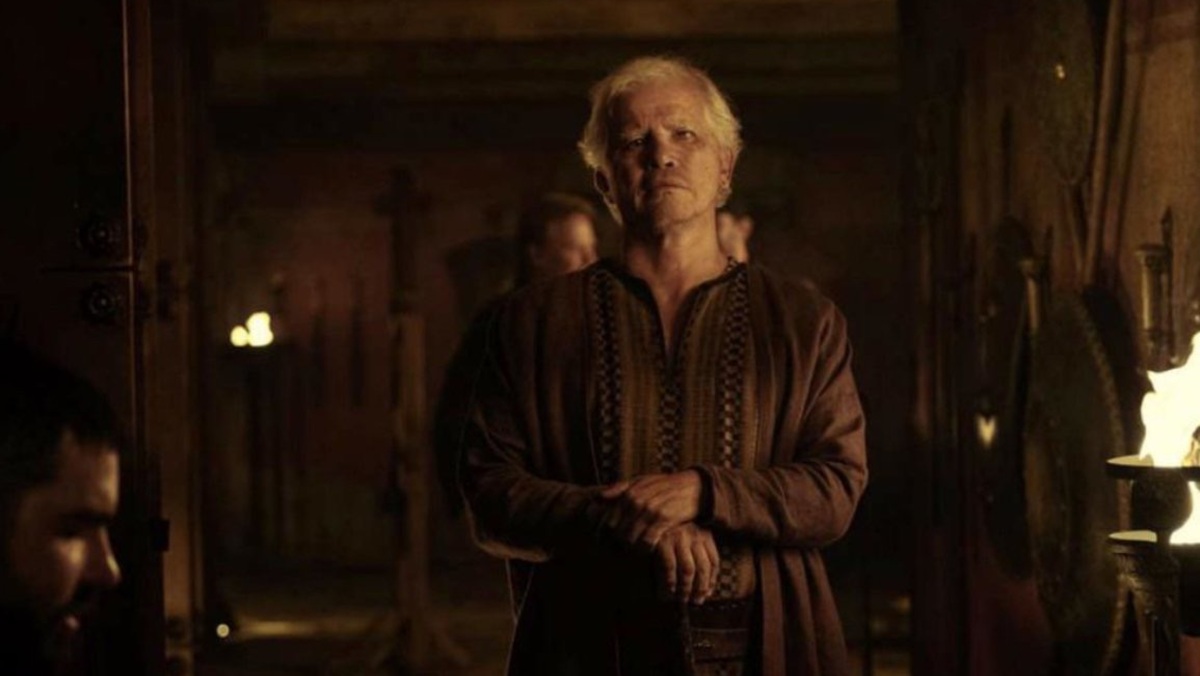
Anne Hathaway Gives Waiting a Temper
Damon plays Odysseus not as a polished hero but as a commander steadily losing the luxury of believing he controls the journey. He still possesses the authority required to keep his men moving, yet Damon lets fatigue erode that confidence from within. The intelligence remains visible, as does the cost of relying on it for too long. Odysseus can devise a way out of almost any danger; what he cannot always do is protect the people expected to follow him through it.
That burden also shapes Telemachus, although from the opposite side of the absence. Holland gives him an appealing mixture of youth, anger, and untested courage. He has inherited a kingdom defined by a man he barely knows, along with a crisis everyone expects him to solve before he has decided what sort of man he wants to become. Holland is particularly good at showing how admiration can harden into resentment. Telemachus wants his father, but he has spent most of his life dealing with the legend instead.
Pattinson’s Antinous exploits that uncertainty with the relaxed menace of someone who believes civilization is merely a delay before the strongest man takes what he wants. He doesn’t need to snarl through every scene because his amusement is threatening enough. Antinous treats predation as social confidence, and Pattinson understands that entitlement becomes more dangerous when it can still pass for charm.
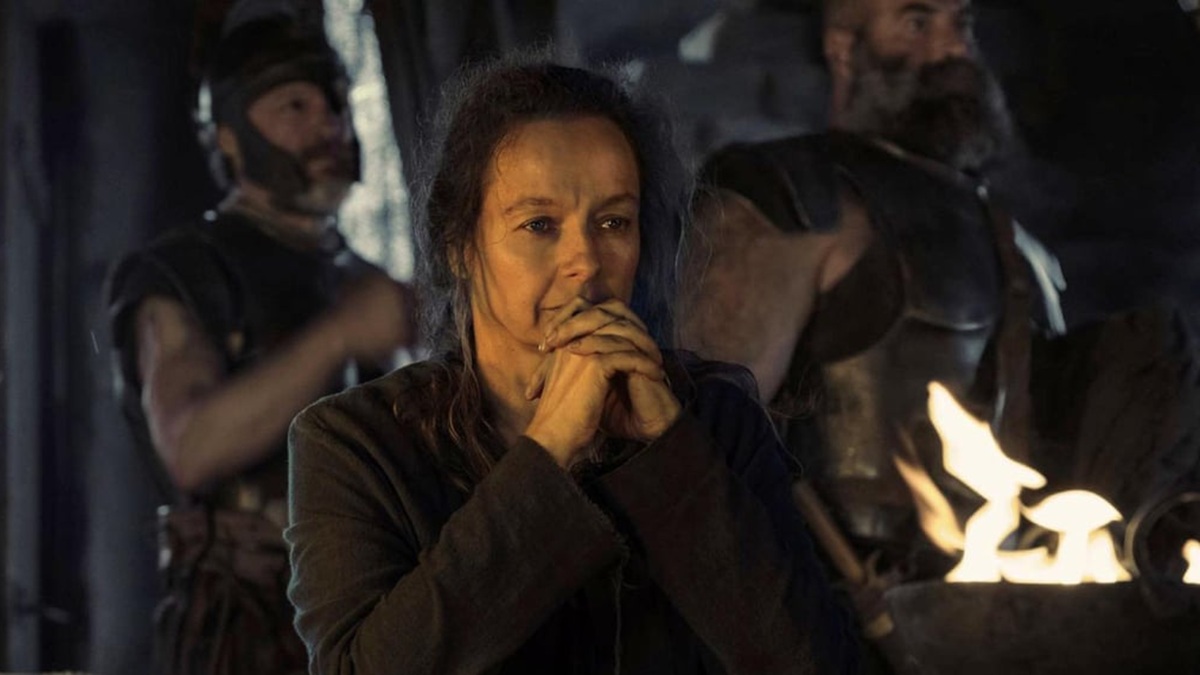
Samantha Morton, meanwhile, works in a different register as Circe. Her limited screen time contains seduction, danger, magic, and an awareness of mortality that Odysseus hasn’t fully acquired. Where Pattinson fills a room by acting as though it already belongs to him, Morton hardly needs to move. Her stillness becomes its own threat, especially in a movie where almost everything else travels at the speed of divine punishment.
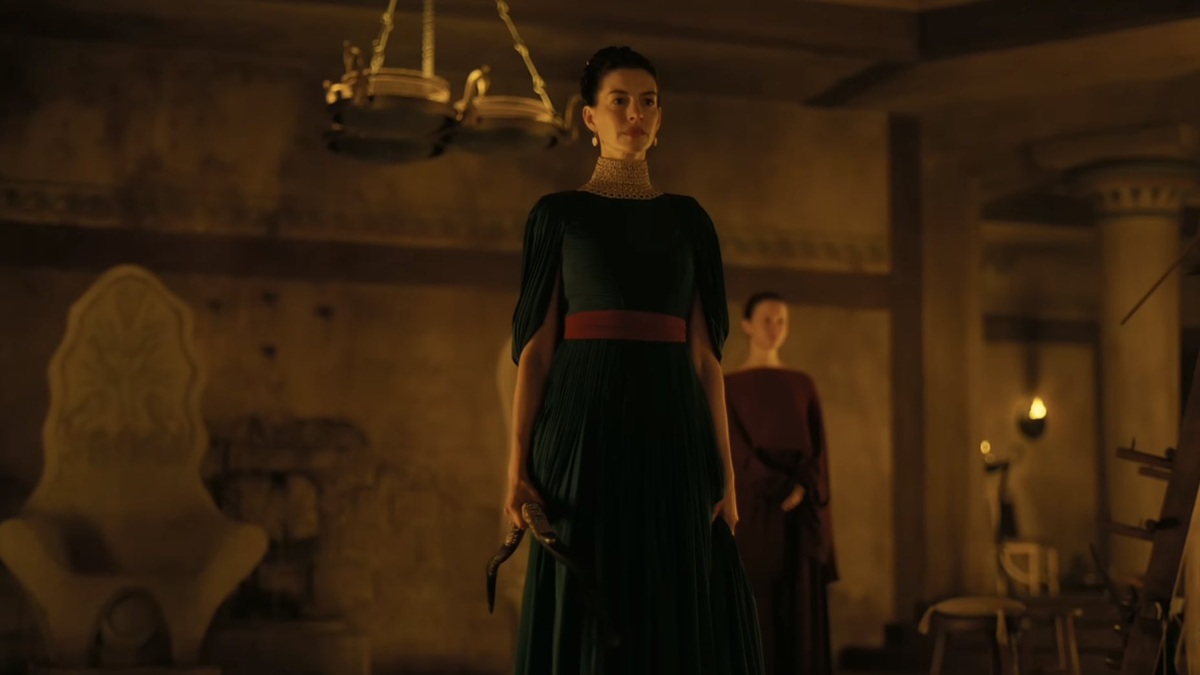
Yet the movie’s emotional weather changes most sharply whenever Anne Hathaway appears as Penelope. Greta Scacchi‘s performance in the 1997 miniseries helped shape my understanding of the character’s endurance, but Hathaway doesn’t erase that memory so much as argue with it.
She gives waiting rage.
Her Penelope hasn’t spent years preserved in devotional sorrow. She has survived political pressure, unwanted attention, and the steady conversion of private grief into a problem men believe they should be allowed to solve for her. Because Hathaway holds love and fury in the same expression, hope never registers as passive virtue. It has kept Penelope sane, but it has also worn her down. Despair may break a person quickly; hope can take its time.
The movie could have given her more room. Penelope’s waiting sometimes functions more as Odysseus’s emotional destination than as an odyssey of its own, and Hathaway supplies layers the screenplay only intermittently pauses to examine. Even so, she makes the reunion matter before it arrives. Odysseus and Penelope have survived by preserving ideas of each other, but time has continued working on the people beneath those ideas. The question is no longer simply whether he can return. It is whether either of them can recognize what the other had to become.
Nolan Has Been Sailing Toward Homer All Along
Before seeing the movie, I wrote that Nolan had been making variations on “The Odyssey” throughout his career. His films repeatedly follow men separated from home by war, grief, duty, distorted time, or the consequences of their own ingenuity.
Cobb crosses layers of consciousness to return to his children—dream layers that include limbo, a clear nod to Odysseus’ prolonged stay on Ogygia with Calypso (Charlize Theron). Cooper travels beyond the known universe while his daughter grows old without him, a nod to Telemachus and Odysseus’ relationship. The soldiers in “Dunkirk” can see England but remain stranded across the water (Himesh Patel’s Eurylochus and the other men come to mind). Oppenheimer wins the race to build the bomb, then spends the rest of his life confronting what winning meant (essentially a 20th-century Trojan Horse).
Odysseus is the oldest version of the Nolan protagonist: a brilliant man who survives through strategy, compartmentalization, and lies, only to discover that intelligence and hubris don’t grant immunity from consequence. Nolan’s flashbacks also complicate the usual image of Odysseus eagerly sailing off in search of glory. Ithaca is a small kingdom, and Agamemnon’s (Benny Safdie) power leaves its king with little meaningful choice about joining the Greek campaign. Refusal would risk retaliation against the very home Odysseus wants to protect. The war may expose his talent for strategy, but it begins as an obligation imposed by a more powerful ruler, making the consequences harder to divide neatly between coercion and ambition. Odysseus is pushed into the machinery; his hubris takes over once he realizes how well he can operate it.
To that end, his victory at Troy depends on deception. Nolan understands that the Trojan Horse isn’t merely an inspired military tactic or the ancient world’s most inconvenient piece of home décor. It’s a false gift, an act of cunning that corrupts the trust required for the plan to work. Victory follows, but so does guilt. Odysseus can justify the intention and admire the design. None of that allows him to control what the act unleashes.
In that respect, “The Odyssey” plays like an ancient-world companion piece to “Oppenheimer.” Both concern men whose defining intellectual achievements become inseparable from the devastation that follows them. Nolan remains fascinated by the moment when a man realizes his brilliance has carried him beyond the limits of his own moral imagination.
Odysseus’s cunning is wisdom, political necessity, survival instinct, and pathology at once. He makes choices because a king and commander must make them. Men still die because of those choices. Himesh Patel’s Eurylochus gives the journey another center of gravity, registering what heroic leadership looks like to those expected to obey it.
The legend belongs to Odysseus. The casualties belong to everyone.
Home is the Final Ordeal
Once the movie draws its attention toward Ithaca, the earlier diffuseness gives way to a cleaner dramatic line. The destination gathers the film’s questions into one place: what Telemachus needs from his father, what Penelope has protected, what the suitors have destroyed, and whether Odysseus can return without bringing the violence of the journey home with him.
Nolan also makes room for Argos, the original good boi of literature, whose presence quietly reduces all the movie’s speeches about loyalty to something much simpler. Gods, kings, and warriors may need laws, songs, and prophecies to tell them who they are. A dog already knows where home is.
The final act is patient where it needs to be, ferocious when patience runs out, and more emotionally direct than Nolan usually allows himself. He still has his habits, of course. Threads converge. Images recur. Sound and editing accelerate toward an ending designed to make the preceding hours snap into formation. He remains Christopher Nolan; nobody expected him to finish with a modest conversation beside a shrub.
This time, however, the architecture feels earned rather than imposed.
I’d call “The Odyssey” Nolan’s most emotionally mature film, even more so than “Interstellar.” That movie reaches openly for sentiment and sometimes squeezes until the tears arrive. “The Odyssey” finds emotion in exhaustion, guilt, duration, and the sight of people trying to recognize one another after time has altered them. It knows when to pull back.
Nolan also understands that reaching home isn’t the same as restoring it. Odysseus moves toward Ithaca as a place, a family, a kingdom, an identity, and an idea strong enough to keep him alive. Penelope and Telemachus preserve corresponding ideas of him. None can return to the people they were before the war.
“The Odyssey” isn’t flawless. Its opening is cumbersome, its ambition periodically outruns its control, and some of its compression sacrifices material earlier adaptations had more time to honor. Nolan’s exposition remains exposition, even when delivered beneath an impressive helmet, or through a goddess (Zendaya) appearing before a wandering king.
Yet the filmmaker’s respect for Homer isn’t expressed through dutiful fidelity. It lives in his conviction that the myth should still frighten us, exhaust us, implicate us, and make home seem both desperately necessary and terrifyingly uncertain. So, for nearly three hours, Nolan throws war, monsters, grief, arrogance, loyalty, water, darkness, and the rage of those left waiting directly at the audience. When those separate currents finally meet, “The Odyssey” becomes one of the loudest and most unrelenting assaults on my senses that I can remember.
And yes, I mean that in the best possible way.


Christopher Nolan’s “The Odyssey” premiered on July 6, 2026, at the Empire Leicester Square in London, ahead of a theatrical release by Universal Pictures on July 17 in the United States and the United Kingdom. Follow us for more coverage.




