





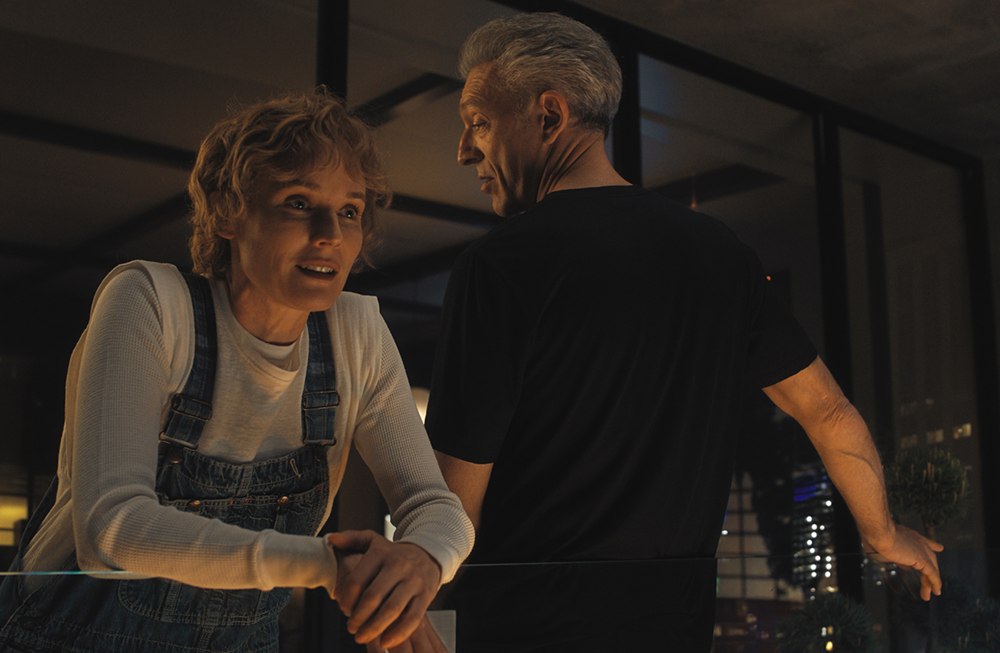
David Cronenberg loves twins. In âDead Ringersâ (1988), an adaptation of Bari Woodâs novel “Twins” (remade into a 2023 miniseries starring Rachel Weisz), the iconoclastic Canadian auteur showcased Jeremy Irons playing twin gynecologists who sleazily swap and share women, until their secret sexual strategy backfires. Duplication shows up even in Cronenbergâs titles: âCrimes of the Futureâ (2023) wasnât a remake of his same-named 1970 feature, but it did signal that the director is committed to reshaping and reframing his preoccupations; an obsessive sculptor constantly tinkering. And when twin sisters take center stage in âThe Shrouds,â a haunting yet tender discourse on grief, denial and memory, Cronenbergâs not just winking at his ardent fan base. Instead, heâs unveiling another chapter in a proudly anti-commercial career, in which each film connects to another through its own particularâand not immediately obviousâpeculiarities, constructing a fully-matured brood of mismatched twins.Â
At âThe Shroudsâ New York Film Festival screening, I caught some giggles in the extended opening credits, which presented an onslaughtâcould it have been a dozen?âof global production companies, including the luxury fashion house Saint Laurent. Cronenberg has spoken about how Netflix had financed then rejected âThe Shroudsâ as a series, so it is almost comical that someone of his stature needs to assemble an international syndicate to compile what had to be a modest budget (relative to Netflixâs estimated $17 billion annual content spend). But the streamerâs loss is our gain, as this version of âThe Shroudsâ feels like a deeply personal passion project, over which Cronenberg maintained majority artistic control.Â
Drawing from Cronenberg’s Personal Life
The finished project is cheekily bat shit, and gloriously unhinged. It starts with, then veers away from the central story of Karsh (Vincent Cassel, hair slicked back in Cronenbergian fashion) mourning his dead wife Becca (Diane Kruger) to lasso in modern-day conspiracy theories, artificial intelligence and the imaginative manner in which human beings refuse, or explain away the harsh inevitability of death. Ultimately, what Cronenberg is telling us is that grief makes the mind spiral out of control, and no amount of rational thinking can offset tragedyâs toll. Work, sex and hobbies are only temporary distractions, and the mind and heart will chase any harebrained leads that might provide the elusive closure that Beccaâs death (from cancer, like Cronenbergâs wife) has robbed from Karsh. And, since this is a Cronenberg film, the body will suffer in tandem.Â
To that end, the film opens in a dentistâs office, where Karsh is told that grief is making his teeth decay. From there, the light mood darkensâbut not without a few chucklesâwhen Karsh drives to a cemetery (of which heâs a part owner) for a blind date. After the meal, Karsh takes the lucky lady down to a column of gravestones and stands in front of Beccaâs plot, with a phone. An image of Beccaâs skeleton comes up on the screen, and Karshâs fascination introduces a new and lurid stage of grieving, nudged between the other seven. No longer worried about his dateâs disgust (really, more of a polite itâs-not-you-itâs-me), Karsh zooms in on some nubby marks on Beccaâs rotting bones. Cameras? Insects? Invigorated and curious, Karsh then visits Terry (Kruger, again), Beccaâs identical twin sister, who never did trust those doctors and surgeons.
A Feat of Macabre Imagination
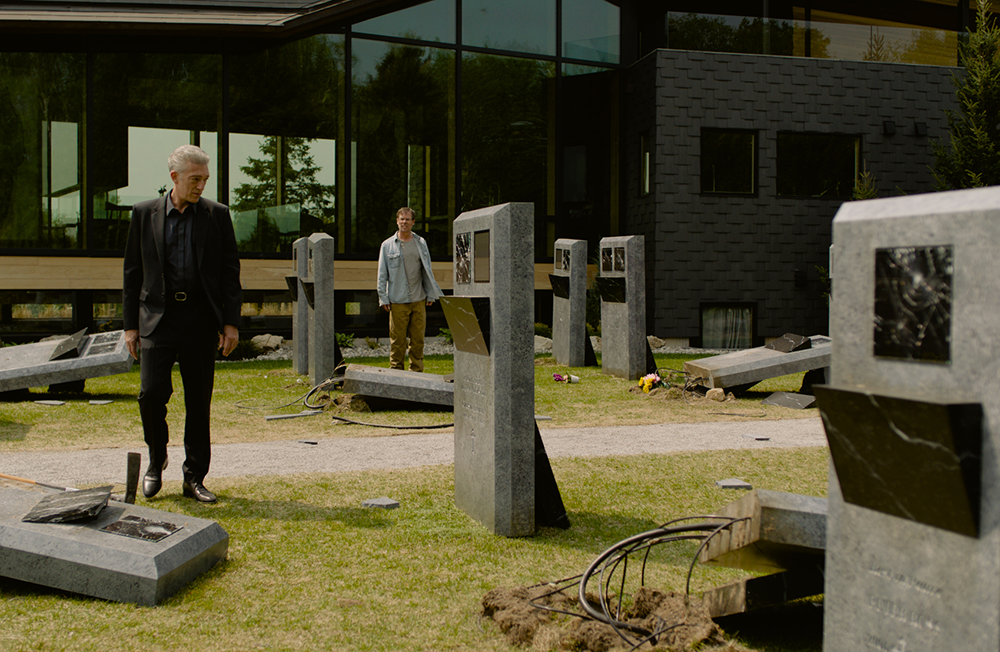
The fever dream that follows is a feat of macabre imagination, startingly effective because it allows and encourages viewers to fantasize along with Karsh. The flirty chemistry between Karsh and Terry foreshadows that theyâll sleep together, but that relationship has the energy of buddy cops, instead of budding lovers. Karsh had refused to accept Terryâs mistrust of Beccaâs doctors, but as the truth, half-truths and anti-truths pile up, she starts to seem like the most sane member of a cadre which includes her jealous and unreliable ex Maury (Guy Pearce), a coder who helped design the technology that drives Karshâs grave-viewing app, not to mention his saucy virtual assistant Honey (voiced by Kruger).Â
When Karsh and Terry have sex, itâs intercut withâand followed byâdream (nightmare?) sequences from Karshâs past, in which Becca is in bed next to him, only to leave for the hospital, and return a shell of herself. The last time this image comes to Karsh, Becca had a breast (the left, Karshâs âfavoriteâ) removed, an arm amputated, and her brittle hips shattered by Karshâs delicate touch. The suffering clouds Karshâs memory, but revs up his craving for Becca, who he canât ever have, so her living twin is an adequate surrogate. Linking desire with desperation, Karsh and Terry not only resemble Scottie (James Stewart) and Judy/Madeleine (Kim Novak) from âVertigoâ (1958) but John (Donald Sutherland) and Laura Baxter (Julie Christie) from âDonât Look Nowâ (1973), whose unflinching sex scene is unrivaled in its depiction of characters chasing away mental demons through intimate, acrobatic sex.Â
A Cronenberg Original
Death is an isolating experience for the livingâand the dead. So, Cronenberg is generous to present the indirect and direct perspectives, from those with a rooting interest in what Becca has left behind. The agendas of Karsh, Maury, Terry and Karshâs new girlfriend/client Soo-Min (Sandrine Holt) donât always coincide, but theyâre all working through the coping phase, barreling straight towards acceptance. And if that sounds cloying, Cronenberg barely allows a breather for moviegoers to process the filmâs various trapdoors and exits, or audit the plausibility of the varying theories and explanations. The reality is, everyone is vulnerable, verging on insane, and âThe Shroudsâ delights in considering what death does to the living. The richest aspect of the film is that, true to lifeâand the onscreen narrativeâit offers only sloppy, muddled and incoherent resolutions. No mad scientist but Cronenberg could duplicate this vision.Â
“The Shrounds” screened at New York Film Festival this year, which runs from September 27th – October 14th. Follow us for more coverage.Â




